


In the weeks since Algeria’s Imane Khelif won an Olympic gold medal in women’s boxing, athletes and coaches in the North African nation say national enthusiasm is inspiring newfound interest in the sport, particularly among women.
Khelif’s image is practically everywhere, featured in advertisements at airports, on highway billboards and in boxing gyms.
The 25-year-old welterweight’s success in Paris has vaulted her to national hero status, especially after Algerians rallied behind her in the face of uninformed speculation about her gender and eligibility to compete.
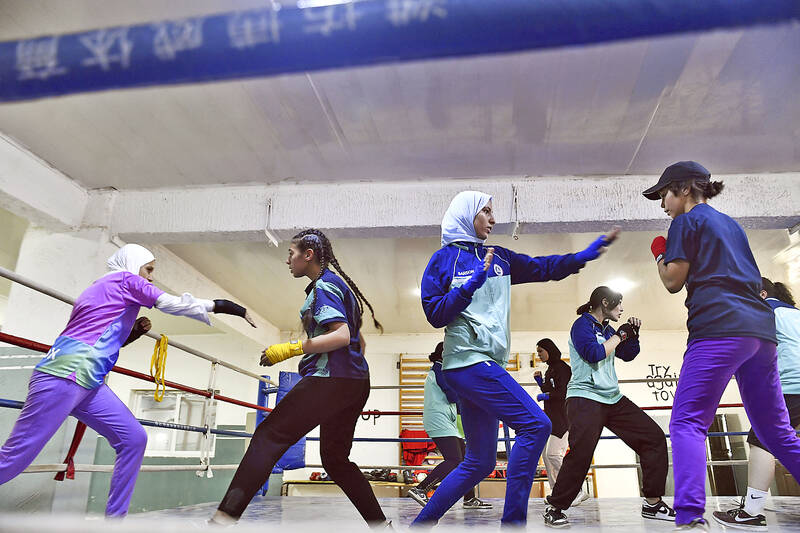
Photo: AP
Amateur boxer Zougar Amina, a medical student who has been practicing for a year, called Khelif an idol and role model.
“Since I’ve been boxing, my personality has changed: I’m more confident, less stressed,” she said, describing the sport as “therapy to fight shyness, to learn to defend myself, to gain self-confidence.”
In Ain Taya, the seaside town east of Algiers where Amina boxes, what local media have termed “Khelifmania” is on full display.
Behind a door wallpapered with a large photograph of the gold medalist, punching bags hang from the ceiling of the local gym, and young girls warm up near a boxing ring surrounded by shelves of masks, gloves and mouth guards.
The 23 young women and girls who train at the gym — an old converted church — all dream of becoming the next Khelif, their coach Malika Abassi said.
Abassi said the women imitate Khelif’s post-win celebrations, hopping around the boxing ring and saluting fans. She is worried that the interest in boxing would grow so rapidly that her gym would not be able to handle it.
“We’re getting calls from parents wanting to sign up their daughters,” she said. “I’m the only coach and our gym is small.”
Algerians from all walks of life flocked to squares in the country’s major cities to watch Khelif’s matches broadcast on projectors. Khelif’s story endeared her to the majority of the conservative country’s population, although a few prominent imams and Islamist politicians have criticized the example she sets by wearing her boxing uniform and not a headscarf.
Still, Amina Abassi, another amateur boxer at the same gym unrelated to her coach, said she believes the deep well of support for Khelif would overwhelm any criticism.
“I’m convinced that even conservative families will allow their daughters to take up boxing,” she said. “Imane has broken through the wall of false modesty and hypocrisy.”
Noureddine Bouteldja, a former amateur boxer and sports journalist, said Khelif has transcended boxing and become a “social phenomenon” throughout Algeria thanks to her personal story and the scrutiny she faced from famous people around the world who — unlike Algerians — saw her advancing in the Olympics as part of the culture war over sex, gender and sport.
Algerians rallied behind Khelif in the face of criticism from former US president Donald Trump, Elon Musk, J.K. Rowling and others who falsely claimed she was transgender.
They largely interpreted attacks on her as attacks on their nation itself, and unlike much of the international community that coalesced behind Khelif, on social media most could not register the thought of a transgender athlete from Algeria.
“It’s the victory of a woman who has shown extraordinary resilience and phenomenal strength of character in the face of the campaign to denigrate her gender,” Bouteldja said.
Boxing coaches and administrators said Khelif’s rise from a poor child in rural central Algeria to worldwide fame has made her an inspirational figure. Mourad Meziane, head of the Algerian Boxing League, expects a huge spike in registration among young women at the start of this school year later this month.
Algeria currently has 30 regional boxing leagues and 10,000 athletes participating nationwide, he said.
“The impact is inevitable and will only be very positive for women’s boxing in Algeria,” Meziane said.
Civil society figures and activists said the impact is also sure to reverberate far beyond the boxing ring.
Attorney Aouicha Bakhti said Khelif’s story would have a lasting impact on Algerian culture and be a counterweight to strands of society that discourage women’s participation in sports.
“This kind of epic helps society, ours in this case, which is in the process of retreating in the face of fundamentalist ideals,” said Bakhti, a prominent feminist and political activist.


“I don’t remember the moment, but ever since I was a kid, that’s the first thing I loved,” two-time NBA All-Star Isaiah Thomas said of his lifelong romance with basketball. However, that journey unfolded against the limitations of his size in a game where height often dictates opportunity — a reality he confronted throughout his career. At 175cm, Thomas is less than 2cm taller than the average Taiwanese adult male, while NBA players during his career stood at about 200cm on average. Compared with the NBA’s average career length of less than five years, Thomas’ 13-season career stands out as
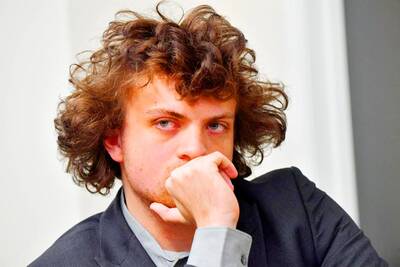
Hans Niemann declares he would become a “stone cold killer” in a Netflix documentary released on Tuesday about his feud with five-time classical world champion Magnus Carlsen, a pledge that injects new edge into the lingering fallout from the cheating scandal that shook elite chess. “I’m gonna be a stone cold killer the rest of my life,” the US’ Niemann says in the film. “I’m going to become the best player in the world, and no one is going to believe that now, but this clip will play over and over again in 10 years — just wait.” “I just
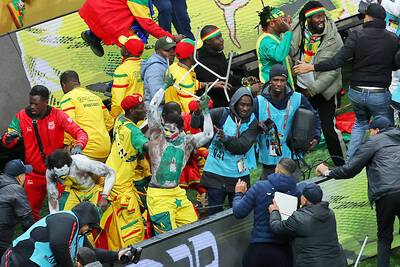
Dakar and Rabat have longstanding ties, but relations have been strained since the Africa Cup of Nations (AFCON) final, which Senegal won in mid-January before being stripped of the title, which was transferred to Morocco. Now, the AFCON trophy is something of a thorn in the two countries’ sides. On Rue Mohamed V, the street where Moroccan vendors are based in the Senegalese capital, a police van is parked. “The police have been on high alert since the Confederation of African Football [CAF] decided to award the title to Morocco, but there have been no incidents,” a local resident said.
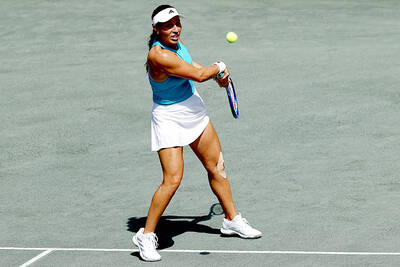
Top seeded Jessica Pegula on Friday once again fought back from a set down to reach the WTA Charleston Open semi-finals with a 3-6, 6-3, 6-2 win against Russia’s Diana Shnaider. Defending champion Pegula has lost the first set in all three of her matches at the tournament so far, but again dug deep to maintain her hopes of retaining the title. The world No. 5 from the US took 2 hours, 10 minutes to defeat 19th-ranked Shnaider, relying on a formidable service game that included eight aces. Shnaider battled well in the first two sets and broke early for a 2-0 lead


 RSS
RSS