


All international soccer comes with displays of pride and heritage, but for Hong Kong fans, it is more than that.
“It’s like the last outlet to watch Hong Kong or support Hong Kong,” one fan said in Qatar, where the team have reached the Asian Cup for the first time in 56 years. “But the government or society is closing that down. That’s why I guess we’re all here, to try and support the team.”
The team ranked lower than anybody else at the tournament at 150 in the world is officially called “Hong Kong, China” such as on scoreboards at games.
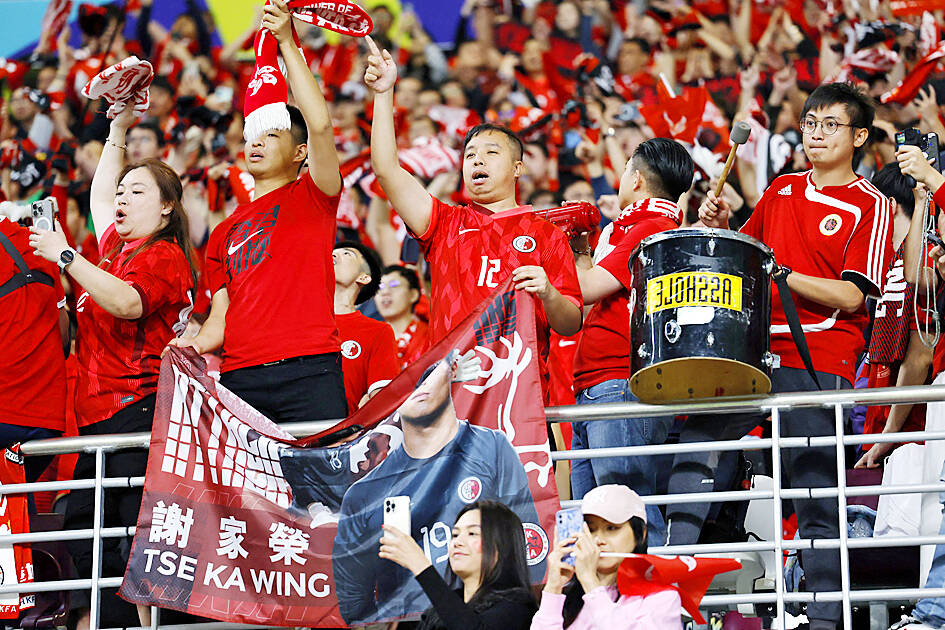
Photo: Reuters
“China” is a recent addition and a subtle example of Beijing’s tightening grip on the territory, following huge and sometimes violent democracy protests in 2019.
The supporter, and others like him, did not wish to be named — another indication of the fast-changing political climate in the former British colony of 7.5 million people.
The fan, waiting to enter Khalifa International Stadium for Hong Kong’s tough group-stage match with Iran on Friday, said that the new name was “kind of expected” after the recent political changes, describing himself as “numb to the whole situation.”
“What we really feel is the team themselves, not the name,” a second fan. “I still support the Hong Kong team, and I call them ‘Hong Kong,’ not ‘Hong Kong, China.’”
As political disquiet swelled throughout the 2010s, so too did support for the territory’s soccer team, with many fans finding it a conduit for civic pride and occasionally anti-government sentiment.
The Hong Kong and Chinese governments have in the past few years remolded the territory’s legal landscape to curb separatism or anti-Beijing sentiment. Among the acts outlawed is any denigration of the Chinese national anthem, which was previously routinely drowned out by a wail of boos before Hong Kong matches — to the outrage of local and mainland officials.
The second supporter said that the team inspires extra fervor because the fans “think Hong Kong football represents the identity of Hong Kong.”
“Like you never give up, because Hong Kong is never a great team, but we fight until the end,” they said.
As kickoff approached, the 300-400 fans forming a red bloc shouted: “We are Hong Kong,” a long-time chant in a territory where many seek to preserve a culture, history and language distinct from those of mainland China.
When the anthems were played, Hong Kong fans were upstanding, but mostly silent, with some citing fear of legal repercussions if they jeered, even though they are more than 6,000km from home.
Under Hong Kong’s National Security Law passed in 2020, acts deemed secessionist can be prosecuted regardless of what country they were committed in.
“There’s no boundary to the law,” the second fan said. “It applies to the whole earth.”
Ernest Lau, a Hong Konger who had flown from London to watch the team, was more ambivalent about recent changes to the match-day experience.
The 22-year-old said he never previously booed the anthem because “I’m less on that political spectrum.”
Despite one of Hong Kong’s best performances in recent memory, Iran won 1-0 in front of a crowd including some waving Hong Kong and China flags.
After the final whistle, Hong Kong fans — completely outnumbered by Iran supporters — locked arms and bounced up and down, waving scarves and flags.
“We are Hong Kong, allez allez,” the small knot of fans sang.
Hong Kong have one last game to get the points which could get them beyond the group stage, today against Palestine.

After letting another big lead slip with an error-strewn performance at the French Open on Wednesday, top-ranked Aryna Sabalenka felt like getting as far away from the courts as possible. “Just want to quit tennis right now,” Sabalenka said after wasting a lead of a set and two breaks in a 3-6, 7-5, 6-0 loss to Diana Shnaider in the women’s singles quarter-finals. “We’ll see in few days. Hopefully I’ll get back on track mentally.” Sabalenka’s wait for a first French Open title continues despite the four-time major winner leading 4-1 in the second set and being two points from victory while

BIG NAMES GONE: Zverev is the clear favorite for a maiden Grand Slam title, reaching semi-finals for the fifth time in six years and finishing second on three occasions Alexander Zverev on Tuesday breezed past Rafael Jodar to stay on course for an elusive Grand Slam title at the French Open, while Jakub Mensik halted Joao Fonseca’s scintillating run in the quarter-finals. Zverev, the highest-ranked player left in the men’s draw, put an end to Spanish teenager Jodar’s impressive Roland Garros debut, easing into the semi-finals with a 7-6, (7/3), 6-1, 6-3 win. The 29-year-old Zverev is the clear favorite for a maiden Grand Slam title. He has finished runner-up on three occasions, including at the 2024 French Open. “I want to win the matches that are ahead of
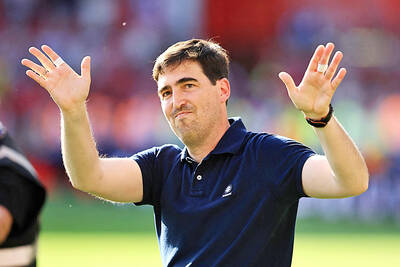
Liverpool are in advanced talks with former AFC Bournemouth manager Andoni Iraola as they seek a replacement for Arne Slot, reports said on Tuesday. Iraola has emerged as Liverpool’s top target to replace Slot, who was sacked on Saturday last week after a turbulent second season in charge. Liverpool have reportedly agreed a deal in principle to bring the Spaniard, who left Bournemouth at the end of this season, to Anfield. Sporting director Richard Hughes was heavily involved in hiring Iraola during his time at Bournemouth and is again spearheading the recruitment of the highly rated coach. The Reds are

KNICKS TAKE LEAD: San Antonio put on a 9-0 run to be up 95-94 with just over 2 minutes to play, but the rest of the game belonged to the New York Knicks It was past five minutes through the third quarter of Game 1 of the NBA Finals on Wednesday and the New York Knicks’ 11-game winning streak was in major jeopardy. The Knicks missed nine of their first 10 shots in the early part of the period and trailed the San Antonio Spurs by 14 points. They were floundering. Then something crazy happened. The Knicks found new life from an unlikely source: The Spurs. New York rallied to tie the game by the end of the period, gave up the lead briefly late in the fourth quarter, and pulled away late for a 105-95


 RSS
RSS