


When the Cricket World Cup opens in India next month, several players will carry Kashmiri willow bats, but manufacturers say that exploitation of trees means their craft faces ruin.
Unchecked logging without replanting has reduced swathes of woodland to scrub in the disputed Indian-administered Himalayan territory and bat manufacturers face a bleak future.
“It’s a case of culling all the time and no sowing,” said Irfan Ali Shah, a senior official in the Indian government’s forest service.
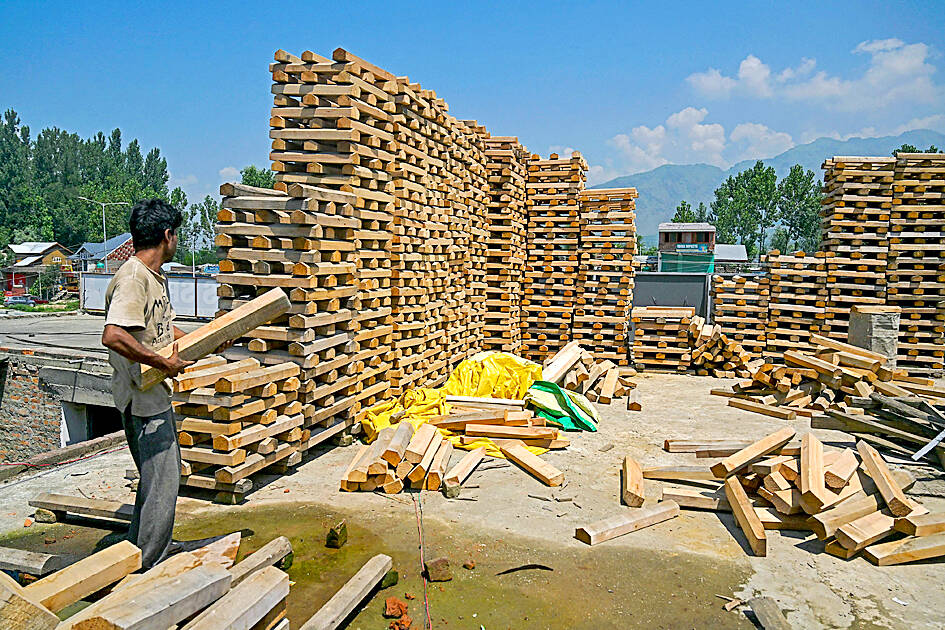
Photo: AFP
Willow grows far more slowly than the more commercially viable poplar, and batmakers warn the entire industry — a major employer — is at risk.
“We have started searching far-off corners of the valley, but there is not much good willow to be found anywhere for making the best-quality bats,” said Fawzul Kabiir, whose GR8 bats are International Cricket Council-approved and sold worldwide. “If the government doesn’t help plant again soon on a large scale ... we will run out of raw material in three to five years.”
Found from Europe to central Asia, water-loving white willows — scientific name Salix alba — are deciduous trees growing up to 30m tall.
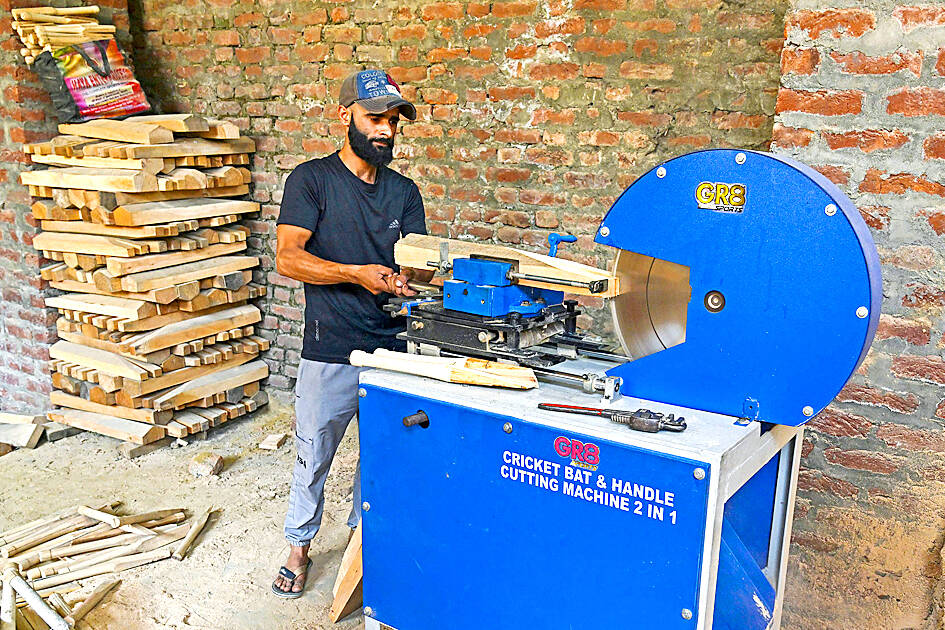
Photo: AFP
Numbers expanded enormously during the 19th century under British colonial rule, when plantations were laid for firewood during the freezing mountain winter.
The ready supply of willow — the wood favored by cricketers — also sparked a craft in bats.
HITTING POWER
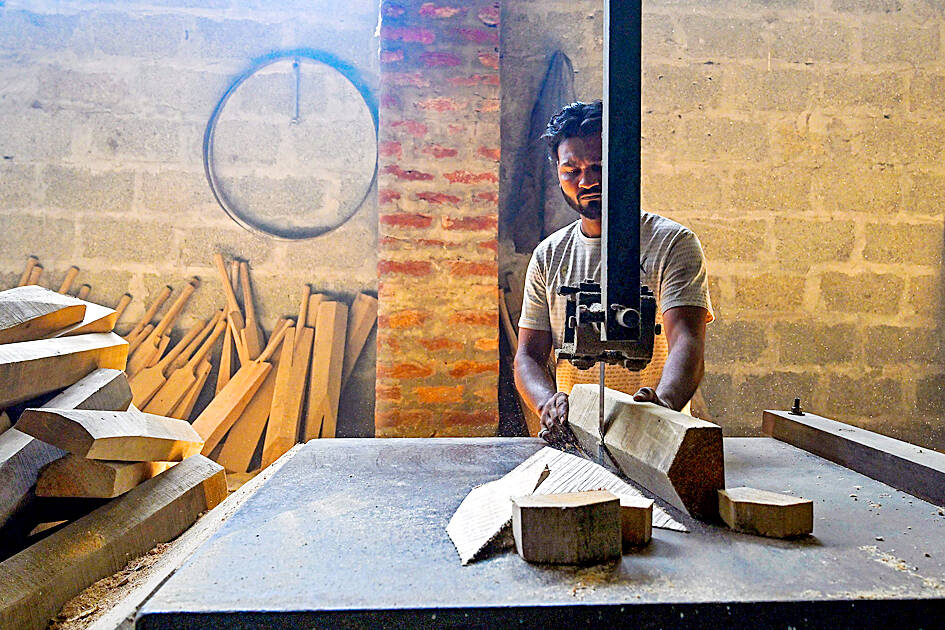
Photo: AFP
Willow has criss-crossing fibers that give it strength and tiny air pockets that reduce vibrations, making the wood light, but powerful enough to smash a ball for six.
International big hitters have traditionally preferred willow from England, but the same tree grows in Kashmir and every year the region now produces 3 million “clefts” — rough-cut blocks of wood ready for shaping.
It is the bulk of global supply.
“The best Kashmir willow bat is at least as good as English willow,” said Kabiir, a batmaker.
GR8 says its customers include cricketing greats from India stars Sachin Tendulkar and Virat Kohli to Australia’s Steve Waugh and South Africa’s Graeme Smith and A.B. de Villiers.
Kashmir’s batmakers prospered over the decades as cricket’s popularity grew. Demand surged after India’s 1983 Cricket World Cup win and the sport now has more than 1 billion fans globally.
Today, the industry employs about 120,000 people across 400 workshops, manufacturers said.
It is a key contributor to the economy of Kashmir, a Muslim-majority region claimed in full by India and Pakistan, but split between them, with the portion controlled by New Delhi roiled by a long-running insurgency.
However, supplies are vanishing fast. Agricultural scientists at Sher-e-Kashmir University have warned that female willow trees — the most suitable for batmaking — are facing “near extermination” in Kashmir.
Nearly 1 million trees were logged in the past decade as the Indian government removed plantations sucking up water from the shrinking Wular Lake, protected under the UN Ramsar Convention, which covers wetlands.
Elsewhere, willows have been hacked down to make space for farmland and rice paddies.
POPULAR POPLARS
Demand for timber from other industries, including plywood and pencils, has meant some have replaced willow with swifter-growing poplar.
“A willow tree matures in 30 years and poplar in half the time, and it fetches the same price,” said Feroz Ahmed Reshi, whose family has supplied willow wood to batmakers for generations. “This year, we planted 300 poplars and about five willows.”
The government banned cleft exports to the rest of India or overseas 25 years ago in a bid to control logging and boost industry in Kashmir, but the law is repeatedly flouted with about 100,000 clefts illegally sent elsewhere annually, an official from a batmakers’ association said.
“Smuggling of our precious raw material has not stopped,” the official said, speaking on condition of anonymity due to the sensitive nature of the topic.
Authorities used to plant willow on state land to maintain firewood supplies, but stopped decades ago as electricity and gas became available for heating.
Shah said that batmakers must “plant their own willow on their own land” to replace each tree felled.
However, private land is scarce in Kashmir and prices have surged since New Delhi suspended the region’s semi-autonomous status and imposed direct rule in 2019.
That allowed Indians from elsewhere to buy land in Kashmir for the first time, a policy denounced by critics as “settler colonialism.”
GR8’s factory and showroom are in the small town of Sangam, the center of the bat industry, where tourists snap up bats from lines of stores, spending anything from US$12 to US$180.
“This is our SOS to the government,” owner Kabiir said. “We cannot do it alone.”

Taiwan’s men’s table tennis team won bronze on Saturday at this year’s International Table Tennis Federation World Team Table Tennis Championships in London, matching the country’s best-ever finish at the regular tournament. Consisting of Lin Yun-ju, Taiwan’s top-ranked player at world No. 7, Feng Yi-hsin, Kuo Guan-hong, Hong Jing-kai and Hsu Hsien-chia, the team won bronze after losing 0-3 to Japan in the semifinals. In the opening match, 24-year-old Lin played the first game against world No. 3 Tomokazu Harimoto 11-5, but ultimately lost the next three closely contested games 9-11, 10-12 and 10-12. Feng then faced world No. 8 Sora Matsushima in

Lin Yun-ju on Thursday handed Taiwan two key victories as they advanced to the semi-finals of the ITTF World Team Table Tennis Championships Finals in London. The Taiwan men’s table tennis team beat Sweden 3-2 in five singles matches. The 24-year-old Lin, Taiwan’s top-ranked player at world No. 7 and nicknamed the “Silent Assassin,” opened the tie by defeating world No. 2 Truls Moregard 3-0 (11-8, 11-9, 13-11) before clinching the deciding fifth match with a 3-0 (11-8, 11-9, 11-5) win over Anton Kallberg to hand his team the overall victory. Kuo Guan-hong put Taiwan up 2-0 with a 3-2 (4-11, 11-8, 8-11,

Taiwanese fire dancer Yang Li-wei advanced to the final of Britain’s Got Talent this weekend after receiving a Golden Buzzer during her live semi-final performance. Yang, a member of Taiwan’s Coming True Fire Group, awed judges and audiences with a high-intensity fire performance featuring flaming umbrellas, fire swallowing and spinning metal structures balanced with her legs. Judge Simon Cowell praised Yang as a star, while guest judge KSI reacted with amazement before pressing the Golden Buzzer, sending her to the finals. The dance group wrote on social media that the Golden Buzzer was “the highest honor” on the talent show, adding: “Twenty-three years

As Super Rugby fast approaches its playoff season it finds itself racing toward a reckoning with many issues that threaten the southern hemisphere tournament. A group of stakeholders met in the New Zealand city of Christchurch late last month to address problems that are making the future of the 31-year-old competition increasingly tenuous. The discussion was made more urgent by the decision by the owners of Moana Pasifika to fold the Auckland-based club for financial reasons. That followed the closure of the Melbourne Rebels at the end of the 2024 season, likewise because of financial difficulties. Problems addressed included player retention as more


 RSS
RSS