


Snicker if you wish. Guffaw for good measure. Bill May and other male synchronized swimmers — now called artistic swimmers — have heard the putdowns before, but they are getting the last laugh.
Men have competed in synchro at the lower levels for decades. Now they are being included in the Olympics, meaning next year’s Summer Games in Paris.
“I think it’s a huge opportunity for the sport to grow and attract more men,” May said at the World Aquatics Championships. “By keeping men out you’re limiting the sport. By including men you’re going to see an upshift in the popularity and the numbers.”
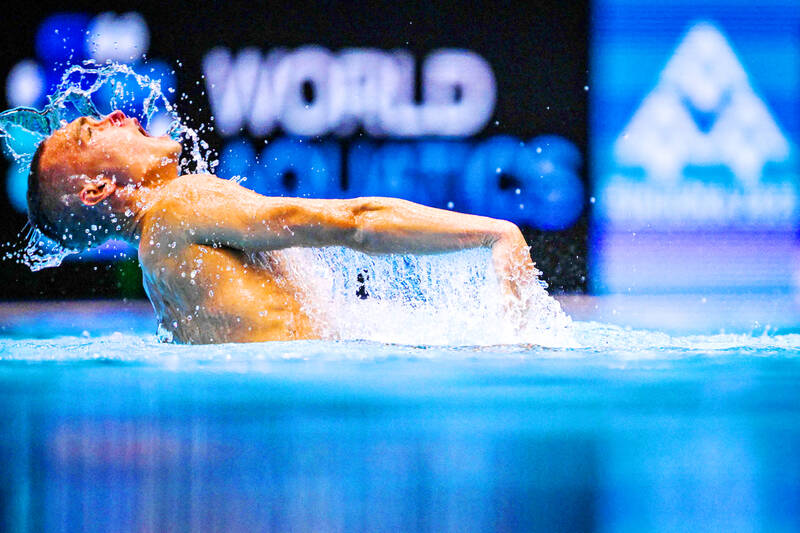
Photo: AFP
May looks like a lean bodybuilder. He was among the first men to compete when synchro was included in the worlds for the first time in 2015. He worked for 17 years at Cirque du Soleil doing water-themed shows. He has come out of competitive retirement for a chance to compete at the Olympics.
“There has always been that misconception that it’s a female-only sport, or that it’s for wimps, or that it’s not a difficult sport,” the 44-year-old May said. “Anyone that has anything negative to say about the sport — boy, female, anyone. Just try it and you’ll know it’s the most difficult sport in the world.”
This is not the synchronized swimming that your parents or grandparents watched — the water ballet that made few waves below the flowery rubber caps and permanent smiles. It is estranged from the sport introduced at the 1984 Los Angeles Olympics.
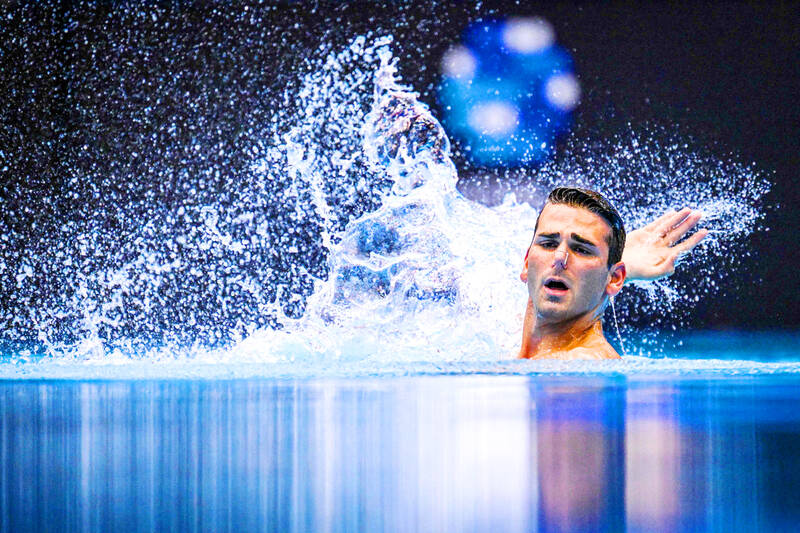
Photo: AFP
The acrobatic team event, in particular, features lifts, throws and flips, and diving routines launched off the shoulders of teammates treading water below. It is gymnastics on water and concussions are a risk.
Interested men often confront the stereotypes.
Beginning in elementary school, 18-year-old American Kenny Gaudet dreamed of being a synchronized swimmer. He made it, but it was not easy.
“It makes me emotional just to think about the problems we all went through and the struggles we all had just to get a chance to swim and do what we love,” said Gaudet, who competed at this year’s worlds.
“So much bullying. So much slander. So much hate,” he added. “Just because of my gender, just because I’m a male in artistic swimming. When I first started I wanted to quit so many times. Growing up my peers would ask why I’m doing a female sport, why am I being like a girl and degrade me for doing what I love to do.”
One aspect of Adam Andrasko’s job as the head of USA Artistic Swimming is recruiting men. He said there are about 100 participating in the US, up from 25 just four years ago.
“There hasn’t been a good foundation of growth,” Andrasko said. “You haven’t had the farm system.”
A few countries at the world championships have male swimmers including the US, Japan, Germany and China. Spain and Italy also have top competitors.
“There aren’t a lot of countries with strong males” in the international competition, Andrasko said, adding that men often lack the flexibility to compete. “So you might not see a lot of males swimming in the Olympics. I’m concerned it goes to the Olympic Games and we don’t see a male participating. I definitely have that fear.”
“To this point, women are still far better at this sport than a man,” he added.
Another fear, apparently unfounded, is that women might resent the men competing in the sport. Men are to compete in only team events at the Olympics.
Teams have a maximum of eight members — with a limit of two men — which means men might crowd out some women.
There is no requirement for men to be included.
Asked about any acrimony, two-time American Olympian Anita Alvarez said: “No, not at all.”
Alvarez has blacked out twice in the past two years while competing and had to be resuscitated. She has been cleared to compete with no diagnosis except physical or mental exhaustion. Holding her breath for too long underwater is also suspected.
“Having the inclusion of both males and females will make it more open for young boys and young girls to dream of being in the Olympics, parents wanting to start their kids,” Alvarez said.
She ran off her workout routine, sure to scare away men and women equally.
“We’re training eight-plus hours a day, treading water all day,” she said. “You have to be able to count time and work with music. You have to be able to watch your patterns and stay in line. We don’t wear goggles when we compete. You’re holding your breath. You don’t touch the bottom. There are so many elements that go into it that people don’t see.”

When Paddy Dwyer arrived in China in 1976, crowds jostled to catch a glimpse of him and his companions — the first Western soccer team to play in the country. China was emerging from the chaos of the Cultural Revolution, and on the brink of market reforms that would take the country from economic stagnation to explosive growth. “All we could see was lines of people running beside our bus, trying to look in the windows, to see their first visual of a white person,” he said. “It was all bicycles,” he said. “There were very few cars to be seen.” Dwyer,

Jannik Sinner continued his quest to become the first man in history to win five Masters 1000 tournaments in a row with a 6-2, 6-3 victory over Danish qualifier Elmer Moller at the Madrid Open on Sunday. The world leader extended his winning streak to 19 matches, a run that began early March in Indian Wells, and he has captured 24 consecutive victories at the Masters 1000 level, dating back to the Paris Masters last October. Searching for a maiden title at this level on clay, Sinner advanced to the round of 16 at the Caja Magica with a 77-minute performance against
Tennis players are facing an unexpected opponent at the Madrid Open. A stomach virus or food poisoning has affected Iga Swiatek, Coco Gauff, Marin Cilic and others, raising concerns. World No. 1 Aryna Sabalenka avoided an upset by Naomi Osaka on the court on Monday and said she is trying to avoid illness by sticking to a diet of chicken breasts, rice and salad. The rumor among the players was bad shrimp tacos were to blame. Sabalenka knocked on wood for luck and said, “So far, so good. I heard that I have to avoid those tacos,” she laughed, adding “I stick to the

Some of Clearlake Capital Group’s largest investors are growing increasingly concerned about how much time the company’s co-founders are spending on sports investments as they have struggled to complete the fundraising for the private equity firm’s latest flagship fund. One of Clearlake’s co-founders, Behdad Eghbali, has been spending what some investors described as a disproportionate amount of time on the firm’s investment in Chelsea Football Club in recent months. Now, co-founder Jose E. Feliciano and his wife, Kwanza Jones, are nearing a record US$3.9 billion deal to acquire the San Diego Padres. That personal investment by Feliciano has set off the latest


 RSS
RSS