


After Hlaing Htet Aung landed another vicious kick to his opponent’s chest, the referee called a stop to the bout of traditional Myanmar boxing, the crowd cheered and the ringside band ended their tune with a flourish.
The 22-year-old strutted victorious from the ring at the end of a five-day traditional Lethwei tournament, now in front of big crowds again following the COVID-19 pandemic. He had just beaten the champion for his weight, and had the bruises and lumps on his face to prove it.
“It’s nothing,” he said of his swelling face. “It’s normal to get hit like this in Lethwei... I’m happy because I won.”
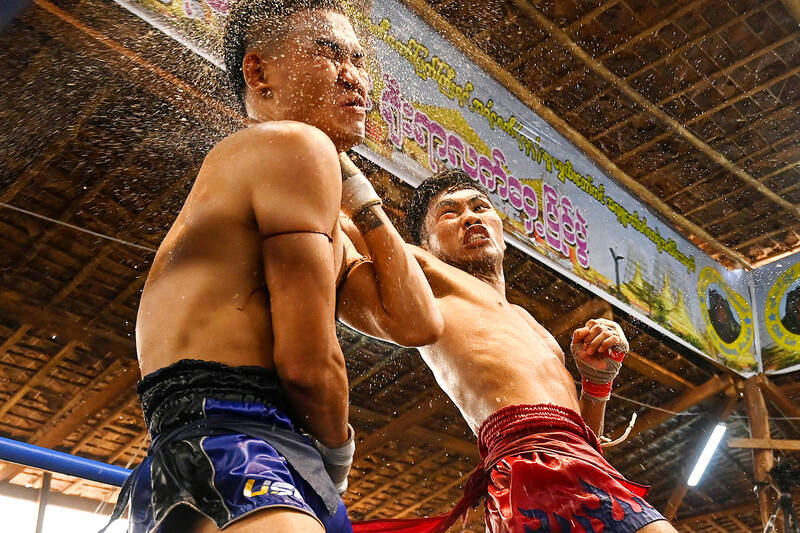
Photo: AFP
Lethwei is considered one of the most aggressive combat sports in the world, with fighters eschewing boxing gloves for thin gauze bandages wrapped around hardened knuckles. Feet, knees, elbows and even the head can also be used to strike an opponent.
Handing her son an ice cube to cool his wounds, the fighter’s mother, Chit Htwe, 52, was unfazed by his injuries.
“Nothing happened. He’s a man, isn’t he? A Lethwei fighter is used to going home with injuries,” she said.
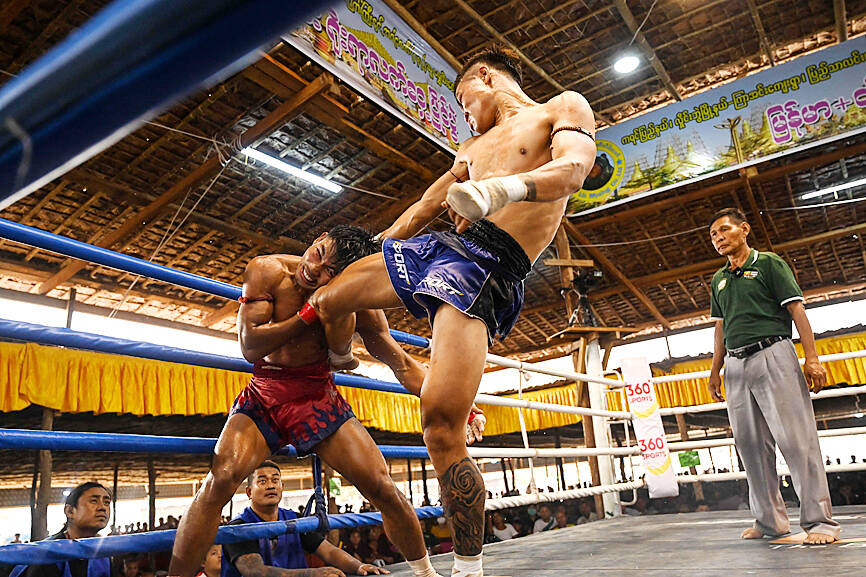
Photo: AFP
Later she counted out his winnings — 900,000 kyat (US$424). The tournament also featured children aged about 10 slugging it out in a whirl of skinny arms and legs.
Many Lethwei fighters start training and competing from a young age.
“I was frightened when I went into the ring... I had no experience in fighting then,” Hlaing Htet Aung said.
Lethwei has a long history, with Myanmar temple carvings appearing to show pairs of men locked in combat, suggesting the sport is more than a thousand years old.
In the modern era, it was kept alive in the eastern border states of Karen and Mon, where bouts are held to mark everything from monks’ funerals to New Year festivities.
More than 1,000 people turned out to watch the end of the tournament in Hlaingbwe Township in Karen state, sitting in plastic chairs under a huge wooden roof. In the crowd a dozen or so monks watched the violence unfold as flutes played, drums and cymbals clanged, and a commentator encouraged the fighters through a microphone.
Fighters from the Burmese Border Guard Forces — former ethnic insurgents now loosely allied with the military — stood outside on guard holding rifles or rode in jeeps with machine guns mounted on the back.
Karen state has been riven by conflict since independence from Britain in 1948, with ethnic rebels fighting the military and each other.
The biggest of the ethnic rebel groups, the Karen National Union, has clashed repeatedly with the military since the junta’s coup two years ago and bloody crackdown on dissent, but on Sunday officers and senior figures from rival groups sat in the same crowd to watch the spectacle.
Not far from the boxing ring thousands prayed at a Buddhist pagoda as part of a ceremony to mark the hoisting of an auspicious golden umbrella to the top of its spire.
One of the few female fighters on the bill, Dawna Bo Ma, 16, is from Myawady on the Thai border. Like Hlaing Htet Aung, her father was a Lethwei fighter.
In her match she went the full five rounds with her taller and heavier Thai opponent.
After the fight, her team took her bandages from her hands and applied petroleum jelly to a cut above her eyebrow. She drew the match match, but has big ambitions.
“I have to beat female fighters in Myanmar first, and if there is no one who will challenge me, I will go to Thailand to fight,” she said. “I am a fighter... I’m not afraid of being hurt.”
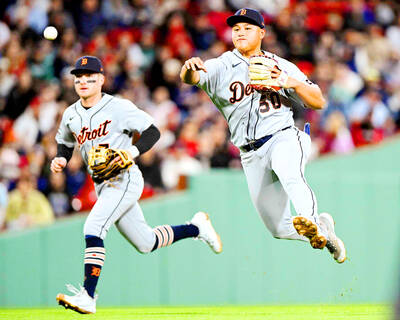
Taiwan’s Lee Hao-yu on Friday went 0-for-3 in his MLB debut for the Detroit Tigers against the Boston Red Sox at Fenway Park, becoming the 19th Taiwan-born player to reach the big leagues. The Tigers ultimately lost 1-0 in 10 innings, ending their six-game winning streak. The 23-year-old started at third base and batted eighth for Detroit. He was promoted from Triple-A Toledo ahead of the four-game series against the Red Sox at the latter’s home stadium, replacing injured utility player Zach McKinstry. “Being right-handed, and given our schedule, I think six of the next 12 games are going to
When Paddy Dwyer arrived in China in 1976, crowds jostled to catch a glimpse of him and his companions — the first Western soccer team to play in the country. China was emerging from the chaos of the Cultural Revolution, and on the brink of market reforms that would take the country from economic stagnation to explosive growth. “All we could see was lines of people running beside our bus, trying to look in the windows, to see their first visual of a white person,” he said. “It was all bicycles,” he said. “There were very few cars to be seen.” Dwyer,
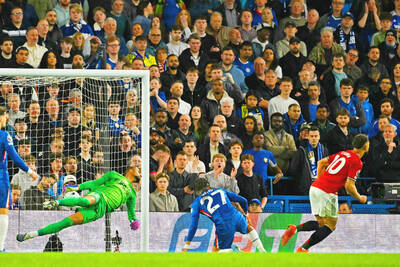
Matheus Cunha on Saturday fired Manchester United toward the UEFA Champions League with a 1-0 win at Chelsea, while Tottenham Hotspur remain in the relegation zone after twice blowing the lead to draw with Brighton & Hove Albion. Chelsea failed to take advantage of a United defense ravaged by injury and suspension as a fourth straight league defeat for the Blues left their Champions League hopes in ruins. United have missed out on the riches of Europe’s elite competition for the past two seasons, but are closing in on a return thanks to an upturn in fortunes under interim manager
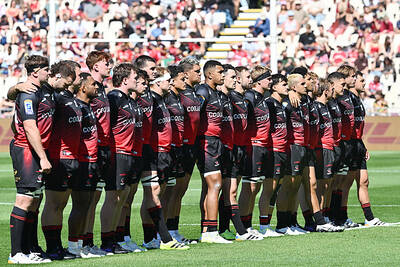
A new NZ$683 million (US$404 million) stadium that was a symbol of Christchurch’s struggle to rebuild after a deadly earthquake struck the New Zealand city is to host its first match tomorrow in front of a sellout crowd. A magnitude 6.2 earthquake killed 185 people in February 2011 and toppled or damaged buildings, including the city’s old Lancaster Park. The stadium, which hosted international rugby and cricket, and was home to the Canterbury Crusaders, was badly damaged and never reopened. It was bulldozed in 2019 and turned into sports fields, leaving the Crusaders without a permanent home. Government funding for a new stadium was


 RSS
RSS