

In a Kenyan reserve near Africa’s highest mountain, Masai youths on Saturday swapped traditional lion hunts for a series of sporting events to test and display their prowess and strength.
For generations, Masai warriors had to kill a lion as part of the Olamayio rite to prove their skills, identify their leaders and attract girlfriends. As the numbers of lions in Kenya plummeted from about 30,000 in the 1970s to just more than 2,000 today, community leaders and conservation group Big Life Foundation created the “Masai Olympics” a decade ago to replace hunting with sport.
Draped in colorful costumes and sporting beads, dozens of athletes participated in the fifth edition of the biannual event.
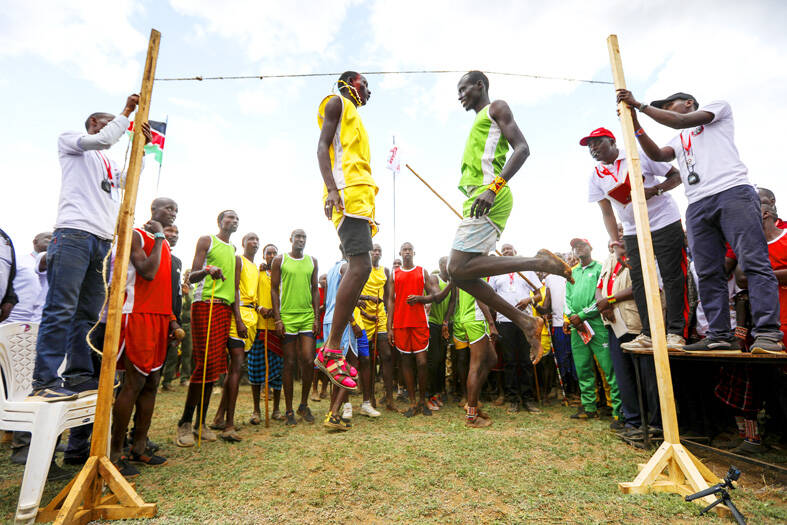
Photo: EPA-EFE
The competition in Kimana Sanctuary, near Mount Kilimanjaro, drew about 160 participants, including 40 women, and is credited with playing a major role in lion conservation.
“It has dropped lion killing to near zero” in the region, Big Life cofounder Tom Hill said.
“There are only 23,000 lions left in Africa and the figure is declining,” he said.
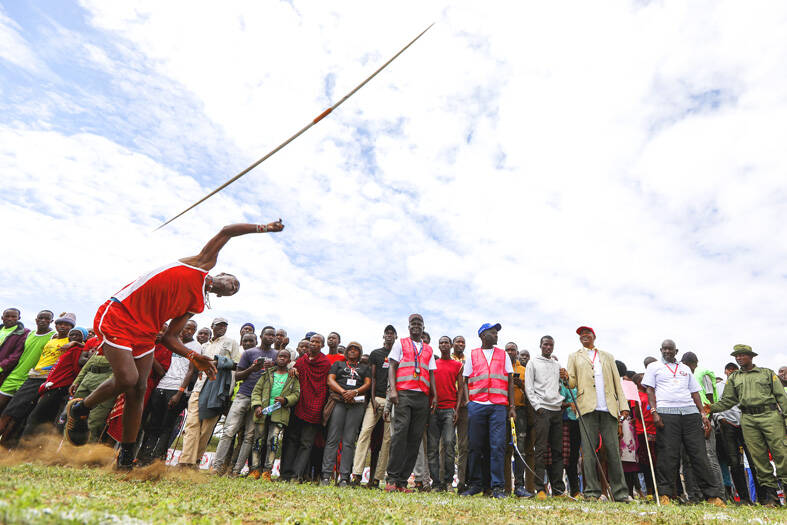
Photo: EPA-EFE
The sanctuary where the games are held is part of the famed Amboseli-Tsavo ecosystem near the Tanzanian border.
The games are a “good way to preserve our lands,” said 30-year-old Joseph Lekatoo, who has been competing since 2012.
Esther Sereya, 20, agreed.
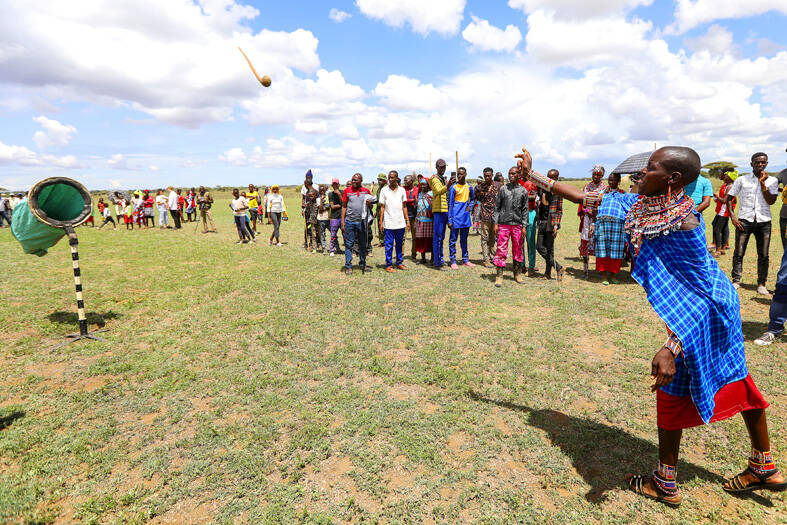
Photo: EPA-EFE
“We are learning a lot about the animals,” she said.
Lions are sometimes hunted for attacking livestock, Hill said, adding that the foundation has a fund to compensate herders.
The games saw participants sprint on a hard dirt track for distances ranging from 100m to 5km.
Other competitions have been adapted to local customs. Wooden clubs known as rungus, used to ward off hyenas, are tossed instead of discuses in throwing events. In a revisited high jump event, the goal is to leap into the air to touch a rope with the top of one’s head, like the traditional Adumu dance performed at ceremonies.
Since its inception, the event has been sponsored by David Rudisha, a two-time Olympic champion and world record holding sprinter who is also Masai.
“We are doing this event for conservation,” he said.
Elder Masai men were all praise for the games.
“I killed two lions when I was young,” 66-year-old herder Lenkai ole Ngola said.
“But today, it is important to protect them, because their numbers are declining and also because they provide jobs for young people,” he said, referring to tourism.
Lions are threatened by poaching as well as an unprecedented drought affecting Kenya.
Following several failed rainy seasons, the land on the Kimana reserve is scorched due to the worst drought in the area in 40 years.
The winners of the various events do not receive medals, but are rewarded with cattle, scholarships or money.
Lekatoo won the javelin throw.
“Now, I am hunting the medals,” he said. “I am not hunting lions.”

COMPLAINTS ABOUND: Long delays, unsuitable accommodation and transport issues have overshadowed the lead-up to the Games, which are to open today The Asian Games in Japan on Friday faced more accusations of poor organization with a world champion gymnast “totally exhausted,” the public drafted in to rescue stranded athletes and South Korea lodging a complaint about a Japanese warlord. The continent’s premier sporting spectacle opens in Nagoya and Aichi prefecture today, but the build-up has been soured by several issues. That includes a shortage of rooms for the more than 17,000 athletes and officials — a bigger number than the Olympics. Some teams have also criticized the quality of the accommodation, including beds that are too short. To save money there is no athletes’ village,
The Hyrox athletics franchise has apologized for allowing an athlete to complete an event in Beijing despite soiling herself midway through, causing an outcry on social media. Posts showed Australian athlete Joanna Wietrzyk with soiled legs and shoes, continuing to use the mats and equipment at the competition held on Saturday in the Chinese capital. She completed the event without the organizing committee intervening, and went on to win the competition, according to the Hyrox Web site. Users pointed out on social media that other participants had to touch the contaminated mats, handles and running tracks after she had used them, raising concerns

UNDER INVESTIGATION: Taiwan has replaced the damaged banner and more cameras have been installed to protect athletes and staff, the sports ministry said The Ministry of Sports yesterday called for mutual respect after a banner at a training facility used by Taiwanese athletes at the Asian Games was defaced to cover up the Chinese characters for “national” and the English word “Taiwan” in Nagoya, Japan. The banner, displayed at Misono Elementary School in Nagoya, was defaced with ink, the Chunichi Shimbun reported on Wednesday. The orange banner, measuring about 5m long by 1.5m wide, hung near the entrance to the former elementary school. In white lettering it read “National Sports Training Center” (國家運動訓練中心) in Mandarin with the English name “Taiwan Sports Training Center.” The Taiwan delegation
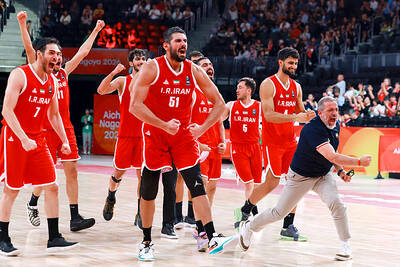
Iran yesterday withstood a late fightback to beat China 79-70 and win Asian Games men’s basketball bronze, an achievement that left their players “speechless” after months of war back home. China led 31-29 at half-time in Nagoya, but Iran took charge in the third quarter to lead 55-46 going into the fourth and held on to spark wild celebrations and an emotional place on the podium. “To be honest with you I’m just speechless,” said 202cm power forward Arsalan Kazemi, who in 2013 was the first Iranian to be drafted in the NBA by the Washington Wizards, but never made


 RSS
RSS