


On a concrete playground in a poor hillside neighborhood in Brazil, ecstatic children are chasing a ball at top speed, but in an unusual scene for the soccer-mad country, they are indifferent to the goalposts nearby, instead swinging cricket bats and fielding drives.
Welcome to Pocos de Caldas, a city of 170,000 people that is the capital of a lovably quirky quest to turn the land of Pele and Neymar into a passionate cricketing nation.
Defying stereotypes, Brazil is emerging as a force to be reckoned with in cricket, especially the women’s national team, who were given professional contracts in 2020 — making the country the first in the world to take its women’s team pro before the men’s.
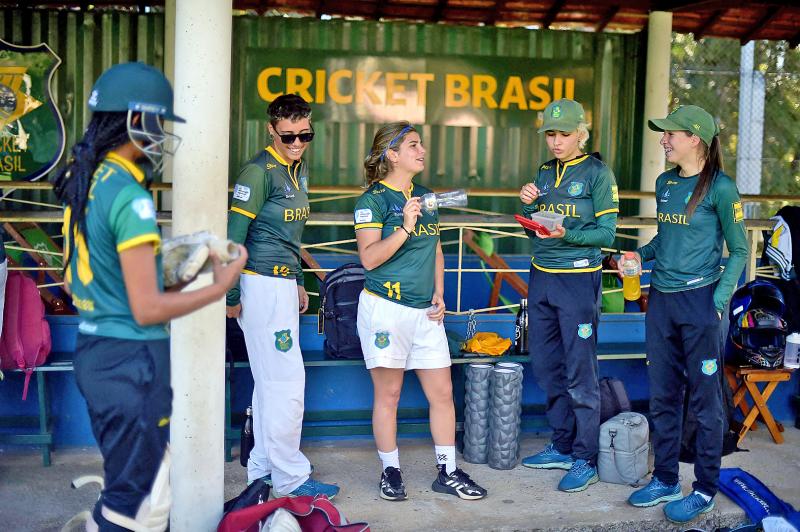
Photo: AFP
Most players have learned the game from 63 community youth programs run by the organization Cricket Brasil, whose president is former professional cricketer Matt Featherstone, an Englishman who married a Brazilian and moved there two decades ago.
“My wife thinks I’m mad” for trying to get Brazilians playing cricket, said Featherstone, 51, a strapping man with infectious enthusiasm.
However, his charisma and community spirit have turned Pocos de Caldas, a tiny spa hub nestled in the green mountains of southeastern coffee country, into what Mayor Sergio Azevedo boasts is “the only city in Brazil where more kids play cricket than football.”
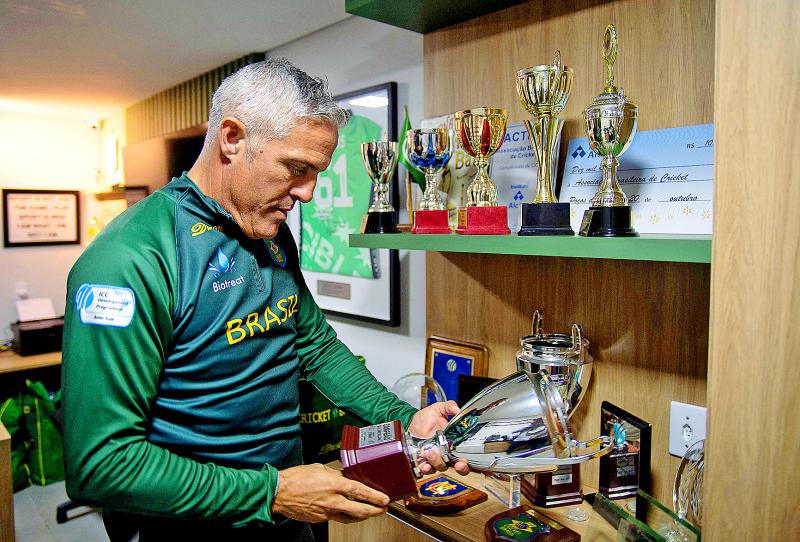
Photo: AFP
When Featherstone moved to Brazil in 2000, he tried spreading his love of cricket at private schools, but soon realized he was competing against rugby, hockey, sailing and “everything else you can imagine,” he said.
However, in poor neighborhoods, where the options were “football or football,” he discovered families were elated to have a new sports program.
Unlike in England, where cricket is sometimes seen as a game for rich men, “here we have a blank piece of paper to invent cricketing culture as we wish,” he said.
Roberta Moretti Avery, the women’s team captain, recalls her first reaction to seeing cricket on TV.
“It wasn’t the best impression,” said the 36-year-old, laughing. “I didn’t understand it, I just saw all these people dressed in white, and it seemed to last forever.”
However, she noticed the sport was similar to a Brazilian street game she liked, known as “bats” or “taco.”
The story goes that Brazilian slaves invented the game, played with broomsticks for bats and bottles for wickets, after seeing cricket played by Brits brought over to build Brazil’s railroads in the 19th century.
The enthusiasm and openness at Cricket Brasil ended up winning her over, said Moretti Avery, a petite dynamo with a wide grin and a mean swing honed by playing golf.
Brazil has put its own stamp on cricket. The women’s team play Brazilian funk at practice, samba before matches, and prefer loud parties at the grounds to tea and cucumber sandwiches.
“The way cricket was developed here was really cool. We’ve made it fun,” Moretti Avery said.
Thanks to the community projects, launched in 2009, Pocos de Caldas has more than 5,000 cricket players. Cricket Brasil wants to reach 30,000 and expand to other cities.
Some players are winning international recognition.
In October last year, Laura Cardoso, a 16-year-old all-rounder, made world headlines with what one sportswriter called a “miraculous” performance, bowling a hat-trick as Brazil took five wickets in six balls in the final over to win a dramatic one-run victory over Canada in the T20 World Cup qualifiers.
It was a feat never accomplished in a women’s T20 international.
Just back from a stint playing professionally in Dubai, Cardoso, a natural athlete with a powerfully compact physique, could well become one of the world’s top players, Featherstone said.
The young phenom, now 17, takes it all in stride.
“Oh my gosh, what did I do to get here?” she said with a laugh near the national team’s training center, donated by the city government.
Brazil’s women are 28th in the T20 international rankings, and are aiming a lot higher.
They have won four of the past five South American championships, and with success comes cash from the International Cricket Council and sponsors.
Cricket Brasil’s annual budget has grown from about US$5,000 a decade ago to US$350,000, enabling the organization to launch a trainee coach program and send promising talent to university.
Cricket has been life-changing for players like 20-year-old Lindsay Mariano.
“Before I played, I didn’t even have a passport,” she said, on a break from training for the national team’s upcoming African tour. “Now, I’ve traveled around the world thanks to cricket.”

After letting another big lead slip with an error-strewn performance at the French Open on Wednesday, top-ranked Aryna Sabalenka felt like getting as far away from the courts as possible. “Just want to quit tennis right now,” Sabalenka said after wasting a lead of a set and two breaks in a 3-6, 7-5, 6-0 loss to Diana Shnaider in the women’s singles quarter-finals. “We’ll see in few days. Hopefully I’ll get back on track mentally.” Sabalenka’s wait for a first French Open title continues despite the four-time major winner leading 4-1 in the second set and being two points from victory while

BIG NAMES GONE: Zverev is the clear favorite for a maiden Grand Slam title, reaching semi-finals for the fifth time in six years and finishing second on three occasions Alexander Zverev on Tuesday breezed past Rafael Jodar to stay on course for an elusive Grand Slam title at the French Open, while Jakub Mensik halted Joao Fonseca’s scintillating run in the quarter-finals. Zverev, the highest-ranked player left in the men’s draw, put an end to Spanish teenager Jodar’s impressive Roland Garros debut, easing into the semi-finals with a 7-6, (7/3), 6-1, 6-3 win. The 29-year-old Zverev is the clear favorite for a maiden Grand Slam title. He has finished runner-up on three occasions, including at the 2024 French Open. “I want to win the matches that are ahead of

For some, Cristiano Ronaldo remains the essential spearhead for Portugal’s FIFA World Cup bid, while others believe his presence would prevent Roberto Martinez’s strong side from flourishing. The debate around the five-time Ballon d’Or winner rages on, as it did at UEFA Euro 2024 and four years ago in Qatar — yet Ronaldo endures, ready to play in a record sixth World Cup. The 41-year-old remains a global superstar despite swapping the European elite for Saudi Arabia’s Al-Nassr, and is the leading men’s international goalscorer with 143 strikes. With 25 of those coming in 30 games under Martinez, the coach

Taiwanese sprinter Chen Yi-cen on Friday won the silver medal in the women’s 400m final at the Asian U20 Athletics Championships in Hong Kong, with a time of 53.16 seconds. Chen, 15, was the youngest among the eight finalists, and her performance also met the qualifying standard of 53.50 seconds for the Nagoya Asian Games in Japan in September and October. Chen first made her mark at the National Games in Tainan in 2023, at the age of 13, winning the women’s 400m final in 55.55 seconds to become the youngest gold medalist in the history of the event. Meanwhile,


 RSS
RSS