

It is a tale reminiscent of The Queen’s Gambit — when defending champion Magnus Carlsen meets Russian Ian Nepomniachtchi at the world championships in Dubai they would renew a rivalry dating from when they were 12.
It was, Norwegian Carlsen said, “one of my worst memories in chess” — at the under-12 world championships in Greece in 2002, the two prodigies were vying for the title, when he cracked.
In the final game, Carlsen lost to the Englishman David Howell, handing the title on a plate to Nepomniachtchi.
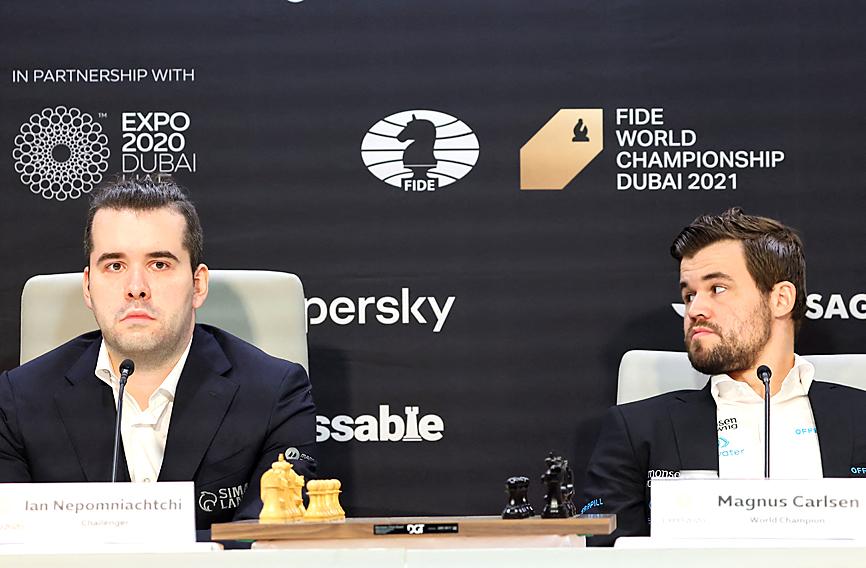
Photo: AFP
As Howell recalled in a documentary by the German chess platform Chess24, as soon as the game ended, a beaming Nepomniachtchi rushed to clasp Howell’s hand, in front of a visibly crestfallen Carlsen.
Would that bitter memory derail what has been since then the relentless domination of Carlsen, now 30, for the past decade?
The pair are to face each other from yesterday in the Gulf state in a 14-game, 19-day clash to determine who will walk away with the world crown.
The psychological aspect is perhaps the main weapon of Nepomniachtchi, the 31-year-old universally known as “Nepo” and the only top player to have a positive win ratio (4-1) against Carlsen in games played slowly, even though his successes date back several years.
“If everything is perfect, and both players are in fantastic form, and play perfectly healthy, Magnus will win the match, but life doesn’t work that way. You sleep bad for some reason — bam, you lose two games,” American international master Cyrus Lakdawala said.
“If I were Nepo’s coach, I would tell him to play soundly, but if he has an opportunity, make [the game] go crazy,” and knock Carlsen off his stride, said Lakdawala, who has written a book about the mercurial Russian called Nepomniachtchi: Move by Move.
Most observers are not tipping Nepomniachtchi to become the first Russian world champion in 15 years.
While he ran Carlsen close during their teenage years, he only recently muscled back into the world’s elite as an adult and has developed an image of an impulsive and inconsistent player whose form often tails off at the end of tournaments.
“He has a knack for making his opponents play badly because he plays his shots very quickly,” Lakdawala said. “Carlsen likes to use his opponents’ thinking time for him as well.”
Playing Nepomniachtchi “makes Carlsen angry. He has never played well against him,” said Emmanuel Neiman, author of The Magnus Method.
The Norwegian, who has won all four of the world championships he has played in — in 2013, 2014, 2016 and 2018 — “is a complete player and the only one who doesn’t have a weakness,” Neiman said.
A fifth victory would bolster his status as one of the best, if not the best, player in history.
Besides the world title, Carlsen has topped the points classification for more than a decade and has an encyclopedic knowledge of his discipline.
He founded the Play Magnus brand, which includes an eponymous application and online chess platforms, and raised nearly 40 million euros (US$45.04 million at the current exchange rate) when it was floated on the Oslo Stock Exchange in October last year.
In September, he won the Norway Chess competition featuring six top players including Nepomniachtchi. The two met twice, playing out two long draws followed by two wins for Carlsen with tie-breakers.
“If Carlsen wins in the opening games, the match could turn into a massacre. On the other hand, if the match remains tense, he could be caught up by the pressure,” Neiman said.
The Netflix series The Queen’s Gambit has made chess cool for arguably the first time since the Cold War-infused battles between American Bobby Fischer and Russian Boris Spassky in the 1970s.
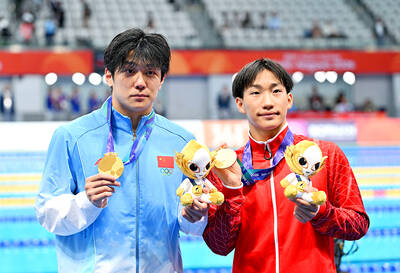
Japan has been starved of swimming success in recent times but with the Olympics two years away junk food-loving teenager Shin Ohashi has emerged as their next big hope. The 17-year-old, who stands just 169cm, has posted the two fastest 200m breaststroke times in the world this year and is aiming for the world record at this year’s Asian Games. Earlier this year he came within almost a second of the 2:05.48 record held by China’s Qin Haiyang. Ohashi has already won gold at the Asian Games in the 100m breaststroke after a dead heat with China’s Dong Zhihao, beating Qin into third

The Football Association of Ireland (FAI) has found itself divided ahead of their two Nations League clashes with Israel, with the players disagreeing over whether to boycott the first game today and goalkeeper Gavin Bazunu withdrawing from the squad. After hours of fraught meetings among the players and occasionally involving coaches and officials, FAI chief executive officer David Courell said at a news conference that had been delayed by several hours that a “significant majority” of the squad had agreed to play the game in Hungary, but it was far from a unanimous decision. The handful of Irish journalists present questioned Courell
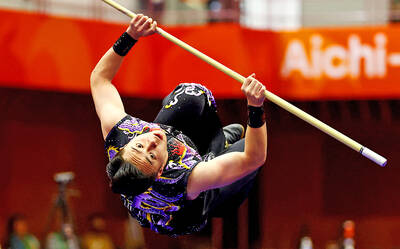
THREE BRONZES: Martial artists dominated Taiwan’s gains for Tuesday, while the baseball team delivered Thailand a thunderous 15-0 shellacking that morning Taiwanese athletes at the Asian Games collected another three bronze medals yesterday, bringing their medals to nine, leaving them in 10th place overall as of yesterday evening, trailing Uzbekistan and leading Iran. Taiwan’s baseball team roared back from a 5-0 defeat by South Korea on Monday to squash Thailand 15-0 as they head into their game today against Hong Kong at 6:30pm at the Games in Japan. KARATE The women’s team kata squad and men’s kumite competitor Chung Meng-yu won bronze medals yesterday. The 34-year-old Chien Hui-hsuan, who won bronze in the women’s individual kata event on Sunday, was joined by

MORE MEDALS: Taiwan’s men’s table tennis team added a bronze to the nation’s medal haul, while the women’s basketball team advanced to the semi-finals Taiwan yesterday secured their first e-sports medal at the Aichi-Nagoya Asian Games, claiming bronze in the Naraka: Bladepoint tournament after falling 0-3 to China in the semi-finals. The Taiwanese squad, comprising Liu Tang-shiun, Chen Shang-yi, Cheng Hsu-yu, Yen Kai-en and Yeh Chih-yu, had already secured a place on the podium when they advanced to the final four as the runners-up in their preliminary group. The bronze is first e-sports medal Taiwan has won at this year’s Asian Games. Naraka: Bladepoint is a game in which the players fight each other to be the last one standing. The game incorporates martial arts-inspired melee combat. TABLE


 RSS
RSS