


At Xia Lugen’s run-down, smoky betting shop in downtown Shanghai, hordes of young men cluster around banks of computers, as betting slips and a huge FIFA World Cup chart adorn the walls and a projector beams matches onto a makeshift screen.
China might not have a team at the World Cup in Russia, but this has not dampened the enthusiasm of the country’s gamblers, with bets in the first three weeks already outstripping the whole of the 2014 tournament in Brazil.
Energetic betting in these technically illegal, but officially sanctioned shops reflects the prevailing attitude toward sports, which are seen as a chance to make money as much as a spectacle to be enjoyed.
Before the first knockout game between France and Argentina, punters — known as caimin, or “lottery citizens,” in Chinese — lined up to place large bets.
Gao Liushun, 55, had previously lost a bundle on Argentina, so doubled down on an Argentina win because “I need to win back what I lost, right?”
He lost 1,000 yuan (US$151) after France’s thrilling 4-3 victory, his heaviest loss of the World Cup so far.
Fellow gambler Xia Junmin, a 25-year-old freelancer, lost five times that amount after wagering on a draw.
The World Cup-inspired surge in betting is borne out in the official figures.
China has spent 28.6 billion yuan in soccer betting in the three weeks up to Sunday, dwarfing the less than 5 billion wagered in the three weeks previous to that, figures from the China Sports Lottery Management Center showed.
That is more than double the nearly 11.5 billion yuan wagered during the 2014 World Cup in Brazil and does not take into account underground betting and syndicated gambling, which is widespread in the country.
China’s underground gambling networks are often cited as an impetus for match-fixing incidents worldwide, usually in obscure leagues, but also in Italy’s Serie A and occasionally in World Cup qualifiers.
Although all gambling is technically illegal in China, it is permitted in the country’s hundreds and thousands of “lottery shops.”
These are run by China’s Sports Administration with a part of the proceeds ploughed back into sports ranging from financing stadiums to training the next generation of Chinese athletes.
However, the government remains vigilant and dozens of unauthorized “lottery ticket” apps, which enable punters to place a bet with a single click, were closed down in the first week of the World Cup.
Xia Lugen converted his auto dealership into a “lottery shop” six years ago and business has boomed during the World Cup, with hundreds of thousands of yuan being bet daily — more than 10 times the stakes for a normal day.
Despite the absence of home interest, the World Cup “has brought out the passion from people who were not interested in soccer before,” he said.
“Everyone is watching it. People who didn’t bet are all betting now,” said the 59-year-old Shanghai local, who also has cashiers taking bets over the telephone.
Like punters all over the world, many gamblers in China lost a packet during some of the tournament’s more surprising results, especially the demise of defending champions Germany, who failed to get out of the group stage for the first time since 1938.
Li Feng, a gambler who has rigged up a big screen at his fried chicken joint to show the games, said he had lost 1,000 yuan betting on Die Mannschaft to beat unfancied South Korea in the group stage.
However, in one of the biggest shocks in World Cup history, South Korea beat the soccer superpower 2-0 with two late goals to break German hearts — and Li’s.
“No sane person would have bet on South Korea to win,” he said.
Gao Liushan, a regular at the bookies, said he was disappointed that China did not make it to the World Cup finals this time around.
“To be frank, China not making it was harmful to us,” he said. “But President Xi Jinping said not to forget your first love. The Chinese dream will be realized one day. I also believe in Chinese soccer. The dream will be realized in the near future.”

Greek swimmer Kristian Gkolomeev was the only athlete to “beat” a world record on Sunday at the Enhanced Games, winning the men’s 50m freestyle at the divisive competition where athletes were free to take performance-enhancing substances. His time of 20.81 seconds — which is not considered official — came in the final event of the night in Las Vegas, sparing the blushes of organizers who made claims that multiple world records would be surpassed due to a sophisticated doping regime. Gkolomeev, who was wearing a synthetic “supersuit” long banned at events such as the Olympics, outpaced Australia’s Cameron McEvoy’s 20.88 set in

The manager of the Yomiuri Giants, one of Japan’s most popular baseball teams, resigned yesterday after he was arrested for allegedly physically attacking his teenage daughter. Shinnosuke Abe allegedly grabbed the 18-year-old and forced her to the floor at their home in central Tokyo on Monday evening, reported national broadcaster NHK and Kyodo News, citing unnamed police sources. “Leaving like this really means I’m causing you a lot of trouble, and I feel truly sorry about that,” Abe told a hastily arranged news conference, his eyes red with tears. The former star catcher, who is among baseball-obsessed Japan’s most recognized sports figures,

For some, Cristiano Ronaldo remains the essential spearhead for Portugal’s FIFA World Cup bid, while others believe his presence would prevent Roberto Martinez’s strong side from flourishing. The debate around the five-time Ballon d’Or winner rages on, as it did at UEFA Euro 2024 and four years ago in Qatar — yet Ronaldo endures, ready to play in a record sixth World Cup. The 41-year-old remains a global superstar despite swapping the European elite for Saudi Arabia’s Al-Nassr, and is the leading men’s international goalscorer with 143 strikes. With 25 of those coming in 30 games under Martinez, the coach
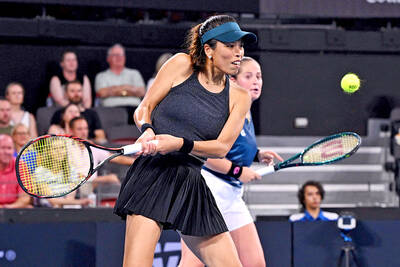
Taiwanese tennis star Hsieh Su-wei on Wednesday advanced to the second round of the mixed doubles at the French Open, after she and German partner Mark Wallner defeated Slovenian Andreja Klepac and Briton Lloyd Glasspool in straight sets, despite temperatures exceeding 32°C in Paris, while Taiwan’s top men’s doubles player Ray Ho also reached the second round. Hsieh, who made it to the semi-finals in the mixed doubles at Roland Garros in 2024, and Wallner defeated Klepac and Glasspool 6-3, 7-5 in just more than an hour, converting three of five break points, while holding their opponents to just one conversion


 RSS
RSS