


As Hungary count down to Euro 2016 and face Germany in a friendly today, a relic of their glory days as a world-beating side has just been demolished in Budapest: the communist-era Ferenc Puskas Stadium.
It was here, watched by almost 100,000 spectators, that the legendary “Magical Magyars” were kings, famously thrashing England 7-1 in 1954, still the Three Lions’ heaviest ever defeat.
Originally called the Nepstadion (Peoples’ Stadium), it was built by volunteer labor “for the people, by the people” between 1948 and 1953, the heyday of Puskas’ all-conquering “Golden Team.”
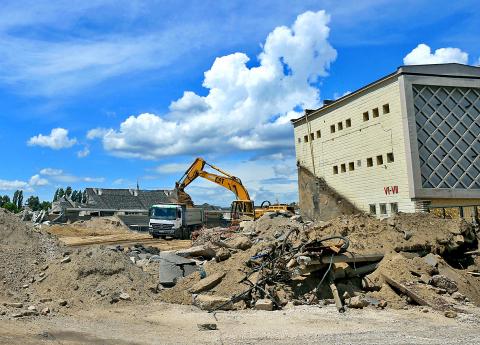
Photo: AFP
“It was more than a stadium, it was where Hungary ruled the world,” Zoltan Molnar, a groundskeeper at the stadium for 28 years, told reporters.
Former Hungarian leader Matyas Rakosi, nicknamed “Stalin’s best pupil,” imagined it as a symbol of communism’s superiority over the West, Gergely Csoti, a sports historian, told reporters.
Even national hero Puskas, seen smiling awkwardly in a propaganda photograph, lent a hand.
“Its style was ‘Stalinist baroque’: vast with lots of reinforced concrete, a state-of-the-art technology at that time,” Csoti said.
In 1957, French sports daily L’Equipe called it a model of “sporting and architectural perfection,” which put the “crumbling” Stade Olympique Yves-du-Manoir in Colombes, near Paris, to shame.
The interiors were finished with marble tiling replete with socialist-realist-style sporting motifs, complementing statues of sportsmen posing on plinths outside the stadium.
Fearful of attack by the West, Rakosi also had an air raid bunker built in, as well as a VIP box with hotlines to communist party henchmen.
He then ordered its opening, despite it missing half its top tier, after a Radio Free Europe broadcast suggested the construction had run into trouble.
“Prestige was at stake,” Csoti said.
Also designed as an Olympic stadium, Ferenc Puskas Stadium was the centerpiece of Hungary’s bid for the 1960 Games.
However, Rakosi appeared to snub then-International Olympic Committee (IOC) president Avery Brundage on its grand opening.
On a hot August day, he reportedly said: “I don’t want to sit beside an imperialist,” and assigned the American a seat outside the air-conditioned VIP area.
Whether the dictator’s attitude influenced the IOC’s decision to award the Games to Rome is not on record.
“It’s more likely that Moscow [which hosted the Games in 1980] did not want the event to be awarded to an Eastern Bloc country before it,” Csoti said.
In April 1954, shortly before a World Cup that the Magical Magyars were favorites to win, Hungary routed England 7-1 at the stadium, a return game after the famous 6-3 mauling in London the previous year.
The English players, used to the 1920s-era Wembley Stadium, marveled at the facilities.
The whole team could soak in the bath after the game, while the dressing rooms were “like a palace,” the English goalkeeper Gil Merrick said.
However, Hungary lost the World Cup final to West Germany, a shock defeat that led to riots in Budapest, a precursor to the failed anti-Soviet uprising in 1956, and the defection of Puskas and the breakup of the Golden Team soon after
Soccer’s use as a propaganda tool now gone, the communist regime withdrew backing from the sport and the stadium, its top tier never to be completed, opened up to other functions.
About 80,000 people watched Louis Armstrong play there in 1965, an attendance record at the time for a jazz concert, while British rock group Queen were allowed to stage one of the first rock concerts behind the Iron Curtain in 1986.
The band’s management charged US$140,000 in cash up front, a struggle to find in near-bankrupt Hungary, Molnar told reporters.
In 2002, soccer-mad Hungarian Prime Minister Viktor Orban renamed the by-then decrepit stadium in honor of Puskas’ 75th birthday.
After he died in 2006, Puskas’ body lay in state at the stadium, where thousands filed past to pay their respects.
“[UEFA president] Michel Platini remarked he’d never seen such an occasion for a footballer,” Molnar told reporters.
The planned 68,000-seater rebuild as one of 13 host venues for Euro 2020 — held in 12 countries — is part of a nationwide stadium-building drive by Orban in a bid to restore Hungary’s soccer fortunes.
Euro 2016 is the first time since 1986 that Hungary has qualified for a major tournament.
For 61-year-old Molnar, who lived in lodgings inside the stadium and whose children grew up there, the reconstruction is painful to watch.
“I switch off the TV if a report on it comes on,” he said. “During communism, sport was all we had, there wasn’t much else to enjoy, a lot of people had good times there.”

Taiwan’s men’s table tennis team won bronze on Saturday at this year’s International Table Tennis Federation World Team Table Tennis Championships in London, matching the country’s best-ever finish at the regular tournament. Consisting of Lin Yun-ju, Taiwan’s top-ranked player at world No. 7, Feng Yi-hsin, Kuo Guan-hong, Hong Jing-kai and Hsu Hsien-chia, the team won bronze after losing 0-3 to Japan in the semifinals. In the opening match, 24-year-old Lin played the first game against world No. 3 Tomokazu Harimoto 11-5, but ultimately lost the next three closely contested games 9-11, 10-12 and 10-12. Feng then faced world No. 8 Sora Matsushima in

Lin Yun-ju on Thursday handed Taiwan two key victories as they advanced to the semi-finals of the ITTF World Team Table Tennis Championships Finals in London. The Taiwan men’s table tennis team beat Sweden 3-2 in five singles matches. The 24-year-old Lin, Taiwan’s top-ranked player at world No. 7 and nicknamed the “Silent Assassin,” opened the tie by defeating world No. 2 Truls Moregard 3-0 (11-8, 11-9, 13-11) before clinching the deciding fifth match with a 3-0 (11-8, 11-9, 11-5) win over Anton Kallberg to hand his team the overall victory. Kuo Guan-hong put Taiwan up 2-0 with a 3-2 (4-11, 11-8, 8-11,
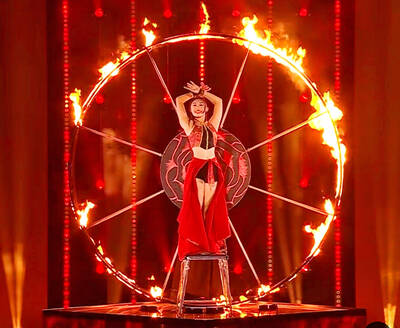
Taiwanese fire dancer Yang Li-wei advanced to the final of Britain’s Got Talent this weekend after receiving a Golden Buzzer during her live semi-final performance. Yang, a member of Taiwan’s Coming True Fire Group, awed judges and audiences with a high-intensity fire performance featuring flaming umbrellas, fire swallowing and spinning metal structures balanced with her legs. Judge Simon Cowell praised Yang as a star, while guest judge KSI reacted with amazement before pressing the Golden Buzzer, sending her to the finals. The dance group wrote on social media that the Golden Buzzer was “the highest honor” on the talent show, adding: “Twenty-three years

As Super Rugby fast approaches its playoff season it finds itself racing toward a reckoning with many issues that threaten the southern hemisphere tournament. A group of stakeholders met in the New Zealand city of Christchurch late last month to address problems that are making the future of the 31-year-old competition increasingly tenuous. The discussion was made more urgent by the decision by the owners of Moana Pasifika to fold the Auckland-based club for financial reasons. That followed the closure of the Melbourne Rebels at the end of the 2024 season, likewise because of financial difficulties. Problems addressed included player retention as more


 RSS
RSS