


Jonah Lomu, who bulldozed opponents with his size and blistering speed only to be felled by a kidney illness that extinguished his meteoric All Blacks career, died suddenly yesterday. He was 40.
“Jonah was a legend of our game and loved by his many fans both here and around the world,” New Zealand Rugby chief executive Steve Tew said. “We’re lost for words. Our heartfelt sympathies go out to Jonah’s family.”
The son of immigrants from Tonga, innately humble off the pitch, was at his devastating best at the 1995 and 1999 World Cups, scoring 15 tries in 11 games, but never winning the trophy.
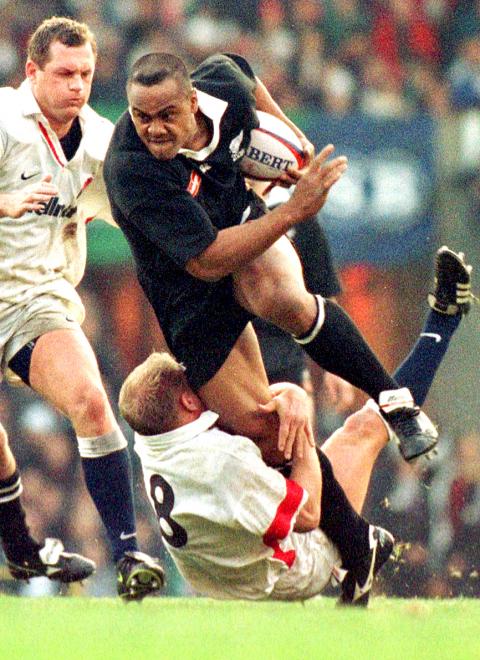
Photo: Reuters
The stabbing death of a friend steered Lomu away from street gangs in the blue-collar suburbs of Auckland, New Zealand’s largest city, where he grew up.
Rugby gave him new direction. He channeled anger he felt about his father into the sport. Aged just 19 for the first of his 63 Tests, he was a physical colossus for a winger — 1.96m tall, 119kg — and quite terrifying when pounding through defensive lines at speed.
Nephrotic syndrome, a degenerative kidney illness, curtailed his career at his peak. Lomu tried making a comeback after a 2004 transplant, but was forced to abandon hopes of playing the 2007 World Cup. He played his last match in 2006.
At the height of his career, Lomu had the ear of former South African president Nelson Mandela, charmed Hollywood comedian Robin Williams — who wore an All Blacks cap and called him “mate” — and visited parliaments and palaces.
His father, Semisi Lomu, was a factory worker, devoutly religious and a harsh disciplinarian. His mother, Hepi, held together the family living on a shoestring and acted as a buffer between father and son.
“At times, he was the best dad that he could be,” Lomu said in a 2013 interview. “It was just when he drank, that’s when me and him disagreed. He was quite violent when he was drunk. Mum was always there to protect the kids, and when Dad got angry and wanted to bash us, she would get in the way. It builds up a lot of things inside of me.”
At age one, Lomu was sent to Tonga to be raised by an aunt who, for the next five years, he thought of as his mother. On his return to New Zealand, Lomu rebelled against his strict father, leading to their eventual estrangement, and gravitated toward the streets.
“It made me battle-hardened for rugby,” he said. “When I was playing, when I found it hard, I just thought of my father and that got me through it. That anger got me through it.”
After the death of his friend, Lomu found new direction at Auckland’s Wesley College, a famous nursery of Polynesian rugby talent. There, he first showed his devastating combination of size fused with speed. Playing out on the wing, with time and space to hit his stride, he crashed through or cruised around opponents.
He played for New Zealand’s under-19 team and starred in rugby sevens before his All Blacks debut in June 1994, aged 19 years, 45 days. He became a formidable scoring weapon after mastering the technique of Test rugby, scoring 37 Test tries.
Selected late to the All Blacks squad after an injury to John Timu, Lomu burst to international fame at the 1995 World Cup in South Africa. He scored seven tries in five matches, including four in a rampaging semi-final win over England.
However, by then he also knew he was sick. He missed Tests against South Africa in 1996 and almost all of the 1997 season.
In 1998, he won a gold medal in rugby sevens at the Commonwealth Games. At the 1999 World Cup in Britain, he scored eight tries in six games, including two in New Zealand’s semi-final loss to France.
Lomu remained an All Black until 2002, but his health faded. He required dialysis three times a week. After his kidney transplant, he played with New Zealand’s North Harbour Province and, with moderate success, for the Cardiff Blues in Wales.
“I was hoping that it would get better, but it never did,” he said. “But, you know, I would never change anything.”

A runner who stopped during a marathon in China to pose doing the splits and another who hoarded energy gels have been banned for two years, the local athletics association said yesterday. The incidents happened during Sunday’s marathon in Sichuan Province’s Chengdu and were widely shared online. Videos showed a female runner stopping suddenly and dropping to the ground in the splits position, holding up her arms in a heart shape as she apparently posed for a photograph. She “committed obstructive fouls during the race, affecting the safe participation of other runners,” the Sichuan Athletics Association said in a statement, which identified

Mercedes’ Kimi Antonelli yesterday vowed to “keep raising the bar” after winning the Japanese Grand Prix to become the youngest driver in Formula One history to lead the championship standings. The 19-year-old Italian took advantage of a mid-race safety car to jump into the lead after a dreadful start from pole position, crossing the line ahead of McLaren’s Oscar Piastri and Ferrari’s Charles Leclerc. Antonelli’s Suzuka victory came two weeks after the first grand prix win of his career in China, and sent him top of the championship standings after three races, nine points ahead of team-mate George Russell. Mercedes are struggling to

Teng Kai-wei, the only Taiwanese player on an opening-day roster in this year’s Major League Baseball (MLB) season, took his first win of the year with the Houston Astros in his season debut. Teng entered in relief in the top of the fifth inning against the Los Angeles Angels on Saturday, with the Astros trailing 5-0. He pitched 2-1/3 scoreless innings with two strikeouts, as Houston scored 11 runs during his outing to snatch an 11-9 comeback victory. The win is the Astros’ first of the season and the third of Teng’s MLB career. “It’s my first time pitching for the Astros, so

Workers are hammering, cranes are swinging and seats are being bolted into place — but the clock is ticking. Mexico City’s famous Azteca stadium, reborn as Estadio Banorte, is in a frantic race to be ready for its grand reopening on Saturday. Drone footage showed crews installing seats and attaching the new stadium name to the facade, with cranes looming overhead 48 hours before the gates are due to open for a high-profile friendly between Mexico and Portugal. For residents, the breakneck pace of construction has done little to inspire confidence. “I know they are working practically seven days a week, 24 hours


 RSS
RSS