


Anthony Martial’s record-breaking move to Manchester United will not only catapult the teenager onto the world’s biggest soccer stage, it will also transform the finances of a tiny sixth-tier club in the Paris suburbs.
The striker’s departure to the English Premier League will be a game changer for Martial’s first club, CO Les Ulis, based in a southwestern Paris suburb about 20km from the French capital.
The 19-year-old Martial, who became the most expensive teenager in the history of soccer after United agreed to pay AS Monaco a reported fee of £36 million (US$55.5 million), learned his skills at Les Ulis from 2001 to 2009.
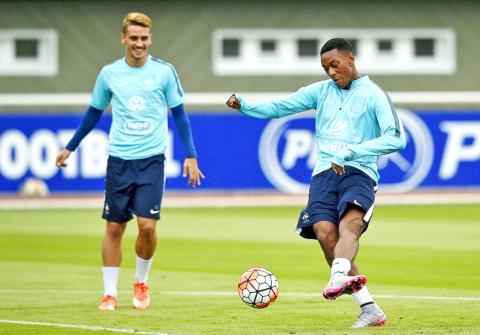
Photo: AFP
Created in 1977, the amateur club is also famous for having nurtured the likes of former Arsenal star Thierry Henry and Patrice Evra, another Frenchman who wore United’s famous red jersey.
Under FIFA rules, clubs that help to develop youngsters who are later transferred are entitled to compensation for all the training and education provided over the years. The so-called “solidarity mechanism” works between the seasons of the player’s 12th and 23rd birthdays.
Martial left Les Ulis when he was 14 to join Olympique Lyonnais’ renowned training academy, meaning that the club will receive three years of development fees — representing 0.75 percent of his transfer to United — worth an estimated £270,000.
It is manna from heaven for a team playing four divisions below the professional leagues.
“It will cover up to four or five years of our budget,” Les Ulis coach Mamadou Niakate said on Wednesday. “We are always struggling to make ends meet. This money will help us secure existing jobs and renew our equipment. At the football school, we’ve been using the same footballs and training shirts over the past four years.”
A small town of about 25,000 people that was built at the end of 1970s and then hit hard by economic recession, Les Ulis is mainly known for its soccer school and its big housing projects. After years of social tension related to poverty, the city council has launched a rehabilitation scheme aimed at diversifying the housing supply and promoting greater social cohesion.
“At the club, we also want to create social links, we try not to turn down anyone and we contribute to the mixing of populations,” Niakate said. “We try to instill a proper football culture, while insisting on school attendance at the same time.”
Niakate, who also coaches at the soccer school, said Martial’s transfer to United would bring much more money into the club’s bank account than those of Henry and Evra combined.
“Thierry was just an 11-year-old boy when he left, so we did not receive anything because the solidarity contribution does not work if the player leaves the club before his 12th birthday. He later paid for an artificial pitch for the club, though,” Niakate said. “With Evra, we received about 38,000 euros [US$43,000] in player development fees, but this is not just about the money. Our main satisfaction is that someone from Les Ulis is able to join such a prestigious club as Manchester United.”
Since the news broke of Martial’s departure to the most widely watched league in the world, the 750-member club has been coping with a plethora of new registration requests, with dozens of children flowing to the Stade Jean-Marc Salinier to sign up.
“Hopefully, there will be other great players among them,” said Niakate, who has been working at the club since 1987 and is coaching Martial’s elder brother, Dorian.
“Anthony was really above the rest,” Niakate said. “On the very first day he registered with us, I could tell he had something special, but that’s still a long way from saying he would one day join United for 80 million euros.”
While the fee United paid for Martial — who has made just 29 senior starts in his spells at Lyon and Monaco — has left many soccer fans perplexed, Niakate is adamant the comparison with Henry is not premature.
“Look at them at the same age, they are very similar. They are both powerful, share the same technical and physical qualities, and have more speed than the rest of the field — and like Thierry, Martial has the stuff of champions,” Niakate said.

Taiwan’s men’s table tennis team won bronze on Saturday at this year’s International Table Tennis Federation World Team Table Tennis Championships in London, matching the country’s best-ever finish at the regular tournament. Consisting of Lin Yun-ju, Taiwan’s top-ranked player at world No. 7, Feng Yi-hsin, Kuo Guan-hong, Hong Jing-kai and Hsu Hsien-chia, the team won bronze after losing 0-3 to Japan in the semifinals. In the opening match, 24-year-old Lin played the first game against world No. 3 Tomokazu Harimoto 11-5, but ultimately lost the next three closely contested games 9-11, 10-12 and 10-12. Feng then faced world No. 8 Sora Matsushima in

Lin Yun-ju on Thursday handed Taiwan two key victories as they advanced to the semi-finals of the ITTF World Team Table Tennis Championships Finals in London. The Taiwan men’s table tennis team beat Sweden 3-2 in five singles matches. The 24-year-old Lin, Taiwan’s top-ranked player at world No. 7 and nicknamed the “Silent Assassin,” opened the tie by defeating world No. 2 Truls Moregard 3-0 (11-8, 11-9, 13-11) before clinching the deciding fifth match with a 3-0 (11-8, 11-9, 11-5) win over Anton Kallberg to hand his team the overall victory. Kuo Guan-hong put Taiwan up 2-0 with a 3-2 (4-11, 11-8, 8-11,

Taiwanese fire dancer Yang Li-wei advanced to the final of Britain’s Got Talent this weekend after receiving a Golden Buzzer during her live semi-final performance. Yang, a member of Taiwan’s Coming True Fire Group, awed judges and audiences with a high-intensity fire performance featuring flaming umbrellas, fire swallowing and spinning metal structures balanced with her legs. Judge Simon Cowell praised Yang as a star, while guest judge KSI reacted with amazement before pressing the Golden Buzzer, sending her to the finals. The dance group wrote on social media that the Golden Buzzer was “the highest honor” on the talent show, adding: “Twenty-three years

As Super Rugby fast approaches its playoff season it finds itself racing toward a reckoning with many issues that threaten the southern hemisphere tournament. A group of stakeholders met in the New Zealand city of Christchurch late last month to address problems that are making the future of the 31-year-old competition increasingly tenuous. The discussion was made more urgent by the decision by the owners of Moana Pasifika to fold the Auckland-based club for financial reasons. That followed the closure of the Melbourne Rebels at the end of the 2024 season, likewise because of financial difficulties. Problems addressed included player retention as more


 RSS
RSS