


As a dirt-poor rookie boxer in the southern Philippines, Manny Pacquiao started his phenomenal rise to global fame not as the Pacman, as he is sometimes called, but as “Kid Kulafu.”
That moniker — the title of a new local film about Pacquiao’s childhood — was taken from the label of a cheap wine whose empty bottles he returned for recycling to earn money to help his family.
Kid Kulafu opened on Wednesday in more than 70 theaters across the Philippines starting ahead of Pacquiao’s May 2 megafight with Floyd Mayweather Jr. It will be shown in some US and Canadian theaters beginning on Friday next week.
Produced with advice and other assistance from Pacquiao, the film depicts the impoverished world he grew up in well before he became the world’s only eight-division boxing champion, one of its highest-paid athletes and the wealthiest member of the Philippine House of Representatives.
“He had every excuse in the book to fail — broken family, no food, no home, nowhere to go, no money, but he still persevered, and that’s what I want the people to see — that he is where he is today because of hard work,” filmmaker Paul Soriano said.
The 36-year-old boxer was born in a thatch-roofed house with a dirt floor in the mountains of southern Bukidnon province at a time when anti-communist militiamen were battling insurgents. One brutal clash near the Pacquiao home forced the family to move to General Santos City, into a shack owned by his uncle, Sardo Mejia.
There often was not enough food for the family; sometimes they ate boiled rice paired with fish entrails or corn on the cob. In the movie, militiamen compel Pacquiao’s mother to hand over two small fried fish she had prepared for her family.
Pacquiao’s father later abandoned the family, leaving Manny, the eldest of three brothers, to find a livelihood, like most young boys in the country’s rural areas. He sold fried peanuts, bread and doughnuts made by his mother, and earned a little money of his own by gathering and selling tiny native lemons called calamansi.
He also worked as a store assistant for Mejia, and collected sacks of empty bottles of Vino Kulafu, which he returned to the distributors to cash in the deposits. Kulafu was originally a Tarzan-like Philippine comic-book hero.
Pacquiao became drawn to boxing after he started watching Betamax tapes of world heavyweight fights with his uncle. Mejia encouraged Pacquiao to box and later trained him, though his mother hated the sport. She wanted her son to be a priest, but was too poor to enter him into a seminary. Still, she ingrained deep spirituality and religious faith in him.
Ironically, Pacquiao’s road to boxing was partially paved by his mother when she was struck by a heart attack, Soriano said.
The movie depicts the boy entering a fight to win 100 pesos (about US$2) needed to buy her medicine.
With training by his uncle and a friend’s father, Pacquiao soon became the amateur boxing derby champion in General Santos, fighting in the open-air ring in the town plaza as Kid Kulafu, a name Mejia came up with. Without telling his mother, he left General Santos to train in a dingy boxing gym in Manila.
“Kid Kulafu is really a movie about a young boy who grew up with nothing,” Soriano said. “All he really had was a dream and he fought and fought and fought until he made those dreams come true.”
“It is a fairy-tale story, but it’s true,” producer Marie Pineda said.
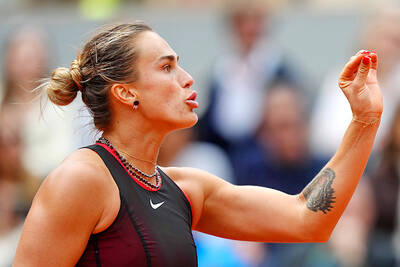
After letting another big lead slip with an error-strewn performance at the French Open on Wednesday, top-ranked Aryna Sabalenka felt like getting as far away from the courts as possible. “Just want to quit tennis right now,” Sabalenka said after wasting a lead of a set and two breaks in a 3-6, 7-5, 6-0 loss to Diana Shnaider in the women’s singles quarter-finals. “We’ll see in few days. Hopefully I’ll get back on track mentally.” Sabalenka’s wait for a first French Open title continues despite the four-time major winner leading 4-1 in the second set and being two points from victory while
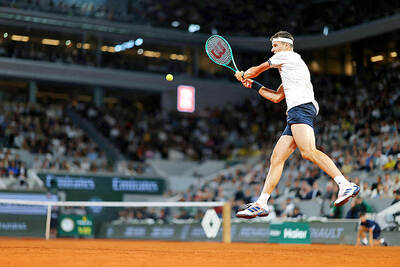
BIG NAMES GONE: Zverev is the clear favorite for a maiden Grand Slam title, reaching semi-finals for the fifth time in six years and finishing second on three occasions Alexander Zverev on Tuesday breezed past Rafael Jodar to stay on course for an elusive Grand Slam title at the French Open, while Jakub Mensik halted Joao Fonseca’s scintillating run in the quarter-finals. Zverev, the highest-ranked player left in the men’s draw, put an end to Spanish teenager Jodar’s impressive Roland Garros debut, easing into the semi-finals with a 7-6, (7/3), 6-1, 6-3 win. The 29-year-old Zverev is the clear favorite for a maiden Grand Slam title. He has finished runner-up on three occasions, including at the 2024 French Open. “I want to win the matches that are ahead of

For some, Cristiano Ronaldo remains the essential spearhead for Portugal’s FIFA World Cup bid, while others believe his presence would prevent Roberto Martinez’s strong side from flourishing. The debate around the five-time Ballon d’Or winner rages on, as it did at UEFA Euro 2024 and four years ago in Qatar — yet Ronaldo endures, ready to play in a record sixth World Cup. The 41-year-old remains a global superstar despite swapping the European elite for Saudi Arabia’s Al-Nassr, and is the leading men’s international goalscorer with 143 strikes. With 25 of those coming in 30 games under Martinez, the coach

Taiwanese sprinter Chen Yi-cen on Friday won the silver medal in the women’s 400m final at the Asian U20 Athletics Championships in Hong Kong, with a time of 53.16 seconds. Chen, 15, was the youngest among the eight finalists, and her performance also met the qualifying standard of 53.50 seconds for the Nagoya Asian Games in Japan in September and October. Chen first made her mark at the National Games in Tainan in 2023, at the age of 13, winning the women’s 400m final in 55.55 seconds to become the youngest gold medalist in the history of the event. Meanwhile,


 RSS
RSS