


The bumpy fairways and patchy putting surfaces — more burned-out browns than grassy greens — are not much to look at. In Iran however, this is golf at its finest.
In the same way that the streets of Tehran got new names when the Islamic republic dramatically came into being in 1979, so did the Engelhab (“Revolution” in Farsi) Club.
Iran’s only recognized golf course has had a fairly rough time since. Somewhat starved of attention, and perhaps a greenkeeper, it lost five of its original 18 holes under an army land order — players now play five holes twice to make up the numbers.
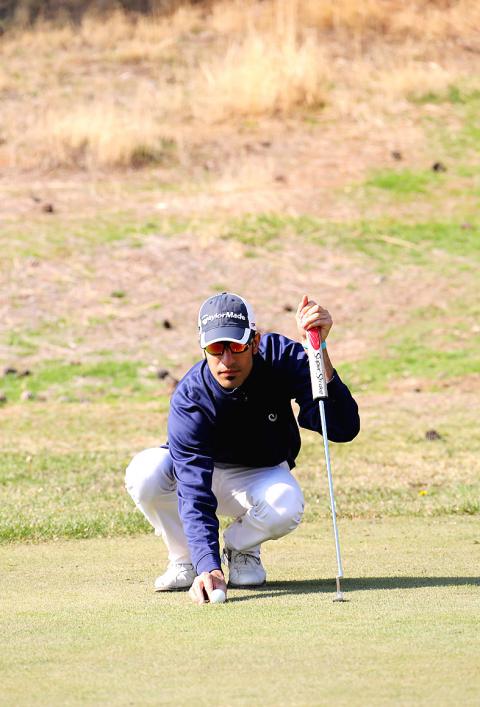
Photo: AFP
However, somehow, the course has kept going despite few regular players. Some grumble and others joke at its unorthodox, 13-hole layout.
“It’s pretty terrible, but it’s all we have,” said Mehrdad, a 40-year-old businessman who splits his time between Iran, Canada and Germany.
He tries to play at least fortnightly with his friends, but other than on the Persian weekend (Thursday and Friday) the club is deserted, he said, remarking that few Iranians know what golf is.
Kaykavos Saeedi is a 53-year-old civil servant tasked with waking Iranians up to the game’s potential.
“Golf can be for everyone, but we are something of a poor relation,” said Saeedi, president of the Islamic Republic of Iran Golf Federation.
Iran’s international sporting success is in wrestling, soccer, volleyball and basketball. As such, golf is considered a tough sell.
Saeedi admits he is no great shakes as a player, but for 15 minutes he talks passionately about what his wish list would include.
More courses, more driving ranges, more education and publicity about the game in schools and then — and only then — could more players ultimately be accommodated.
Only 3,500 people, about 500 of them women, from a population of 78 million, pick up a club, so there would be little point in a sudden uptick in numbers unless more facilities are built, Saeedi said.
The paucity of the sport is reflected in the federation’s annual budget of US$200,000 and the game in Iran has a history that probably does not lend itself to expansion.
It arrived with the British early in the 20th century — when their oil executives were not busy trying to take control of Iran’s southern fields they liked to tee it up.
This elitism was magnified by Iran’s former royal rulers. The last shah, Mohammad Reza Pahlavi, played golf and built the Tehran course in the grounds of what was then the Imperial Country Club.
Beyond the solitary grass course, there are four sand courses across Iran.
As to talent there are few shining hopes for Iranian glory, but Hassan Karimian is the country’s best.
A scratch player and captain of the national side, the 38-year-old has played in Asian Championships.
“When we go ... to international events, I’ve been asked: ‘Do you have any courses in Iran?’” he said. “They’re surprised when told we’ve only one standard grass course, which is not a very good one.”

Taiwan’s men’s table tennis team won bronze on Saturday at this year’s International Table Tennis Federation World Team Table Tennis Championships in London, matching the country’s best-ever finish at the regular tournament. Consisting of Lin Yun-ju, Taiwan’s top-ranked player at world No. 7, Feng Yi-hsin, Kuo Guan-hong, Hong Jing-kai and Hsu Hsien-chia, the team won bronze after losing 0-3 to Japan in the semifinals. In the opening match, 24-year-old Lin played the first game against world No. 3 Tomokazu Harimoto 11-5, but ultimately lost the next three closely contested games 9-11, 10-12 and 10-12. Feng then faced world No. 8 Sora Matsushima in

Lin Yun-ju on Thursday handed Taiwan two key victories as they advanced to the semi-finals of the ITTF World Team Table Tennis Championships Finals in London. The Taiwan men’s table tennis team beat Sweden 3-2 in five singles matches. The 24-year-old Lin, Taiwan’s top-ranked player at world No. 7 and nicknamed the “Silent Assassin,” opened the tie by defeating world No. 2 Truls Moregard 3-0 (11-8, 11-9, 13-11) before clinching the deciding fifth match with a 3-0 (11-8, 11-9, 11-5) win over Anton Kallberg to hand his team the overall victory. Kuo Guan-hong put Taiwan up 2-0 with a 3-2 (4-11, 11-8, 8-11,
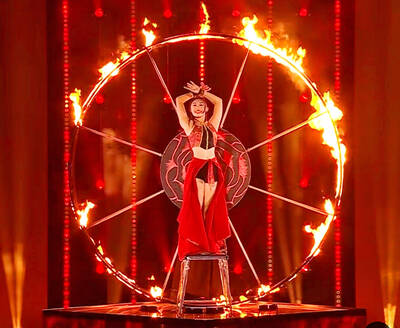
Taiwanese fire dancer Yang Li-wei advanced to the final of Britain’s Got Talent this weekend after receiving a Golden Buzzer during her live semi-final performance. Yang, a member of Taiwan’s Coming True Fire Group, awed judges and audiences with a high-intensity fire performance featuring flaming umbrellas, fire swallowing and spinning metal structures balanced with her legs. Judge Simon Cowell praised Yang as a star, while guest judge KSI reacted with amazement before pressing the Golden Buzzer, sending her to the finals. The dance group wrote on social media that the Golden Buzzer was “the highest honor” on the talent show, adding: “Twenty-three years

As Super Rugby fast approaches its playoff season it finds itself racing toward a reckoning with many issues that threaten the southern hemisphere tournament. A group of stakeholders met in the New Zealand city of Christchurch late last month to address problems that are making the future of the 31-year-old competition increasingly tenuous. The discussion was made more urgent by the decision by the owners of Moana Pasifika to fold the Auckland-based club for financial reasons. That followed the closure of the Melbourne Rebels at the end of the 2024 season, likewise because of financial difficulties. Problems addressed included player retention as more


 RSS
RSS