


Denver defensive end DeMarcus Ware considers himself a mixed martial artist on the football field.
Ever since his rookie year in 2005, he has spent as much time in the off-season working on his handwork with a second-generation Bruce Lee student as he has working out at a traditional gym.
Ware is part of a growing number of NFL pass rushers who have adopted the grappling and striking techniques of MMA. It helps them outmaneuver the ever-expanding 150kg tackles and get to the ever-quicker quarterbacks before they can throw the football.
Ware credits the moves he has learned and refined under the tutelage of Valentin Espiricueta, owner/operator of AppliedMMA in Dallas, for helping him amass 127 sacks over his decade in the NFL.
“If I didn’t learn martial arts, I’d be just a basic dip-and-rip guy just trying to go around the corner,” Ware said.
Instead, Espiricueta’s star pupil and eight-time Pro Bowler uses swift swipes and whirlwind motions to set up and ultimately vanquish pass protectors, like a fighter getting the best of his opponent in the octagon.
Sparring or grappling with technical fighters and their trainers teaches NFL players to swat away and otherwise avoid punches from O-linemen. It also aids their cardiovascular training, tenacity and acumen.
“What we’re doing, at least in the grappling aspect of our sport, is we’re manipulating another man’s body, putting it where we want it, whether that’s putting it on the ground or moving it to the left or right or off-balance,” said Matt “The Immortal” Brown, a 33-year-old welterweight UFC fighter from Columbus, Ohio. “So, to learn how to control another man’s body is surely going to be an important skill for them. Anytime it’s one-on-one, man against man, there’s going to be some correlation.”
Packers pass rusher Datone Jones said MMA training helps his “hand-eye coordination, balance, body control and just being able to strike, being able to endure more.”
The ancillary benefit, he said, is greater flexibility, “so it’s working on more areas so you get stronger, flexible, faster, looser.”
Vikings pass rusher Brian Robison said mastering MMA techniques and transferring them to the football field “allow you to rush the passer a little bit easier.”
Ware was introduced to the martial arts aspect of pass rushing by Greg Ellis, a defensive end in the NFL from 1998 to 2009. Ellis learned of Espiricueta’s training methods from Randy White, who played for the Cowboys from 1975 to 1988.
“Greg Ellis told me: ‘You’re not going to have this speed forever, but you can have the quickness.’ So, one thing I learned when I did have a lot of ability, like Von Miller, was I would actually just beat guys from here,” Ware said, tapping his right temple, “instead of beating them just with athleticism.”
Espiricueta combined the Philippine martial art known as kali with the Bruce Lee style of kungfu known as jeet kune do (JKD). Practitioners of JKD believe in smooth, minimal movements and with maximum effects and extreme speed.
Espiricueta, who studied under Lee’s student Dan Inosanto, has worked with numerous NFL players, but said Ware “took it to a different level.”
He developed a training program customized for football players in response to a rule change in 1978 that allowed offensive linemen to open their hands and leave their arms extended rather than use hit-and-recoil techniques like boxers.
“It was all about the hands and how to get their hands off you,” he said.
That rule change led to a transformation in the trenches as O-linemen ballooned past 136kg, overpowering defenders by sheer size. Nowadays, they are typically 150kg and outweigh most defensive ends by 34kg and linebackers by 45kg.
So defenders either have to be fast enough to get around them or quick enough to swat away their hands when they punch.
A dip-and-rip or jab step just does not always do the trick anymore, but with martial arts techniques, “you figure out what’s the best leverage point and he can be 350 pounds [150kg] and it doesn’t matter, you’re going to beat him,” Ware said.
“The tackles now, they’re so big and they’re pretty quick,” Ware said. “And they use their hands to set you up or they use their arms for leverage because usually their arms are longer than a pass rusher’s. So, you have to figure out how to defend yourself from that, and with mixed martial arts, you sort of figure out how to set guys up and use certain moves so you dictate what they’re going to do. If you do it so many times, eventually, you figure out the timing of when they’re going to punch — because eventually they have to punch.”
And when they do, that is when Ware will use his martial arts, maybe with something Espiricueta came up with called the “side scissor.”
The pass rusher uses both hands to swipe away the punch to his chest and throw the tackle off-balance.
“It’s like a chess match. You’ve got to be patient,” Ware said. “Because if you beat him just three times and have three sacks in that game, you had a monster game.”
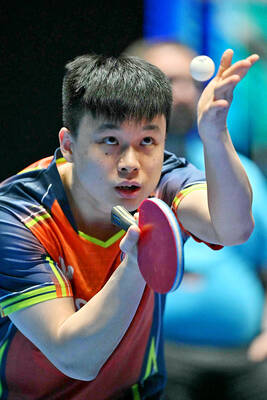
Taiwan’s men’s table tennis team won bronze on Saturday at this year’s International Table Tennis Federation World Team Table Tennis Championships in London, matching the country’s best-ever finish at the regular tournament. Consisting of Lin Yun-ju, Taiwan’s top-ranked player at world No. 7, Feng Yi-hsin, Kuo Guan-hong, Hong Jing-kai and Hsu Hsien-chia, the team won bronze after losing 0-3 to Japan in the semifinals. In the opening match, 24-year-old Lin played the first game against world No. 3 Tomokazu Harimoto 11-5, but ultimately lost the next three closely contested games 9-11, 10-12 and 10-12. Feng then faced world No. 8 Sora Matsushima in
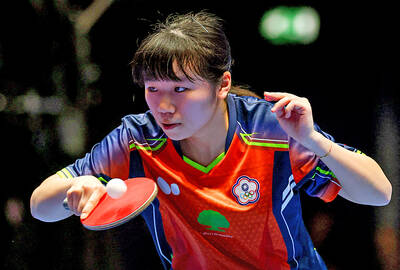
Lin Yun-ju on Thursday handed Taiwan two key victories as they advanced to the semi-finals of the ITTF World Team Table Tennis Championships Finals in London. The Taiwan men’s table tennis team beat Sweden 3-2 in five singles matches. The 24-year-old Lin, Taiwan’s top-ranked player at world No. 7 and nicknamed the “Silent Assassin,” opened the tie by defeating world No. 2 Truls Moregard 3-0 (11-8, 11-9, 13-11) before clinching the deciding fifth match with a 3-0 (11-8, 11-9, 11-5) win over Anton Kallberg to hand his team the overall victory. Kuo Guan-hong put Taiwan up 2-0 with a 3-2 (4-11, 11-8, 8-11,
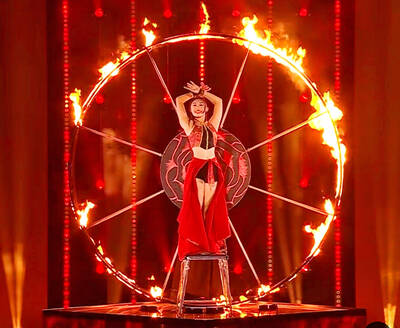
Taiwanese fire dancer Yang Li-wei advanced to the final of Britain’s Got Talent this weekend after receiving a Golden Buzzer during her live semi-final performance. Yang, a member of Taiwan’s Coming True Fire Group, awed judges and audiences with a high-intensity fire performance featuring flaming umbrellas, fire swallowing and spinning metal structures balanced with her legs. Judge Simon Cowell praised Yang as a star, while guest judge KSI reacted with amazement before pressing the Golden Buzzer, sending her to the finals. The dance group wrote on social media that the Golden Buzzer was “the highest honor” on the talent show, adding: “Twenty-three years

As Super Rugby fast approaches its playoff season it finds itself racing toward a reckoning with many issues that threaten the southern hemisphere tournament. A group of stakeholders met in the New Zealand city of Christchurch late last month to address problems that are making the future of the 31-year-old competition increasingly tenuous. The discussion was made more urgent by the decision by the owners of Moana Pasifika to fold the Auckland-based club for financial reasons. That followed the closure of the Melbourne Rebels at the end of the 2024 season, likewise because of financial difficulties. Problems addressed included player retention as more


 RSS
RSS