


Late on a Saturday morning on Taipei’s Bailing rugby fields, by the banks of the Keelung River in Shilin District, alongside games of rugby union and touch, a group of men and women play a strange sport with a round ball.
Strange that is, unless you are Irish — or one of the more than 600 players involved in Gaelic football around Asia.
The appeal of Gaelic football, Ireland’s national sport, is growing outside the Emerald Isle, including here in Taiwan.
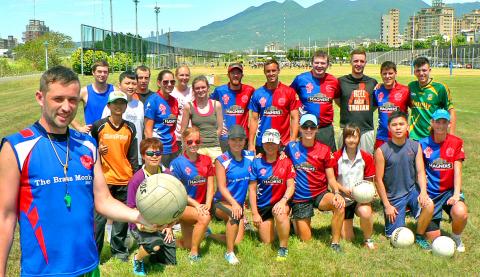
Photo: Grant Dexter, Taipei Times
“The Taiwan Celts Gaelic Football Club was founded in 1996, when a group of young Irish college graduates found themselves landed in the hustle and bustle of Taipei,” former club president Barry Cahill said. “They met every weekend to train and play games, and the number soon grew as people from many different countries came along, taking up the rather surprising opportunity to play a Gaelic sport in Asia.”
Eighteen years later, the sport continues to draw a mixed crowd — men and women, local and foreign.
In fact, the Irish are now somewhat of a minority, as the group extends to expats from the US, Canada, Australia, New Zealand, South Africa, Brazil, the UK, Hungary, Latvia, India and Japan, as well as a solid contingent of Taiwanese.
“It is amazing to see so many nations represented,” club coach Brian Fitzpatrick said. “Gaelic football combines skills from soccer, rugby, Australian Rules football and basketball, and I think it appeals to anyone who has played any of those sports.”
It is not soccer, as, while there is kicking involved, the players also carry the ball in their hands.
It is not basketball or netball, as it is a field sport and there are no hoops, only rugby-style goalposts — though it is not rugby of any form either.
It is perhaps most similar to Australian Rules football — another little-known sport outside its home nation — with the object of the game to move the ball toward the goal by running, handpassing and kicking.
In Gaelic football, kicking or handpassing the ball over the crossbar of the goalposts scores the team one point.
Kicking the ball underneath the crossbar, past a goalkeeper into a soccer-style net, scores the team three points.
“It is a field game where players are required to be skilled kickers, catchers and ball handlers, and there is a lot of running — so good fitness is also key,” Fitzpatrick said.
Gaelic football is also unique in that it is one of the few team sports around the world that has kept its amateur status — even at the highest level.
While the Gaelic Athletic Association (GAA), the organizing body of the sport in Ireland and around the world, is a highly commercial enterprise, the players in the national league receive at most a small stipend — enough to cover their costs.
That means players play for their home counties for little reason other than passion — there is no financial incentive to play for other counties — and they usually have a “day job” to support themselves and their families.
“It is at the heart of our community back home,” said Fitzpatrick, a native of County Clare, now teaching English in Taipei. “It is a spirited game where you rely heavily on your teammates... You form a great camaraderie with teammates on and off the pitch.”
Former women’s team member and club social officer Lee Yi-Hsuan, from Taipei, said most players become involved in the club through word-of-mouth.
“I joined Gaelic football because of a friend who I play touch rugby with. I like it because it’s a competitive game and a good workout,” she said. “Also there is a very good family feeling. We share life experiences together, not only playing Gaelic — on and off the field.”
While there are not enough players in Taipei for a regular local competition, the group trains once a week in preparation for an Asia-wide competition held in October each year — the Asian Gaelic Games — a tournament that was the brainchild of the Celts founding members 18 years ago.
“With strong Irish communities in Japan, Hong Kong and Singapore, we thought: Why not have an Asian Gaelic Games tournament? We saw this as a fantastic opportunity to get all the Irish in Asia together for a weekend of football and craic,” Cahill said. “After Trojan work by founding members, the first Asian finals were held in Manila in 1996.”
This year’s tournament is to be held in Kuala Lumpur this weekend, and the Celts, who last won the tournament in 2011, have a men’s and a women’s side participating, Fitzpatrick said.
“We have been training since April and we are confident of being successful in both competitions,” he said.
Cahill said teams compete for the Derek Brady Cup, named in honor of one of the Celts’ key founding members.
“This beautiful piece of Cavan Crystal was specially commissioned by the Brady family as a way of supporting a competition set up by their youngest son, who tragically died in an accident in Taipei,” he said. “Derek was one of the founding members of the event and a leading light as a player for the Taiwan senior side.”
“Liked by all, Derek was one of those who could inspire others to achieve their best and will be forever associated in Asia with football of an Irish flavor,” Cahill said.
To find out more about the Celts, search for “Taiwan Celts GAA” on Facebook.

Memphis Grizzlies forward Brandon Clarke, 29, has died, the NBA team said in a statement on Tuesday, while the family of Jason Collins, the first openly gay man to play in a major US pro sports league, announced the former Grizzlies and Brooklyn Nets player had died after a battle with brain cancer. “We are heartbroken by the tragic loss of Brandon Clarke,” the Grizzlies said in a statement posted on social media. “Brandon was an outstanding teammate and an even better person whose impact on the organization and the greater Memphis community will not be forgotten.” The statement did not provide
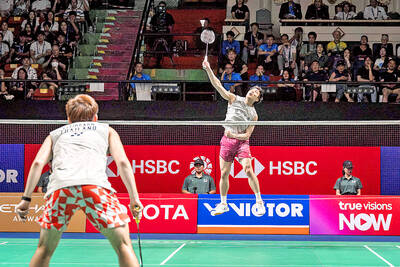
Taiwan’s top male badminton player, Chou Tien-chen, on Saturday bowed out in the men’s singles semi-finals at the Thailand Open after losing in straight games to Thailand’s Kunlavut Vitidsarn. The world No. 6 Chou, seeded fourth at the Super 500 tournament, lost to the world No. 2 Thai 21-7, 21-19 in 53 minutes. The victory improved Vitidsarn’s head-to-head record against Chou to 3-5. Chou, 36, trailed throughout the opening game after the score was tied 2-2. His relatively passive approach allowed the 25-year-old Thai to capitalize on Chou’s defensive clears with powerful smashes while committing few unforced errors. The Taiwanese

FRUSTRATION: Gauff smacked herself on the head with her racket before storming down the tunnel, emerging afterward to have a heated discussion with her coach Elina Svitolina on Saturday won the Italian Open after beating Coco Gauff 6-4, 6-7 (3/7), 6-2 to claim her third Rome title, while Jannik Sinner set a date with Casper Ruud in the men’s final. Ukraine’s Svitolina had not claimed a WTA 1000 title since her last victory at the Foro Italico eight years ago, but prevailed over the ever-erratic Gauff to claim her 20th tournament triumph. Saturday’s win over Gauff was her third in a row against a player in the top four of the world rankings — including Iga Swiatek and Elena Rybakina — ahead of the French

West Ham United’s 3-1 defeat at Newcastle United on Sunday left Tottenham Hotspur realistically only needing one more point to win the battle for English Premier League survival, while Bruno Fernandes made history in Manchester United’s 3-2 win over Nottingham Forest. Spurs can avoid dropping out of the English top flight for the first time in nearly 50 years with victory at Chelsea today, but a draw would also likely suffice thanks to their much superior goal-difference over West Ham. “Overall bad performance. Too many things [went wrong], I think we gifted them the goals,” West Ham head caoch Nuno Espirito Santo


 RSS
RSS