


Asian competitors are becoming increasingly desperate over African-born athletes running for wealthy Gulf states who have dominated the Asian Games track golds for the third contest in a row.
“I think it’s unfair because they are taller and have a longer stride,” men’s 100m silver medalist Su Bingtian said. “They are more powerful and athletic. Physically, we are at a disadvantage.”
Su lost to Qatar’s Femi Ogunode, born in Nigeria, who smashed Asia’s men’s 100m record on Sunday with a 9.93 second time.
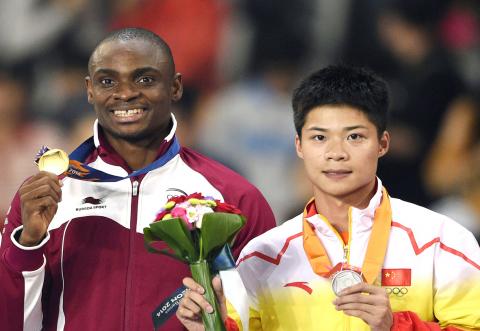
Photo: AFP
Japanese and South Korean sprinters added their voice to the protests, while Asian sport leaders appear divided over the foreign influx.
Competitors originally from Africa have swept to five gold medals in seven races in the first two days of the Asian Games athletics, blowing away their native Asian competitors.
Foreign imports, mainly representing Bahrain and Qatar, have continued a dominance in track events which stretches back to the 2006 Doha Games, when Kenya-born runners won the men’s 800m, 1500m, 5,000m, 10,000m, 3000m steeplechase and marathon.
At the 2010 Guangzhou Games, Bahrain and Qatar’s African runners again completely dominated the men’s long-distance track events, taking all six medals in the 5,000m and 10,000m.
In Incheon, Bahrain’s Nigerian import Oluwakemi Adekoya won the women’s 400m just months after switching country, to add to Kenyan-born teenager Ruth Jebet’s gold for the kingdom in the 3,000m steeplechase.
Meanwhile, Alia Saeed Mohammed — originally from Ethiopia — stood draped in the flag of her adopted United Arab Emirates after winning the 10,000m.
It has been the same story in the men’s competition.
The men’s 5,000m saw Moroccan-born Mohamad al-Garni taking gold ahead of Bahrain’s Alemu Bekele Gebre, who switched allegiance from Ethiopia, and Albert Kibichii Rop, formerly Kenyan.
Ogunode, who scored a golden 200m-400m double in Guangzhou, left Su (10.10 seconds) and Japan’s Kei Takase (10.15 seconds) trailing in his wake in the 100m.
No native Asian has ever run below 10 seconds.
The Japanese sprinter conceded that Asians could be “left behind” as the bar set by African runners at Asia’s Olympics gets “higher and higher.”
South Korean Kim Kuk-young suggested that the foreign influx would lead Asian runners to lose hope.
“My time isn’t really competitive against the African athletes,” he said.
The ranks of the world’s top long and middle distance runners have long been stuffed with Kenyans, Ethiopians and Moroccans, and competition to get into their national teams is fierce.
This has led to many budding young athletes turning to the opportunities, income and facilities offered by the likes of Qatar and Bahrain.
South Korea’s Kim Yong-gu, who narrowly missed out on qualifying for the men’s 1,500m final, said the difference between himself and runners from Africa was plain to see.
“I felt during my race that there was a gap between them and the Asian competitors. They seem to have a greater capacity to run,” he said.
Kim added that he hoped the Asian Games would get back to “what it was like 10 years ago,” before the switching of allegiance became commonplace.
Olympic Council of Asia official honorary vice president Wei Jizhongo echoed the sentiment, saying countries should “work together to decrease” the number of imported medal winners.
“If they buy some athletes, they stop the training of their athletes. This is not beneficial for their country’s sports,” Wei told reporters.
However, some Asian runners said the imports could help drive up standards.
“We believe the inclusion of more and more African athletes is better for us,” said Ding Changqin, silver medalist to Mohammed in the 10,000m. “It makes us more powerful and we believe it will make us try harder and achieve better results.”
The African-born athletes were unequivocal — switching allegiance gives them the best opportunity to compete at the highest level.
“It’s hard to make the team in Kenya. Everyone is very strong,” Rop said. “I sought a way [to get on].”


After letting another big lead slip with an error-strewn performance at the French Open on Wednesday, top-ranked Aryna Sabalenka felt like getting as far away from the courts as possible. “Just want to quit tennis right now,” Sabalenka said after wasting a lead of a set and two breaks in a 3-6, 7-5, 6-0 loss to Diana Shnaider in the women’s singles quarter-finals. “We’ll see in few days. Hopefully I’ll get back on track mentally.” Sabalenka’s wait for a first French Open title continues despite the four-time major winner leading 4-1 in the second set and being two points from victory while

BIG NAMES GONE: Zverev is the clear favorite for a maiden Grand Slam title, reaching semi-finals for the fifth time in six years and finishing second on three occasions Alexander Zverev on Tuesday breezed past Rafael Jodar to stay on course for an elusive Grand Slam title at the French Open, while Jakub Mensik halted Joao Fonseca’s scintillating run in the quarter-finals. Zverev, the highest-ranked player left in the men’s draw, put an end to Spanish teenager Jodar’s impressive Roland Garros debut, easing into the semi-finals with a 7-6, (7/3), 6-1, 6-3 win. The 29-year-old Zverev is the clear favorite for a maiden Grand Slam title. He has finished runner-up on three occasions, including at the 2024 French Open. “I want to win the matches that are ahead of

Liverpool are in advanced talks with former AFC Bournemouth manager Andoni Iraola as they seek a replacement for Arne Slot, reports said on Tuesday. Iraola has emerged as Liverpool’s top target to replace Slot, who was sacked on Saturday last week after a turbulent second season in charge. Liverpool have reportedly agreed a deal in principle to bring the Spaniard, who left Bournemouth at the end of this season, to Anfield. Sporting director Richard Hughes was heavily involved in hiring Iraola during his time at Bournemouth and is again spearheading the recruitment of the highly rated coach. The Reds are

US President Donald Trump said he would attend Game 3 of the NBA Finals on Monday at Madison Square Garden, but said he does not have much sympathy for ordinary basketball fans who cannot afford sky-high ticket prices to do the same. “They can watch it on television,” Trump said aboard Air Force One on Friday as he flew to Wisconsin for an event with farmers, after he was asked about tickets that have climbed as high as US$8,000 each when the New York Knicks and San Antonio Spurs square off in Manhattan for the first time in the series. “It’s sorta


 RSS
RSS