


After a traumatic summer of war and death, Israeli and Palestinian children squared off on Monday for games of soccer, just kilometres away from the devastated Gaza Strip.
About 80 boys aged between six and 16 met for the tournament at the playing fields of the Dorot kibbutz in southern Israel, which had been struck by rockets from Gaza during the 50-day war.
The Israeli children came from villages surrounding the besieged Palestinian enclave, while the Palestinians were bused in from Yatta in the southern West Bank.
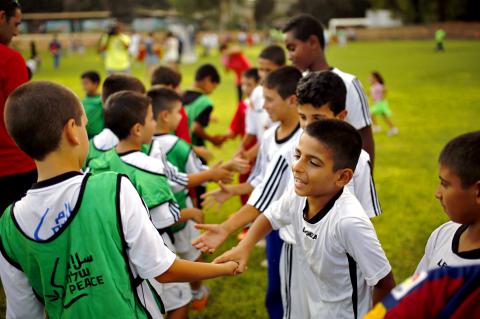
Photo: Reuters
The tournament was part of an initiative launched 12 years ago and aimed at bringing together Palestinians from Israeli-annexed east Jerusalem and disaffected Israeli youths.
Many of the boys had played together before at other such gatherings organized by the Peres Center for Peace, which is run by former Israeli president Shimon Peres.
Monday’s soccer came nearly a week after a ceasefire ended the Gaza war, and allowed Israeli children to return to their homes.
Initial apprehension was obvious on both sides, but the young players’ enthusiasm for the game soon took over.
The war in Gaza killed more than 2,140 Palestinians — one-quarter of them children — and 71 on the Israeli side, mostly soldiers, but also a four-year-old boy.
“It’s great to come back here after weeks stuck at home during the war, and to have some fun,” said 11-year-old Ofir from Sderot in southern Israel, one of the towns most hit by Gaza rocket fire.
“The Arab kids aren’t mean, and there are some who want peace like me,” the curly-haired blond boy said.
Eleven-year-old Qusay agreed.
“I like it when we play together. I hope one day there will be peace between Jews and Arabs, and no more war or death,” he said.
The Palestinian children had traveled for three hours by bus, and were stopped by an Israeli army checkpoint and searched by soldiers. For some, it was their first such experience.
However, any feelings of animosity they may have had toward their Israeli hosts appeared to evaporate as they put on their soccer shoes and ran out on to the pitch.
Peres, who stepped down as Israel’s ninth president in July, made a rare public appearance to help start the day and support the event.
“You won’t be playing against each other, but with each other,” the 90-year-old Nobel Laureate told the boys, holding a soccer ball. “You’re the generation of tomorrow. Show us how to play together, how to live together, because you are children of peace — the children who chose sport over violence.”
Meir Azram, one of the coordinators of the project, said the soccer initiative aims to help children learn to live together by playing together.
“In 12 years, we’ve seen war and tension, but we know how to deal with that,” Azram said.
“The adult trainers from both sides sit down together and say what they’ve lived through, then it’s down to the kids to bond” through sport, Azram said.
Since its inception in east Jerusalem, the project has been extended to include children from 15 schools on both sides of Israel’s vast separation barrier that cuts off the West Bank.
Monday’s tournament followed some of the worst violence in a decade.
As Israeli missiles rained down on Gaza for 50 days and Palestinian rockets soared back over the border, the army carried out many arrests and clashed in violent stand-offs with West Bank Palestinians protesting against the operation.
However, on the pitch on Monday, Israeli and Palestinian teammates overcame the Arabic-Hebrew language barrier by signalling to each other and just playing the beautiful game.

NO HARD FEELINGS: Taiwan’s Lin Hsiang-ti and Indonesia’s Dhinda Amartya Pratiwi embraced after fighting to a tense and rare 30-29 final game in their Uber Cup match The Taiwanese men’s team on Wednesday fought back from the brink of elimination to defeat Denmark in Group C and advance to the quarter-finals of the Thomas Cup, while the women’s team were to face South Korea after press time last night in the Uber Cup quarter-finals in Horsens, Denmark. In the first match, Taiwan’s top shuttler Chou Tien-chen faced a familiar opponent in world No. 3 Anders Antonsen. It was their 16th head-to-head matchup, with the Dane taking his fourth victory in a row against former world No. 2 Chou, winning 21-14, 13-21, 21-15 in 1 hour, 22 minutes. The

Jannik Sinner continued his quest to become the first man in history to win five Masters 1000 tournaments in a row with a 6-2, 6-3 victory over Danish qualifier Elmer Moller at the Madrid Open on Sunday. The world leader extended his winning streak to 19 matches, a run that began early March in Indian Wells, and he has captured 24 consecutive victories at the Masters 1000 level, dating back to the Paris Masters last October. Searching for a maiden title at this level on clay, Sinner advanced to the round of 16 at the Caja Magica with a 77-minute performance against

When Paddy Dwyer arrived in China in 1976, crowds jostled to catch a glimpse of him and his companions — the first Western soccer team to play in the country. China was emerging from the chaos of the Cultural Revolution, and on the brink of market reforms that would take the country from economic stagnation to explosive growth. “All we could see was lines of people running beside our bus, trying to look in the windows, to see their first visual of a white person,” he said. “It was all bicycles,” he said. “There were very few cars to be seen.” Dwyer,
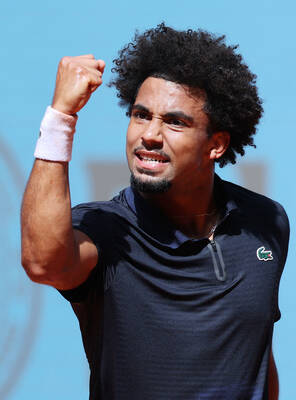
Tennis players are facing an unexpected opponent at the Madrid Open. A stomach virus or food poisoning has affected Iga Swiatek, Coco Gauff, Marin Cilic and others, raising concerns. World No. 1 Aryna Sabalenka avoided an upset by Naomi Osaka on the court on Monday and said she is trying to avoid illness by sticking to a diet of chicken breasts, rice and salad. The rumor among the players was bad shrimp tacos were to blame. Sabalenka knocked on wood for luck and said, “So far, so good. I heard that I have to avoid those tacos,” she laughed, adding “I stick to the


 RSS
RSS