


The moment play breaks down, the counterattack begins, the players sweeping forward at a dizzying pace. The ball is fizzed out to the left, but the resulting shot thumps into the wall behind the goal. Brazil’s next generation are honing their skills.
Despite the warm winter weather in the city of Recife on Brazil’s northeastern coast, these young players are not outdoors playing in the sunshine with their friends. Instead, they are indoors playing futsal.
Played with a goalkeeper and four outfield players on tight pitches bordered by lines, this version of soccer has yet to really make a breakthrough in Europe, but it has long been an essential element of Brazil’s soccer success.
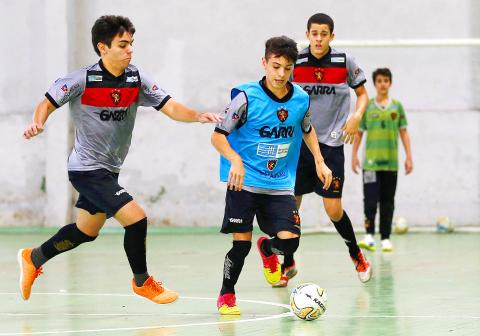
Photo: Reuters
That fact was evident in Brazil’s opening game of this World Cup, when Oscar’s lightning toe-poked finish bounced past the despairing dive of Croatia goalkeeper Stipe Pletikosa to put Brail 3-1 ahead.
“It was like something you might do in futsal,” the midfielder told reporters. “A lot of the squad started out playing futsal. When you get the chance, you shoot.”
There is no shortage of powerful shooting at Sport Club do Recife, where the club’s under-16 side is getting ready to defend the national title it won last year at under-15 level.
However, there is also plenty of dribbling and fast, accurate passing as they seek to work the ball forward and create an opening. Many of the players, drenched in sweat from their early-morning exertions, dream of one day emulating Oscar and playing for Brazil.
“Brazilian players with a more refined touch have played futsal initially, like Neymar,” said Gabriel Maia, a tall teenager with a silky touch and explosive pace.
Maia finds his futsal skills to be a great help when he plays the 11-a-side game more familiar to World Cup watchers, and plays futsal with the team as a way of expanding and completing his education.
QUICK THINKING
“Futsal requires very quick thinking from the player, so he learns at a young age,” he says. “When you go to the regular pitch, even with a very high tempo, he has a good pass, good control, so it helps with strategy of the game.”
Amid the squeak of sneakers on the floor where his team are playing, Maia’s teammate Guilherme Henrique explains the difference between futsal and regular soccer.
“The ball in futsal is smaller and heavier than a regular football. When controlling the ball, because it’s done on a flat surface with more friction, we tend to step on the ball, while in regular football we control the ball with the side of the foot,” he said. “So in futsal, you can have more stability with the ball, you can roll the ball and make faster moves with it.”
The practice game bears out his claim, as players kill the ball with the sole of the foot before quickly turning and accelerating away.
Short chipped passes that would run out of play on grass outdoors drop dead on the floor and stay in, thanks to the weight of the ball.
The two teenagers would love careers as professional soccer players with big clubs in Europe, but they are aware that the popularity of futsal, in which Brazil has won five FIFA World Cups, means that they can make a living there too.
“It depends where you play. In the south or southeast of Brazil, you’re more valuable because that’s where the futsal league is,” says Maia, who is in awe of the game’s top earner, Alessandro Rosa Vieira, better known as Falcao, the “King of Futsal.”
The 37-year-old spent a brief spell in Brazilian soccer at Sao Paulo before returning to futsal, where his stunning array of flicks, tricks and dribbles have seen him showered with awards and titles.
VIABLE ALTERNATIVE
His success, and the high profile of the game in Brazil, means that a futsal career is a viable alternative for the two teenagers and their teammates.
“The majority of athletes prefer regular football,” Maia says. “We stay here to learn the way of thinking and all that, but even me, I prefer regular football. But in futsal, I know the doors are open, so I can kind of choose.”
Though the sport is growing in Europe, with Spain, Italy and Russia among the top international sides, it still has a long way to go before it will see the benefits in the way that Brazil already has.
Asked if European players could learn from playing the game, Maia is adamant.
“They could,” Maia says. “This could be a good way to improve football and open the doors to futsal, because futsal is more popular in Brazil. In the rest of the world, it’s not as much.”
His teammate Henrique believes that Europeans may not yet have the individual skills taught to Brazilians by futsal, but they are finally learning the tactical lessons of the game, although not necessarily by playing it.
“Lately, football in Spain, England, Germany, in Europe in general, has started to work with the lines on the field closer together,” he says, displaying a tactical acumen beyond his years. “The idea of that is to reduce the space the opponent has to play in. That’s the basic work of futsal.”
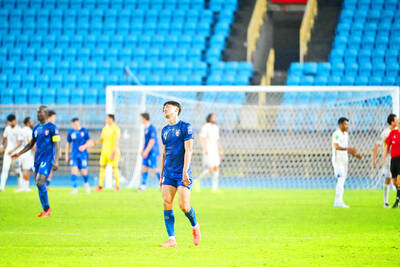
Yu Yao-hsing on Tuesday nabbed Taiwan’s only goal in the final round of qualifiers for the 2027 AFC Asian Cup, as they fell 3-1 to Sri Lanka at Taipei Municipal Stadium. Early goals from Sri Lanka in the first half left Taiwan struggling to get on the board, and Christopher Tiao’s own goal at 53 minutes sealed the team’s fate in the third round of qualifiers. While acknowledging that the defeat, Taiwan’s sixth in Group D, was disappointing, head coach Matt Ross said he saw reasons to stay positive about the team’s development. “There were lots of positive signs in terms of the
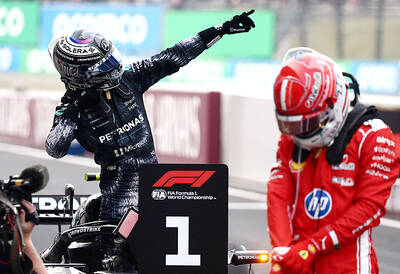
Mercedes’ Kimi Antonelli yesterday vowed to “keep raising the bar” after winning the Japanese Grand Prix to become the youngest driver in Formula One history to lead the championship standings. The 19-year-old Italian took advantage of a mid-race safety car to jump into the lead after a dreadful start from pole position, crossing the line ahead of McLaren’s Oscar Piastri and Ferrari’s Charles Leclerc. Antonelli’s Suzuka victory came two weeks after the first grand prix win of his career in China, and sent him top of the championship standings after three races, nine points ahead of team-mate George Russell. Mercedes are struggling to
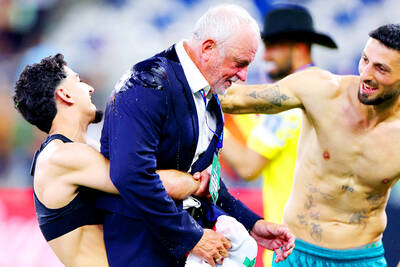
INDIGESTION: Italy failed to qualify for the World Cup for a third consecutive time after a 4-1 defeat to Bosnia on penalties in a loss Gattuso said was ‘difficult to digest’ Coach Graham Arnold on Tuesday challenged his players to “shock the world” after Iraq became the 48th and final team to qualify for the FIFA World Cup with a nerve-shredding 2-1 win over Bolivia in an intercontinental playoff in Mexico, as Bosnia and Herzegovina, Turkey, the Czech Republic, Sweden and the Democratic Republic of the Congo (DRC) also secured their places at the finals. Iraq, whose preparations were disrupted by the war in the Middle East, sealed their first appearance at the finals in 40 years and are to play in Group I against France, Senegal and Norway. Goals from Ali al-Hamadi

Teng Kai-wei, the only Taiwanese player on an opening-day roster in this year’s Major League Baseball (MLB) season, took his first win of the year with the Houston Astros in his season debut. Teng entered in relief in the top of the fifth inning against the Los Angeles Angels on Saturday, with the Astros trailing 5-0. He pitched 2-1/3 scoreless innings with two strikeouts, as Houston scored 11 runs during his outing to snatch an 11-9 comeback victory. The win is the Astros’ first of the season and the third of Teng’s MLB career. “It’s my first time pitching for the Astros, so


 RSS
RSS