


White-clad Chinese cricketers roared as a homegrown bowler sent the bails flying in Beijing — to the unfamiliar clatter of leather on plastic.
The national universities’ tournament, the country’s top competition, was held on an astroturf baseball field in the capital, where the pitcher’s mound had been removed, the stumps were made of plastic and the boundary marked out by orange discs.
It was a sign of the lack of government support for the non-Olympic sport in China, where only about two dozen homegrown teams play regular competitive matches and a few foreigners are trying to drive it forward.
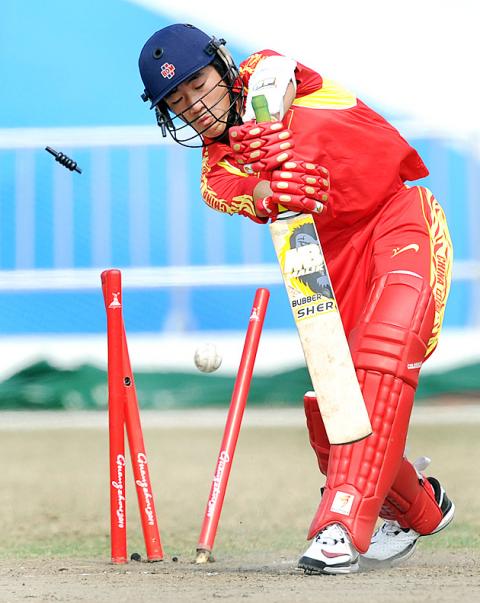
Photo: AFP
Across the Himalayas, cricket-obsessed India are top of the world rankings in one-day internationals, but despite an even larger population, China are listed last but two in Asia, ahead of only Myanmar and tiny Brunei.
“When I got here, everyone was holding the bat like it was baseball,” said Rashid Khan, the former Pakistan international who now coaches China’s national team, one of the few spectators at the university event.
“Now they can play good cricket,” he added, as players hooked balls toward the baseball netting. “The bowlers at least are bowling with a decent action.”
The first recorded cricket match in China was played in 1858 between a team of officers from the British navy’s HMS Highflyer and a side from Shanghai, but while the British Empire spread the game to Australia, South Asia and the Caribbean among others places — its former territory Hong Kong recently qualified for next year’s Twenty20 World Cup in Bangladesh — mainland China resisted colonization and the sport never caught on.
Now a wave of sports governing bodies from American football to rugby union are pushing their wares in China, hoping to secure a slice of its vast market after basketball and soccer won over tens of millions of fans.
The Malaysian-based Asian Cricket Council funds the national team and Briton Matt Smith, who coaches at a university in the northwestern city of Shenyang, said: “We’ve begun to build a cricket culture.”
There are expatriate sides in China’s major cities, but according to the state-backed Chinese Cricket Association (CCA) the vast country has only 68 homegrown teams, in schools and universities.
Smith has carried balls and bats back from Britain, but one of his toughest tasks has been translating cricket’s unique lexicon into Chinese. He rendered “googly” — a type of delivery bowled by a right-arm leg-spinner — as a “cross-eyed ball,” while bowlers send down “bright-spin” rather than “off-spin.”
The spin delivery known as a “Chinaman” has been bowled in the country, but it remains untranslated, although the cricketers’ cry of “howzat” is apparently universal.
Smith brokered a deal to send batsman Jiang Shuyao to the English seaside resort of Cleethorpes for local matches last year — the first time a Chinese cricketer had played in a foreign league.
“If we want to get better we need to study abroad, there are not enough high-level matches here in China,” said Jiang, a floppy white hat framing his face. “If cricket is to be successful here, it needs to become an Olympic sport.”
Chinese sport remains dominated by the government, with vast sums plowed into training athletes for events which can bring Olympic glory and other disciplines disregarded, experts say.
The country’s only cricket stadium was built for the 2010 Asian Games in Guangzhou, where there is no adult Chinese team to use it.
China’s men’s side meet mostly crushing defeats in international matches, but its women cricketers have occasionally fared better, notching victories against Malaysia and Thailand in 2010, before being on the wrong end of a 128-run thrashing from Pakistan. Nonetheless they are still ranked joint-bottom in Asia.
Terry Zhang of the CCA admitted that there were “no funds from the central government,” but that has not prevented China from investing in the game abroad — it has reportedly funded US$132 million worth of cricket facilities in the West Indies.
The loans were dubbed “cricket diplomacy” by Caribbean media, as Beijing seeks to win friends in a region where several countries still have diplomatic ties with Taiwan.
Back in China, one of the nation’s top players, Zhang Yufei, described as the first Chinese cricketer to score a century in a competitive match is on the verge of retirement at just 21.
Zhang says his career may be over before it has even begun and he is preparing to start work at an engineering firm run by his father.
“There is no chance to make a living from cricket,” Zhang lamented.

After letting another big lead slip with an error-strewn performance at the French Open on Wednesday, top-ranked Aryna Sabalenka felt like getting as far away from the courts as possible. “Just want to quit tennis right now,” Sabalenka said after wasting a lead of a set and two breaks in a 3-6, 7-5, 6-0 loss to Diana Shnaider in the women’s singles quarter-finals. “We’ll see in few days. Hopefully I’ll get back on track mentally.” Sabalenka’s wait for a first French Open title continues despite the four-time major winner leading 4-1 in the second set and being two points from victory while

BIG NAMES GONE: Zverev is the clear favorite for a maiden Grand Slam title, reaching semi-finals for the fifth time in six years and finishing second on three occasions Alexander Zverev on Tuesday breezed past Rafael Jodar to stay on course for an elusive Grand Slam title at the French Open, while Jakub Mensik halted Joao Fonseca’s scintillating run in the quarter-finals. Zverev, the highest-ranked player left in the men’s draw, put an end to Spanish teenager Jodar’s impressive Roland Garros debut, easing into the semi-finals with a 7-6, (7/3), 6-1, 6-3 win. The 29-year-old Zverev is the clear favorite for a maiden Grand Slam title. He has finished runner-up on three occasions, including at the 2024 French Open. “I want to win the matches that are ahead of

Liverpool are in advanced talks with former AFC Bournemouth manager Andoni Iraola as they seek a replacement for Arne Slot, reports said on Tuesday. Iraola has emerged as Liverpool’s top target to replace Slot, who was sacked on Saturday last week after a turbulent second season in charge. Liverpool have reportedly agreed a deal in principle to bring the Spaniard, who left Bournemouth at the end of this season, to Anfield. Sporting director Richard Hughes was heavily involved in hiring Iraola during his time at Bournemouth and is again spearheading the recruitment of the highly rated coach. The Reds are

KNICKS TAKE LEAD: San Antonio put on a 9-0 run to be up 95-94 with just over 2 minutes to play, but the rest of the game belonged to the New York Knicks It was past five minutes through the third quarter of Game 1 of the NBA Finals on Wednesday and the New York Knicks’ 11-game winning streak was in major jeopardy. The Knicks missed nine of their first 10 shots in the early part of the period and trailed the San Antonio Spurs by 14 points. They were floundering. Then something crazy happened. The Knicks found new life from an unlikely source: The Spurs. New York rallied to tie the game by the end of the period, gave up the lead briefly late in the fourth quarter, and pulled away late for a 105-95


 RSS
RSS