


The following article was first published in the Taipei Times on Oct. 17, 2002. It has been reprinted to commemorate the 10th anniversary of the Bali bombing.
Staring blankly at the pile of rubble that once housed the Sari Club, Peter Chworowsky shook his head and hugged his fellow rugby players.
Teammate Kelvin Bezuidenhout sobbed as a group of Balinese threw rose petals on the site of Saturday’s bomb blast. Behind the charred remains of a nearby pub, someone sang Amazing Grace.
This memorial Tuesday marked the end of a chapter for the Taipei Baboons, a tight-knit expatriate rugby club based in Taiwan. It was a chance to say goodbye to the four teammates and a female fan they lost, and reflect on how the terrorist attack changed their lives.
“I feel mostly sadness for the guys that didn’t get out,” said Chworowsky, a 43-year-old American businessman from Lakeville, Wisconsin, who was left partially deaf from the blast. “But I’m also sad for the terrorists. I’m trying to figure out why they would do that, how their minds would get so screwed up that they would bomb a nightclub.”
202 people were killed and 300 wounded in the car-bomb attack on the popular nightclub. Indonesian officials suspect the al-Qaeda terrorist network carried out the bombing.
Rugby teams — in town for a weekend tournament — appear to be among the hardest hit. Chworowsky said many players spent the weekend at the Sari Club, and at least three teams he has talked to lost a combined total of up to 15 players.
Among them was the Hong Kong Football Club, which confirmed Tuesday that it lost two players and that five other players and two female fans remain missing.
Twenty members of the Taipei team arrived in Bali Thursday and Friday and hung out at the Sari Club and nearby Paddy’s.
They played three games Saturday, had dinner and headed for the Sari Club around 10pm. Packed with mostly young Australian and European tourists, it seemed like a typical night out — until the crowd heard a loud bang around 11:30pm.
Most turned around to see an orange glow coming from Paddy’s, where a first bomb exploded. Seconds later, a second, more powerful explosion tore into the Sari Club. It knocked many patrons unconscious, caused the roof to collapse and sparked a fire that consumed the bar within minutes.
The stunned players found themselves covered in concrete or pieces of the roof. They smelled smoke and heard the crackling of the fast-moving fire.
“It was pitch black and you could see the glow of the fire illuminating the room,” said Scott Murphy, a 29-year-old Australian from Brisbane whose brother, Max, also survived. “I just started grabbing people and pulling them to their feet.”
Nearby, Chworowsky found himself on his back, being trampled on. He got up and saw the main entrance blocked by thick smoke and flames. Bodies were everywhere and screams filled the air.
“I remember thinking: This is what war is like,” he said.
Chworowsky climbed out through a hole in a wall. He soon realized that at least five of the 12 players at the club had not come out.
“When I was standing on the street, I was thinking anyone who did not get out was probably gone,” he said.
The teammates later searched for the missing, but found only one injured player at a hospital.
The Taipei team’s lost members — James Hardman, 28, of Sydney; Daniel Braden, 28, of Brighton, England; Godfrey Fitz, 39, and Craig Harty, 35, both of South Africa; and Eve Kuo, 24, of Taiwan — will leave a gaping hole in the club that players described as their extended family.
Fitz was the smooth-talking teacher, who had been a soccer star in South Africa. Braden was the wacky dresser with the dry sense of humor. Hardman was the surfer who could not stop talking about Australia. And Harty was a family man who had just recovered from the death of his brother and illness of his mother.
“You couldn’t have asked for better mates than these guys,” Boyden said.
The surviving club members said they have all decided one thing — that the club will eventually take to the field again.
“This is what we loved to do with these guys,” Max Murphy said. “That’s what they would have wanted.”

After letting another big lead slip with an error-strewn performance at the French Open on Wednesday, top-ranked Aryna Sabalenka felt like getting as far away from the courts as possible. “Just want to quit tennis right now,” Sabalenka said after wasting a lead of a set and two breaks in a 3-6, 7-5, 6-0 loss to Diana Shnaider in the women’s singles quarter-finals. “We’ll see in few days. Hopefully I’ll get back on track mentally.” Sabalenka’s wait for a first French Open title continues despite the four-time major winner leading 4-1 in the second set and being two points from victory while
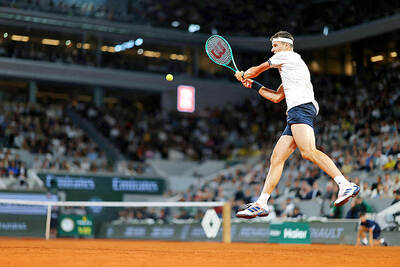
BIG NAMES GONE: Zverev is the clear favorite for a maiden Grand Slam title, reaching semi-finals for the fifth time in six years and finishing second on three occasions Alexander Zverev on Tuesday breezed past Rafael Jodar to stay on course for an elusive Grand Slam title at the French Open, while Jakub Mensik halted Joao Fonseca’s scintillating run in the quarter-finals. Zverev, the highest-ranked player left in the men’s draw, put an end to Spanish teenager Jodar’s impressive Roland Garros debut, easing into the semi-finals with a 7-6, (7/3), 6-1, 6-3 win. The 29-year-old Zverev is the clear favorite for a maiden Grand Slam title. He has finished runner-up on three occasions, including at the 2024 French Open. “I want to win the matches that are ahead of

For some, Cristiano Ronaldo remains the essential spearhead for Portugal’s FIFA World Cup bid, while others believe his presence would prevent Roberto Martinez’s strong side from flourishing. The debate around the five-time Ballon d’Or winner rages on, as it did at UEFA Euro 2024 and four years ago in Qatar — yet Ronaldo endures, ready to play in a record sixth World Cup. The 41-year-old remains a global superstar despite swapping the European elite for Saudi Arabia’s Al-Nassr, and is the leading men’s international goalscorer with 143 strikes. With 25 of those coming in 30 games under Martinez, the coach
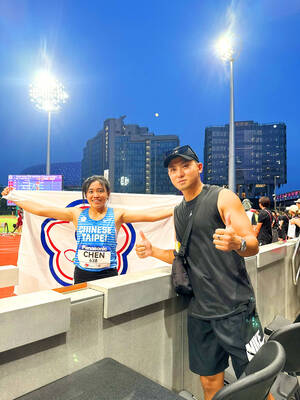
Taiwanese sprinter Chen Yi-cen on Friday won the silver medal in the women’s 400m final at the Asian U20 Athletics Championships in Hong Kong, with a time of 53.16 seconds. Chen, 15, was the youngest among the eight finalists, and her performance also met the qualifying standard of 53.50 seconds for the Nagoya Asian Games in Japan in September and October. Chen first made her mark at the National Games in Tainan in 2023, at the age of 13, winning the women’s 400m final in 55.55 seconds to become the youngest gold medalist in the history of the event. Meanwhile,


 RSS
RSS