


The US’ Todd Rogers and Phil Dalhausser, gold medalists in the men’s beach volleyball in Beijing in 2008, were knocked out of the London Olympics by a low-ranked Italian pair on Friday in the biggest upset of the tournament so far.
Rogers, 38, and Dalhausser, 32, were considered strong medal contenders and had won all three of their pool matches, dropping just one set along the way.
In contrast, Italians Daniele Lupo, 21, and Paolo Nicolai, 23, had lost two out of their three pool matches, finishing third of their group. They scraped into the round-of-16 by winning a lucky loser match late on Thursday.
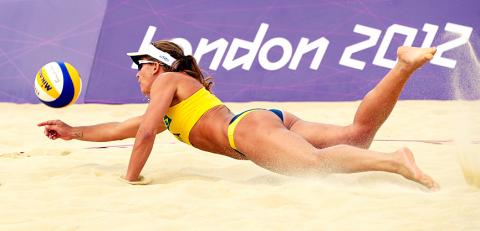
Photo: AFP
However, the inspired Italians played the match of their lives on Friday, landing one unstoppable spike after another and relentlessly blocking the Americans’ usually powerful attacks.
Rogers and Dalhausser were defeated by two sets to nil on the score of 21-17, 21-19.
The Italians had beaten Rogers and Dalhausser twice this year, but their relatively poor performance during the pool phase, compared with three comfortable wins by the Americans, meant that Friday’s result came as a big surprise to most.
The Italians seemed almost dazed by their own performance.
“We’ve won against them before, but every time it’s a battle. They’ve been idols for me and it’s strange to beat them,” Nicolai said.
The Americans did not seem as surprised as everyone else.
“They’re a very, very good team. They’re younger. The tall guy is like Phil, the little guy is like me, just 10 or 20 years younger, so,” Rogers said with a chuckle.
Tall and small, as defined by beach volleyball players, are relative concepts.
Nicolai is 2.03m tall while Lupo measures 1.95m. Lupo is presumably the “little guy” referred to by Rogers, a diminutive 1.87m next to Dalhausser, who towers over his teammate at 2.06m.
The other high-profile men’s pair in action on Friday, Brazilians Ricardo Santos and Pedro Cunha, faced a tough challenge from Spaniards Pablo Herrera and Adrian Gavira, but were able to stave them off 2-0 (21-18, 21-19).
Ricardo won silver in Sydney in 2000 with Ze Marco de Melo, then gold in Athens in 2004 and bronze in Beijing with Emanuel Rego, who is also competing at the London Games with his own new teammate, Alison Cerutti.
Earlier, the US’ women’s pair Jennifer Kessy and April Ross, former world champions, had a two-sets-to-nil win over Swiss pair Simone Kuhn and Nadine Zumkehr.
Kessy and Ross have spent much of their career in the shadow of compatriots Misty May-Treanor and Kerri Walsh, the only pair to have won Olympic gold in beach volleyball twice.
May-Treanor and Walsh are again in the limelight in London as they bid for a third consecutive gold, but Kessy and Ross have been looking strong and may well pose a serious challenge to their US rivals at a later stage.
May-Treanor and Walsh would play their first match of the knock-out phase against a Dutch team last night.
However, the favorites in the women’s event are reigning world champions Larissa Franca and Juliana Felisberta of Brazil, who thumped their way into the quarter-finals on Friday by beating Dutch pair Madelein Meppelink and Sophie van Gestel.
Larissa and Juliana have dominated the women’s world tour for several years, but they missed out on the Beijing Olympics in 2008 after Juliana had to pull out with a knee injury. Olympic gold is the only trophy they are missing and they want it badly.
The Brazilians won on Friday by two sets to nil on the score of 21-10, 21-17, but the Dutch pair captured the crowd’s hearts with some heroic defensive diving.
When the teams were level in the second set at 15-15, the four women played one of the best points seen in the tournament so far, earning a deafening ovation from the 15,000 spectators.
With the Brazilians on the attack, the Dutch sprinted across the sand and flung themselves on the ground to successfully save three powerful spikes, regaining the offensive only for the Brazilians to pull off an improbable save and win the point.
“SANDSTORM!” said the screens in the corners of the court.
The Brazilians sealed the set and the match by 21-17, but the gracious Dutch seemed pleased to have put on a good show.
“We tried, we tried, I crossed the whole court, we were just running, and it was a shame that we didn’t make the point, but we made the crowd happy with a nice rally,” Meppelink said in a classic example of understatement.

NO HARD FEELINGS: Taiwan’s Lin Hsiang-ti and Indonesia’s Dhinda Amartya Pratiwi embraced after fighting to a tense and rare 30-29 final game in their Uber Cup match The Taiwanese men’s team on Wednesday fought back from the brink of elimination to defeat Denmark in Group C and advance to the quarter-finals of the Thomas Cup, while the women’s team were to face South Korea after press time last night in the Uber Cup quarter-finals in Horsens, Denmark. In the first match, Taiwan’s top shuttler Chou Tien-chen faced a familiar opponent in world No. 3 Anders Antonsen. It was their 16th head-to-head matchup, with the Dane taking his fourth victory in a row against former world No. 2 Chou, winning 21-14, 13-21, 21-15 in 1 hour, 22 minutes. The

Marta Kostyuk’s maiden WTA 1000 title in Madrid came on Saturday thanks to her power, poise and a pair of unexpected lucky shorts. The world No. 23 beat eighth-ranked Mirra Andreeva 6-3, 7-5 in under 90 minutes to secure the most prestigious trophy of her career, her third professional singles title and second in less than a month after Rouen. Yet as the 23-year-old Ukrainian posed for photographs at the Caja Magica, it was not just the silverware that caught the eye. Held alongside her team and her two dogs, Kostyuk showed off a piece of black men’s underwear, prompting
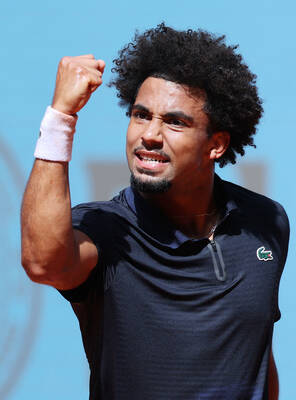
Tennis players are facing an unexpected opponent at the Madrid Open. A stomach virus or food poisoning has affected Iga Swiatek, Coco Gauff, Marin Cilic and others, raising concerns. World No. 1 Aryna Sabalenka avoided an upset by Naomi Osaka on the court on Monday and said she is trying to avoid illness by sticking to a diet of chicken breasts, rice and salad. The rumor among the players was bad shrimp tacos were to blame. Sabalenka knocked on wood for luck and said, “So far, so good. I heard that I have to avoid those tacos,” she laughed, adding “I stick to the

Throwing more than US$5 billion at a divisive new tour and walking away after five seasons does not look like good business, but LIV Golf was not all bad news for Saudi Arabia. Oil-funded LIV, which poached top stars and sent golf’s establishment into a tailspin, helped push the conservative kingdom into global view — one of its key aims, experts said. The exit, confirmed on Thursday after weeks of speculation, does not signal a flight of Saudi money from sport, even after the Middle East war that sparked Iranian attacks around the Gulf, they said. “Saudi Arabia is not


 RSS
RSS