


South Korean taekwondo competitors going for gold at the London Olympics know the price of failure will be extreme. Such is Koreans’ pride in their national sport that coming home without a gold medal would be tantamount to treason.
After a disappointing Athens Games, when they won only two golds, South Korea returned with a vengeance in Beijing with all four of their fighters becoming Olympic champions.
Kim Sei-hyeok, general manager of the national taekwondo team, said anything short of four golds in London would be a body blow to South Korea’s taekwondo pride.
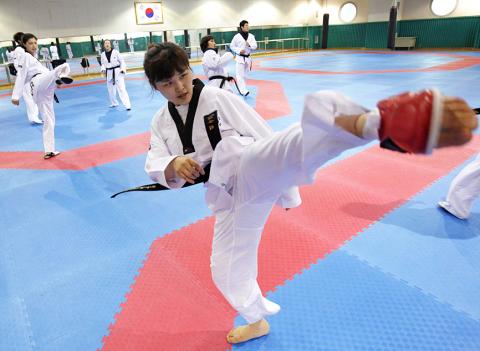
Photo: Reuters
“Taekwondo is our national sport, it originated in Korea, so we are under pressure to get many gold medals,” Kim said at the national training center. “It’s natural for us to win gold medals, we’ll be treated as traitors if we don’t, that’s what our media says.”
Taekwondo, loosely translated as “way of the fist and foot,” enjoyed a surge in popularity after being exhibited as a demonstration sport at the Seoul Olympics in 1988 and quickly rose to become one of the world’s most practiced martial arts.
While there have been calls for the sport’s place in the Olympic program to come under review due to a complicated scoring system and complaints about a lack of action, Kim said taekwondo’s global appeal made it a good fit with the Games.
“We have more than 200 member countries worldwide,” he said. “As far as Olympic Games are concerned, 52 member countries participated in Athens, 54 in Beijing and there will be 53 member countries at the London Olympics.”
New rules aimed at protecting competitors could make for more spectacular bouts, and Kim said the South Koreans would take full advantage of the changes.
Previously, kicks to the head, worth three points, had to land with significant force to score, but in London, a competitor will be awarded the points as soon as any part of their foot touches their opponent’s head, regardless of the impact power.
“Our strategy will be to give up one point to our opponents and get three points instead,” Kim said. “We are not giving up kicking the body, but we will try hard to kick the face of our opponents with power, that’s our tactics and strategy.”
For Olympic candidate Hwang Kyung-seon, working on her footwork was the priority, while Cha Dong-min was focusing on his timing and Lee Dae-hoon had developed his speed.
Kim said brute force was the key.
“To remain the world’s taekwondo power, our motto is ‘physical strength first, skill will follow,’” he said, adding that the Olympians would be pushed to the limit at higher altitude on long distance runs to build endurance. “We need strong spiritual power based on physical strength.”
The London Olympics taekwondo competition will be held at the ExCeL arena in London from Aug. 8-11.

NO HARD FEELINGS: Taiwan’s Lin Hsiang-ti and Indonesia’s Dhinda Amartya Pratiwi embraced after fighting to a tense and rare 30-29 final game in their Uber Cup match The Taiwanese men’s team on Wednesday fought back from the brink of elimination to defeat Denmark in Group C and advance to the quarter-finals of the Thomas Cup, while the women’s team were to face South Korea after press time last night in the Uber Cup quarter-finals in Horsens, Denmark. In the first match, Taiwan’s top shuttler Chou Tien-chen faced a familiar opponent in world No. 3 Anders Antonsen. It was their 16th head-to-head matchup, with the Dane taking his fourth victory in a row against former world No. 2 Chou, winning 21-14, 13-21, 21-15 in 1 hour, 22 minutes. The

Jannik Sinner continued his quest to become the first man in history to win five Masters 1000 tournaments in a row with a 6-2, 6-3 victory over Danish qualifier Elmer Moller at the Madrid Open on Sunday. The world leader extended his winning streak to 19 matches, a run that began early March in Indian Wells, and he has captured 24 consecutive victories at the Masters 1000 level, dating back to the Paris Masters last October. Searching for a maiden title at this level on clay, Sinner advanced to the round of 16 at the Caja Magica with a 77-minute performance against
When Paddy Dwyer arrived in China in 1976, crowds jostled to catch a glimpse of him and his companions — the first Western soccer team to play in the country. China was emerging from the chaos of the Cultural Revolution, and on the brink of market reforms that would take the country from economic stagnation to explosive growth. “All we could see was lines of people running beside our bus, trying to look in the windows, to see their first visual of a white person,” he said. “It was all bicycles,” he said. “There were very few cars to be seen.” Dwyer,
Tennis players are facing an unexpected opponent at the Madrid Open. A stomach virus or food poisoning has affected Iga Swiatek, Coco Gauff, Marin Cilic and others, raising concerns. World No. 1 Aryna Sabalenka avoided an upset by Naomi Osaka on the court on Monday and said she is trying to avoid illness by sticking to a diet of chicken breasts, rice and salad. The rumor among the players was bad shrimp tacos were to blame. Sabalenka knocked on wood for luck and said, “So far, so good. I heard that I have to avoid those tacos,” she laughed, adding “I stick to the


 RSS
RSS