


The image of 24-year-old Nour Fitiany resting courtside as the pounding of basketballs and thumping of feet reverberated around her would not merit a second glance in most countries.
However, in Saudi Arabia, where girls are banned from sports in state schools, powerful clerics castigate women for exercising and female gyms must adhere to strict regulations, Fitiany’s ambition to play basketball — let alone represent her country in international tournaments — is a bold political statement.
“I hope that when they see that there are girls who really want to play and who do play, regardless of the obstacles that lie in their path, they realize that they have to do something,” she said, dressed in a baby blue T-shirt and gray jogging pants, spinning a basketball on her index finger.
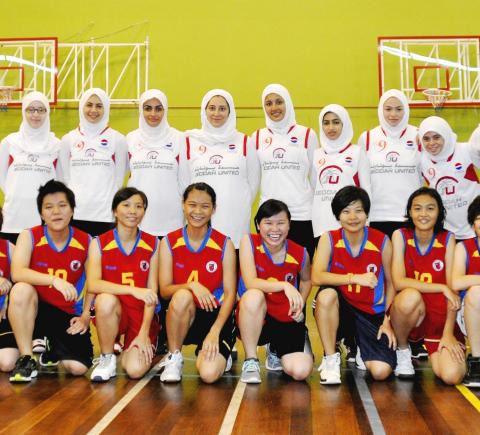
Photo: Reuters
Female participation in sports has long been a controversial issue in the conservative kingdom, which on Feb. 15 was lambasted by Human Rights Watch (HRW) for never having sent a woman athlete to the Olympics.
The stance of the official Supreme Council of Religious Scholars is represented by Sheikh Abdullah al-Maneea, who said in 2009 that the excessive “movement and jumping” needed in soccer and basketball might cause girls to tear their hymens and lose their virginity.
After Saudi King Abdullah moved last year to bring women into the country’s political process, however, there have been some signs authorities may allow sportswomen to compete internationally and make it easier for girls to exercise.
The HRW report said the Saudi Arabian Olympic Committee had “indicated” it would not stop women athletes taking part in the Games if they were invited, and speculation has been rife that the government would send equestrian Dalma Malhas to compete in this year’s Summer Olympics in London.
The Saudi Arabian General Investment Authority said earlier this year there are plans to introduce after-hours physical education classes for both girls and boys.
The kingdom’s official sporting body, the Saudi General Presidency of Youth Welfare, did not respond to questions on the issue.
Sports in the patriarchal society of Saudi Arabia have long been reserved as an activity for men. Even stadiums for watching sports prohibit females to be present.
Women are able to play in the privacy of their homes or in private schools, but as soon as they step beyond that to play professionally or in organized teams in public competitions they are publicly slammed for going against their natural role.
Newspaper articles that refer to such women as “shameless” when they play sports are a cause of great embarrassment for the women and their families. Some have even received text messages advising them to stay at home, and tend to their household duties as mothers and wives.
“If there is no support from the family we can not get into these types of activities ... some people are extremist or extra conservative,” said Hadeer Sadagah, 17, who plays with Fitiany on their basketball team, Jeddah United.
Jeddah United were set up in 2003 to promote women’s fitness; Malhas, who specializes in show jumping, trained privately and has competed in international tournaments since she was young.
A group of Saudi women is also planning a hiking expedition to Everest base camp this summer as part of a charity fundraising exercise to promote a healthy lifestyle for breast cancer patients.
Billionaire Prince al-Waleed bin Talal, a nephew of the king who is known to be a supporter of women’s rights, has included women in his Kingdom Equestrian Team, part of his company Kingdom Holding, which has allowed Saudi women to compete in international competitions since 2007.
Liberal Saudis consider women who participate in sports to be pioneers and encourage the women to play regardless of the obstacles.
“We have a very famous Arabic saying that goes: ‘A healthy brain needs a healthy body,’ so from that I believe that people who are against women’s sports are actually against women,” said Jeddah resident Hashim Larry, 27.
“They come from the same group of ‘don’t allow women to work and drive,’” Larry said.
The pressure against women in sports is intense and comes from senior figures in a clerical establishment that is closely allied to the ruling Al Saud family.
In 2010, Sheikh Abdulkareem al-Khudair, who also sits on the Supreme Council for Religious Scholars, renewed a religious edict banning sports for women, which he said “will lead to following in the footsteps of the devil.”
He said it is not permitted to request that the government introduce sports in schools for girls because such activity is forbidden in Islam. Such comments from a high-ranking cleric have immense influence in the monarchy, which rules in alliance with the conservative clerics.
When Jeddah United returned from a tournament in which they played the Jordanian national team, in 2009, a local newspaper published their photograph under the headline: “Shameless girls.”
The religious pressure is so great that even female gyms have to wear a non-sporting fig leaf, masquerading as “health centers” that are regulated not by a national sports body, but by the Saudi Ministry of Health.
Fees are so high — at a minimum of 1,000 riyals (US$266) a month — that only the affluent can afford membership.
In 2009, a clampdown on unlicensed female gyms gave rise to a women’s rights campaign in newspapers and blogs, with the sarcastic slogan: “Let her get fat!”
“As a nation we need to focus on preventative measures that include healthy lifestyle, specifically nutrition and fitness, and early detection [of women’s illnesses],” said Princess Reema Al Saud, who is leading the climb to Everest base camp.
“The inspiration to climb Everest base camp came from the basic idea that a healthy lifestyle and healthy body can fight illness better,” she added.
The lack of facilities for women is a significant barrier in a country where gender segregation is strictly enforced.
While girls’ state schools are barred from teaching physical education and consequently have no sports facilities, some private schools and private universities are very well equipped.
Jeddah United practice in one of the few courts available for women, surrounded by 5m concrete walls, which they rent for 7,000 riyals to 10,000 riyals a month. Members get training and the opportunity to play three times a week for a monthly fee of 600 riyals.
“We believe that [Jeddah United] are a pressure group to promote a healthy lifestyle on a local level and on an international level,” said the team’s founder, Lina al-Maeena. “We play a role of sport diplomacy by building bridges and breaking stereotypes of Saudi women. I hope that we are paving the way.”
Malhas, the equestrian who might yet be selected to represent the kingdom in London, trained in exclusively private facilities in Saudi Arabia.
She has already competed in international tournaments, which she traveled to by herself, financed not by the state, but by her own family.
In the Singapore Youth Olympics in 2010, she stood on the podium to receive a bronze medal, although she was not officially delegated to represent the kingdom.
“I think women playing sports should ignore the criticisms they get from society,” Fitiany said. “That is a kind of struggle, standing strong and not caring what people say.”
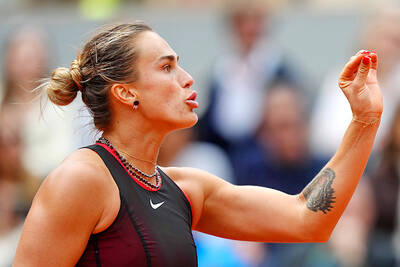
After letting another big lead slip with an error-strewn performance at the French Open on Wednesday, top-ranked Aryna Sabalenka felt like getting as far away from the courts as possible. “Just want to quit tennis right now,” Sabalenka said after wasting a lead of a set and two breaks in a 3-6, 7-5, 6-0 loss to Diana Shnaider in the women’s singles quarter-finals. “We’ll see in few days. Hopefully I’ll get back on track mentally.” Sabalenka’s wait for a first French Open title continues despite the four-time major winner leading 4-1 in the second set and being two points from victory while
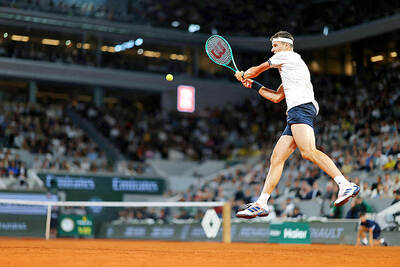
BIG NAMES GONE: Zverev is the clear favorite for a maiden Grand Slam title, reaching semi-finals for the fifth time in six years and finishing second on three occasions Alexander Zverev on Tuesday breezed past Rafael Jodar to stay on course for an elusive Grand Slam title at the French Open, while Jakub Mensik halted Joao Fonseca’s scintillating run in the quarter-finals. Zverev, the highest-ranked player left in the men’s draw, put an end to Spanish teenager Jodar’s impressive Roland Garros debut, easing into the semi-finals with a 7-6, (7/3), 6-1, 6-3 win. The 29-year-old Zverev is the clear favorite for a maiden Grand Slam title. He has finished runner-up on three occasions, including at the 2024 French Open. “I want to win the matches that are ahead of
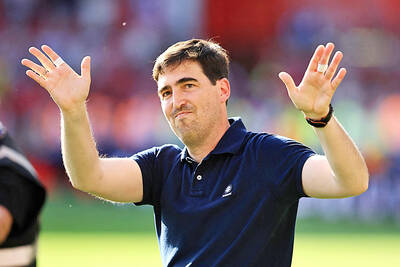
Liverpool are in advanced talks with former AFC Bournemouth manager Andoni Iraola as they seek a replacement for Arne Slot, reports said on Tuesday. Iraola has emerged as Liverpool’s top target to replace Slot, who was sacked on Saturday last week after a turbulent second season in charge. Liverpool have reportedly agreed a deal in principle to bring the Spaniard, who left Bournemouth at the end of this season, to Anfield. Sporting director Richard Hughes was heavily involved in hiring Iraola during his time at Bournemouth and is again spearheading the recruitment of the highly rated coach. The Reds are
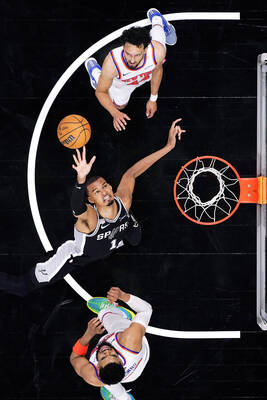
KNICKS TAKE LEAD: San Antonio put on a 9-0 run to be up 95-94 with just over 2 minutes to play, but the rest of the game belonged to the New York Knicks It was past five minutes through the third quarter of Game 1 of the NBA Finals on Wednesday and the New York Knicks’ 11-game winning streak was in major jeopardy. The Knicks missed nine of their first 10 shots in the early part of the period and trailed the San Antonio Spurs by 14 points. They were floundering. Then something crazy happened. The Knicks found new life from an unlikely source: The Spurs. New York rallied to tie the game by the end of the period, gave up the lead briefly late in the fourth quarter, and pulled away late for a 105-95


 RSS
RSS