


Spain coach Vicente Del Bosque saluted his nation’s first World Cup triumph as deserved reward for their commitment to playing the “Beautiful Game.”
Andres Iniesta’s 116th-minute strike ensured the European Champions finally overcame the Netherlands in a final that was enthralling, but partially disfigured by the intimidating tactics employed by the Dutch as they attempted to knock their opponents out of their elegant stride.
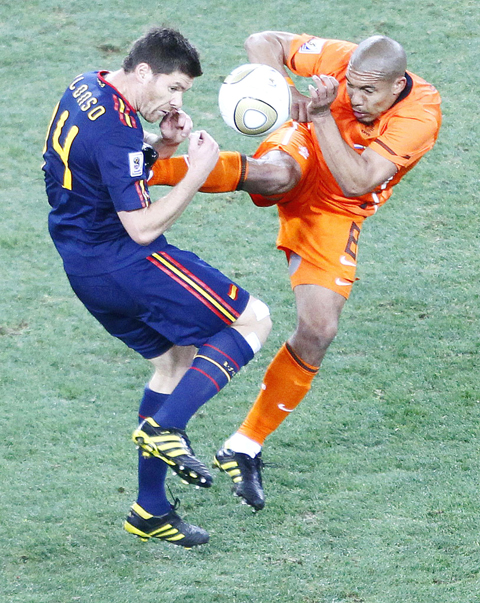
PHOTO: EPA
“Today is a reward for beautiful football,” Del Bosque said. “Spain, the country, deserves this triumph. This goes beyond sport. We have to celebrate and are delighted to be able to offer this victory to all the people of Spain.”
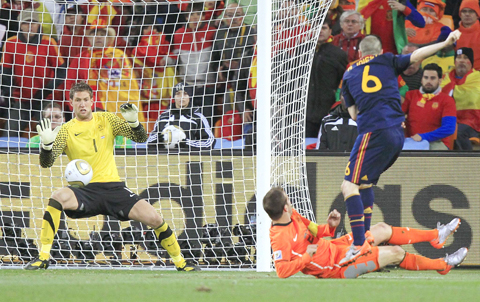
PHOTO: EPA
The Spanish coach graciously side-stepped questions about the tactics deployed by the Dutch, who had centerback Johnny Heitinga sent off and seven other players booked by English referee Howard Webb.
“I’m here to speak about the beautiful things of football,” he said. “Holland played a good game. It was an even, balanced match. Yes, it was rough at times, but that is part of football.”
Dutch coach Bert van Marwijk defended his players’ approach, which resulted in him being accused of betraying the legacy of great Dutch sides of the past.
“We knew that we would really have to have a top day to beat Spain and tactically we did a good job. For the major part of the match we were in a good position,” Marwijk said.
Marwijk accepted that the the high card count — Spain also had five players booked — was “regrettable for a final.”
“It is not our style, but then again you play a match to win,” he said. “It is a World Cup final and there is a lot of emotion — you saw that at the end of the match. I would have loved to win the match, even with not so beautiful football.”
Had it gone to penalties, that might have happened. As it was, Iniesta was set free by substitute Cesc Fabregas’ pass and hammered in an unstoppable shot to ring the starting bell for the mother of all fiestas.
It was a painful blow for a Dutch side that had hoped to eradicate memories of the country’s defeats in the 1974 and 1978 finals.
“To lose a final with four minutes to go, it leaves you with a very bitter feeling,” van Marwijk said. “Even with 10 men, I thought it would be possible to get to penalties.”
Marwijk admitted, however, that Spain had deserved their victory over the 120 minutes, although he could only reflect on what might have been had Arjen Robben taken either of the two great chances he had in the second half.
On the first, the Bayern Munich winger was denied by the boot of goalkeeper Iker Casillas. On the second, he was impeded by Carles Puyol, who had already been booked and it might easily have resulted in a red card if Webb had had a better view of the challenge.
“I’m not someone to look back on the what the referee did. I think the best team usually wins the match, but if you look at the second chance of Robben, the referee should give Puyol a second yellow card, which would have meant him being sent off,” the Dutch coach said. “It was a crucial moment just before the end of the 90 minutes. It is very bitter, but that is sport. It is harsh and as I said, Spain were the better team.”
Former South African president Nelson Mandela’s beaming pre-match appearance ensured the only glum face before kickoff belonged to Fernando Torres, consigned to the bench until the second period of extra-time as Spain opted to keep David Villa as the central striker.
Torres’ evening was to finish on a much happier note, however, with his cross causing the disruption in the Dutch defense that enabled Fabregas to tee up Iniesta for the winner.
Villa had contributed five of the seven goals his side had scored en route to the final, but a superb block by Heitinga early in the second half denied him a sixth from his only clear chance in a final in which most of Spain’s best chances fell to their defenders.
Sergio Ramos had an early header well saved by the excellent Maarten Stekelenburg and then saw a drive across the goalmouth deflected over the bar by Heitinga, without the Dutch centerback knowing too much about it.
Spain’s early impetus slowed in the face of the Dutch snapping into every tackle — Nigel de Jong in particular was lucky to stay on the pitch after a reckless high challenge resulted in him planting his studs into Xabi Alonso’s chest — but they reasserted themselves after the interval, with Joan Capdevila and then Villa both squandering great chances.
The Dutch, through Robben, also had their opportunities, but it was Spain who always looked the more likely winners in extra-time.
Fabregas fired the best chance against the Dutch goalkeeper’s legs, before Heitinga left Webb with no option but to issue a second yellow card by pulling back Iniesta as he chased a pass from Xavi into the box.
The Spanish were unable to exploit the resulting free-kick, but Iniesta finally ensured they got what they deserved.

When Paddy Dwyer arrived in China in 1976, crowds jostled to catch a glimpse of him and his companions — the first Western soccer team to play in the country. China was emerging from the chaos of the Cultural Revolution, and on the brink of market reforms that would take the country from economic stagnation to explosive growth. “All we could see was lines of people running beside our bus, trying to look in the windows, to see their first visual of a white person,” he said. “It was all bicycles,” he said. “There were very few cars to be seen.” Dwyer,
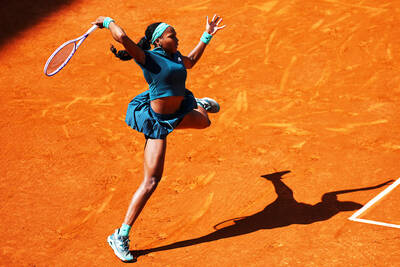
Jannik Sinner continued his quest to become the first man in history to win five Masters 1000 tournaments in a row with a 6-2, 6-3 victory over Danish qualifier Elmer Moller at the Madrid Open on Sunday. The world leader extended his winning streak to 19 matches, a run that began early March in Indian Wells, and he has captured 24 consecutive victories at the Masters 1000 level, dating back to the Paris Masters last October. Searching for a maiden title at this level on clay, Sinner advanced to the round of 16 at the Caja Magica with a 77-minute performance against

Some of Clearlake Capital Group’s largest investors are growing increasingly concerned about how much time the company’s co-founders are spending on sports investments as they have struggled to complete the fundraising for the private equity firm’s latest flagship fund. One of Clearlake’s co-founders, Behdad Eghbali, has been spending what some investors described as a disproportionate amount of time on the firm’s investment in Chelsea Football Club in recent months. Now, co-founder Jose E. Feliciano and his wife, Kwanza Jones, are nearing a record US$3.9 billion deal to acquire the San Diego Padres. That personal investment by Feliciano has set off the latest
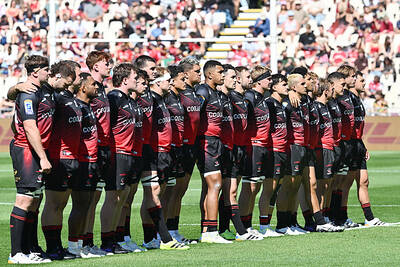
A new NZ$683 million (US$404 million) stadium that was a symbol of Christchurch’s struggle to rebuild after a deadly earthquake struck the New Zealand city is to host its first match tomorrow in front of a sellout crowd. A magnitude 6.2 earthquake killed 185 people in February 2011 and toppled or damaged buildings, including the city’s old Lancaster Park. The stadium, which hosted international rugby and cricket, and was home to the Canterbury Crusaders, was badly damaged and never reopened. It was bulldozed in 2019 and turned into sports fields, leaving the Crusaders without a permanent home. Government funding for a new stadium was


 RSS
RSS