


Sepp Blatter must be squirming. If he isn’t, he should be.
Why is it that the FIFA boss uses modern technology when it suits him — to burnish his public persona by Tweeting, for example — but not when it would do some good for global soccer?
Blatter merrily Tweeted on Sunday that he was on his way to the World Cup match between Germany and England.
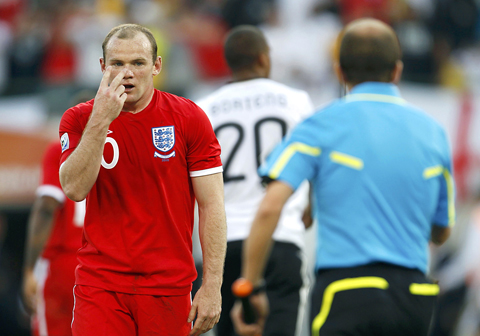
PHOTO: REUTERS
Since he was at the Free State Stadium, we must assume that he saw the “Blunder of Bloemfontein” with his own eyes.
It was impossible to miss — unless you were a linesman from Uruguay called Mauricio Espinosa.
Fact: Frank Lampard’s first-half goal for England was good.
Let’s not fall into the trap of saying that Espinosa’s failure to see that the ball crossed the line was merely 1966 in reverse, some sort of karmic retribution for Geoff Hurst’s goal against Germany in the World Cup final 44 years ago. Even now, it is impossible to say for certain that the linesman called it correctly when he said Hurst’s strike crossed the goal-line.
But this time in South Africa was different. Lampard’s lob was clearly over the goal line.
Fact: Espinosa should have seen it. Practically everyone else did, without the need for video technology. It was visible with the naked eye. England coach Fabio Capello actually started celebrating before he realized, horrified, that the goal wouldn’t be given.
“From the bench, I saw the ball go over,” Capello said.
David Beckham, at half-time, went over to the referee, holding apart his hands like an angler boasting about the size of a prize salmon he caught. The message: Ref, it was that far over the line.
Fact: The goal, had it been given, would have pegged the score back to 2-2 and perhaps altered the complexion of the match. Instead, at 2-1 to Germany, England were forced to chase for another goal. The English left themselves vulnerable at the back as they pushed forward.
Fact: Germany were much better than England and deserved to win. Lampard’s un-allowed goal should not mask the fact that England had a poor World Cup. England have wonderful players who play in the world’s toughest league but yet, as a national side, cannot be taken seriously. Capello has failed to change that enigma.
Fact: Technology exists that could quickly tell referees whether balls crossed goal-lines. Balls could be used with an embedded chip that sends the message “Goal” or a beep to the referee’s earpiece. Or Hawkeye’s all-seeing eye could be used, as it is in tennis for disputed line calls.
But FIFA prefers the Dark Ages. Three months before this World Cup, it ruled out further experiments with goal-line technology.
Because of FIFA’s refusal of machines, even the Blunder of Bloemfontein is unlikely to change its mind. FIFA said on Sunday night it would not comment on the performance of the referee. The un-goal was also edited out of a two-minute highlight reel of the match on FIFA’s Web site. Basically, FIFA doesn’t want to know.
What dinosaurs. FIFA fears that technology would undermine the authority of referees and their assistants. But the reverse is in fact happening. Match officials are being made to look like idiots because they are not getting the help that they need.
Soccer, like life, can never always be fair. But balls, as Lampard proved, can bounce in and out of goal so quickly that a linesman can miss it. That’s why technology is needed. The time to introduce it was yesterday.

NO HARD FEELINGS: Taiwan’s Lin Hsiang-ti and Indonesia’s Dhinda Amartya Pratiwi embraced after fighting to a tense and rare 30-29 final game in their Uber Cup match The Taiwanese men’s team on Wednesday fought back from the brink of elimination to defeat Denmark in Group C and advance to the quarter-finals of the Thomas Cup, while the women’s team were to face South Korea after press time last night in the Uber Cup quarter-finals in Horsens, Denmark. In the first match, Taiwan’s top shuttler Chou Tien-chen faced a familiar opponent in world No. 3 Anders Antonsen. It was their 16th head-to-head matchup, with the Dane taking his fourth victory in a row against former world No. 2 Chou, winning 21-14, 13-21, 21-15 in 1 hour, 22 minutes. The

Jannik Sinner continued his quest to become the first man in history to win five Masters 1000 tournaments in a row with a 6-2, 6-3 victory over Danish qualifier Elmer Moller at the Madrid Open on Sunday. The world leader extended his winning streak to 19 matches, a run that began early March in Indian Wells, and he has captured 24 consecutive victories at the Masters 1000 level, dating back to the Paris Masters last October. Searching for a maiden title at this level on clay, Sinner advanced to the round of 16 at the Caja Magica with a 77-minute performance against

When Paddy Dwyer arrived in China in 1976, crowds jostled to catch a glimpse of him and his companions — the first Western soccer team to play in the country. China was emerging from the chaos of the Cultural Revolution, and on the brink of market reforms that would take the country from economic stagnation to explosive growth. “All we could see was lines of people running beside our bus, trying to look in the windows, to see their first visual of a white person,” he said. “It was all bicycles,” he said. “There were very few cars to be seen.” Dwyer,

Tennis players are facing an unexpected opponent at the Madrid Open. A stomach virus or food poisoning has affected Iga Swiatek, Coco Gauff, Marin Cilic and others, raising concerns. World No. 1 Aryna Sabalenka avoided an upset by Naomi Osaka on the court on Monday and said she is trying to avoid illness by sticking to a diet of chicken breasts, rice and salad. The rumor among the players was bad shrimp tacos were to blame. Sabalenka knocked on wood for luck and said, “So far, so good. I heard that I have to avoid those tacos,” she laughed, adding “I stick to the


 RSS
RSS