


Fiji’s decision on religious grounds not to perform the cibi, or war chant, before Saturday’s rugby match against Scotland in Edinburgh has polarized the deeply religious but rugby-mad nation.
A 70-year-old tradition ended at Murrayfield when Fiji decided not to perform the cibi on the urging of team coach and pastor Sam Domoni, who described it as a relic of Fiji’s pre-Christian past.
Domoni told Fiji media players had voted in favor of a team management move to ban the war dance because they “fear God.”
Letters columns in Fiji’s major newspapers have been filled with reaction to the decision since Saturday and several former Fiji players have expressed disappointment that a long-standing part of Fiji’s rugby history had been discarded.
Hooker George Farrell, who played for Fiji in 1964, said the cibi was performed with pride by all Fijian players.
“It is part of our rugby culture,” he said.
Sale Sorovaki, who led Fiji to their last win over Scotland in 1998, said the cibi motivated players. In its absence on Saturday, Fiji slumped to a 23-10 loss to Scotland.
A leading article yesterday in the Fiji Times newspaper called for the cibi to be reinstated.
“Every national rugby side since the introduction of the sport has performed this brief battle challenge prior to Test matches,” the Times said. “This is part of our heritage as a nation, a rallying point similar to the national anthem and a matter of pride for all our people.”
“The cibi has been performed in Argentina, Australia, England, France, Ireland, Italy, Japan, New Zealand, Samoa, South Africa, Tonga, the United States and Wales. Indeed, true rugby fans at home and abroad rank this traditional battle cry as one of the most eagerly awaited moments in the sport,” it said.
The Fiji Times said religious objections to the cibi were misplaced.
“For the record, the cibi is a war challenge, not a prayer to some deity worshipped by the indigenous people,” it said. “The words of this now contentious dance refer only to the action of storming the enemy’s battlements and laying his village to waste.”
“It was an ingenious way to motivate the first Fiji rugby teams, drawing on their warrior instinct and using language which would inspire them to achieve victory,” it said.
The newspaper said the decision taken by the Fiji players to discard the tradition marked an unfortunate intrusion of religion into sport.
“Now a national rugby coach has decided that the team will not perform a basic element of the sport as it is perceived by Fijians of all ethnicities,” the Fiji Times said. “That is not his call, nor is it a decision which should have been made on tour.”
“Sports and religion do not mix,” it said.

Memphis Grizzlies forward Brandon Clarke, 29, has died, the NBA team said in a statement on Tuesday, while the family of Jason Collins, the first openly gay man to play in a major US pro sports league, announced the former Grizzlies and Brooklyn Nets player had died after a battle with brain cancer. “We are heartbroken by the tragic loss of Brandon Clarke,” the Grizzlies said in a statement posted on social media. “Brandon was an outstanding teammate and an even better person whose impact on the organization and the greater Memphis community will not be forgotten.” The statement did not provide
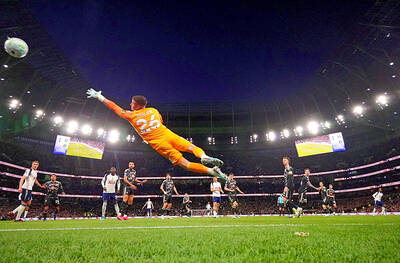
Mathys Tel was hero and villain as Tottenham drew 1-1 at home to Leeds United on Monday — a result that leaves their English Premier League future hanging in the balance. The Frenchman broke the deadlock early in the second half to ease the tension at Tottenham Hotspur Stadium, but then gave away a penalty with a reckless attempted clearance. In the dying minutes, Spurs were grateful to Antonin Kinsky, who produced an astonishing save to deny the visitors a win. Tottenham are now two points clear of 18th-placed West Ham United with just two games left this season. The

Houston Astros right-hander Teng Kai-wei, the only active Taiwanese pitcher in MLB, on Sunday suffered his third loss of the season, throwing a season-high 63 pitches in his second start of the year. Teng allowed three earned runs over three innings on five hits in the Astros’ 5-0 road loss to the Cincinnati Reds. He struck out one, walked one, and hit one batter among the 15 hitters he faced, raising his earned run average to 3.12. It was the Astros’ second attempt to use the 27-year-old Taiwanese as a starter, after he had established himself as a reliable bullpen
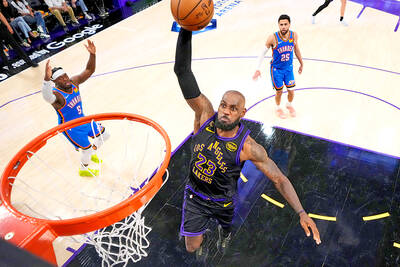
‘DONE IT ALL’: LeBron James is now out of contract with the Lakers and would head into the off season as a free agent with uncertainty swirling around his future LeBron James on Monday said he would take time to consider his future after the Los Angeles Lakers were swept out of the NBA playoffs by the Oklahoma City Thunder in what could turn out to be the final game of his career. James, 41, delivered a typically defiant performance with 24 points and 12 rebounds, but it was not enough to prevent the Lakers from falling 115-110 as the Thunder completed a 4-0 sweep in the Western Conference semi-finals series. The four-time NBA champion is now out of contract with the Lakers and would head into the off season


 RSS
RSS