


The World Games get underway in Kaoshiung this week with Thursday’s opening ceremony. Here’s an alphabetical summary of all you need to know about the 10-day sporting extravaganza.
A — Athletes
An estimated 4,500 athletes will be arriving in Kaohsiung ahead of Friday when the competition starts, up from the 3,500 who participated in the last World Games in Duisberg, Germany, in 2005. That is just under half the approximately 10,500 that usually participate in an Olympic Games.
B — Bizarre
The World Games are often associated with the weird and wonderful, and with sports such as boules, frisbee, tchoukball, lifesaving and ballroom dancing on the roster it is easy to understand why. Nevertheless, the Games also have their fair share of “regular” sports, with squash, rugby sevens, powerlifting, softball, racquetball and sumo wrestling featuring, among others.
C — Casting
Probably the wackiest sport on the World Games roster is casting. It is basically fly fishing without the water as competitors cast a rod and try and land the fly on a series of targets. The sport even has its own governing body — The International Casting Sport Federation. However, those hoping to “catch” some of the action in Kaohsiung will be disappointed. The event has been cast aside and will not feature.
D — Drugs
Drug cheats are not just the preserve of the Olympic Games, and the World Games adheres to the same strict anti-doping regime as the Olympics. All doping matters are dealt with according to standards set out by the World Anti-Doping Agency (WADA).
E — Eco-friendly
The 40,000-seat main stadium for the Games, designed by Japanese architect Toyo Ito, is a great example of green construction. According to the Kaohsiung Organizing Committee (KOC), solar panels on the stadium roof are capable of generating more than 1 million kW/h of electricity per year, saving 660 tonnes of carbon emissions annually. The stadium is also built at a specific orientation to ensure natural ventilation, while sheltering spectators from both seasonal winds and the harsh tropical sun.
F — Flags
Whenever Taiwan and China appear at the same sporting event there is always potential for trouble and more often than not the source is Taiwan’s flag (it is barred from all Olympic events). The KOC has already stoked the embers by announcing it will allow Taiwan’s flag to be displayed by supporters. Expect at least one crazed Chinese official to lose their temper.
G — Gongs
As hosts, the Taiwanese squad will be looking to improve on their meager medal tally from four years ago in Duisburg, when they finished in 22nd position in the final medal table, bagging just six medals — two gold, two silver and two bronze.
H — History
From modest beginnings — the first World Games in Santa Clara, California, in 1981 saw just 1,265 athletes take part in 18 different sports — to this year’s eighth edition, where almost four times the number of athletes will take part in 31 sports, the World Games is a growing concern and a genuine success story.
I — Invitational
Sports which are not governed by International World Games Member Federations can be played at the World Games, but they are classified as “invitational” and no medals are awarded. Also, the host city can choose to classify official IWGA sports as invitational events. The invitational events for Kaohsiung are beach handball, tchoukball, softball, wushu (martial arts) and dragon boat racing.
J — Jia you
With only one phrase available in Mandarin when it comes to shouting encouragement for athletes, expect to be hearing jia you (加油), literally “add oil,” a lot during the 10 days of competition.
K — Kaohsiung
The host city and Taiwan’s second largest, with a population of more than 1.5 million and an area of 154km².
L — Ladies
The ladies of Taiwan’s tug of war team are not to be trifled with. As reigning World Games and world indoor champions they represent Taiwan’s best hope of gold in Kaohsiung.
Part 2 of the A to Z will be in tomorrow’s Taipei Times.
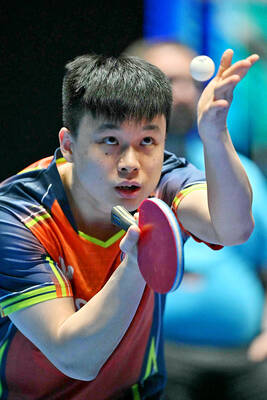
Taiwan’s men’s table tennis team won bronze on Saturday at this year’s International Table Tennis Federation World Team Table Tennis Championships in London, matching the country’s best-ever finish at the regular tournament. Consisting of Lin Yun-ju, Taiwan’s top-ranked player at world No. 7, Feng Yi-hsin, Kuo Guan-hong, Hong Jing-kai and Hsu Hsien-chia, the team won bronze after losing 0-3 to Japan in the semifinals. In the opening match, 24-year-old Lin played the first game against world No. 3 Tomokazu Harimoto 11-5, but ultimately lost the next three closely contested games 9-11, 10-12 and 10-12. Feng then faced world No. 8 Sora Matsushima in
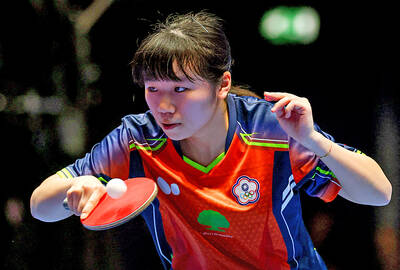
Lin Yun-ju on Thursday handed Taiwan two key victories as they advanced to the semi-finals of the ITTF World Team Table Tennis Championships Finals in London. The Taiwan men’s table tennis team beat Sweden 3-2 in five singles matches. The 24-year-old Lin, Taiwan’s top-ranked player at world No. 7 and nicknamed the “Silent Assassin,” opened the tie by defeating world No. 2 Truls Moregard 3-0 (11-8, 11-9, 13-11) before clinching the deciding fifth match with a 3-0 (11-8, 11-9, 11-5) win over Anton Kallberg to hand his team the overall victory. Kuo Guan-hong put Taiwan up 2-0 with a 3-2 (4-11, 11-8, 8-11,
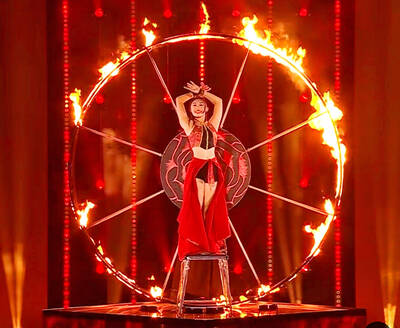
Taiwanese fire dancer Yang Li-wei advanced to the final of Britain’s Got Talent this weekend after receiving a Golden Buzzer during her live semi-final performance. Yang, a member of Taiwan’s Coming True Fire Group, awed judges and audiences with a high-intensity fire performance featuring flaming umbrellas, fire swallowing and spinning metal structures balanced with her legs. Judge Simon Cowell praised Yang as a star, while guest judge KSI reacted with amazement before pressing the Golden Buzzer, sending her to the finals. The dance group wrote on social media that the Golden Buzzer was “the highest honor” on the talent show, adding: “Twenty-three years

As Super Rugby fast approaches its playoff season it finds itself racing toward a reckoning with many issues that threaten the southern hemisphere tournament. A group of stakeholders met in the New Zealand city of Christchurch late last month to address problems that are making the future of the 31-year-old competition increasingly tenuous. The discussion was made more urgent by the decision by the owners of Moana Pasifika to fold the Auckland-based club for financial reasons. That followed the closure of the Melbourne Rebels at the end of the 2024 season, likewise because of financial difficulties. Problems addressed included player retention as more


 RSS
RSS