


With the Beijing Olympics looming and China's image at stake, their hostile and sometimes abusive soccer fans have been told to shut up.
Organizers of the East Asian championships issued a public notice before the tournament banning unruly behavior, and the message was reinforced ahead of their game against Japan on Wednesday.
Some 3,000 security guards were reportedly on hand and eight green military-type trucks were seen near the main gate of the 60,000-seat Olympic Sports Center in Chongqing, which was heavily bombed by Japan in World War II.
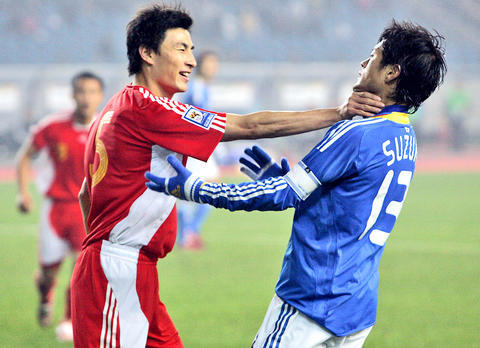
PHOTO: AP
It followed Chinese spectators, still angry at their neighbor's World War II aggression, persistently booing, jeering and throwing rubbish at three-time Asian champions Japan on Sunday when they played North Korea.
They did the same at the 2004 Asian Cup in China, hurling cups and plastic bottles at Japanese supporters.
The 2004 event almost ended in a riot after Japan beat China in the final and a Japanese diplomat's car was attacked.
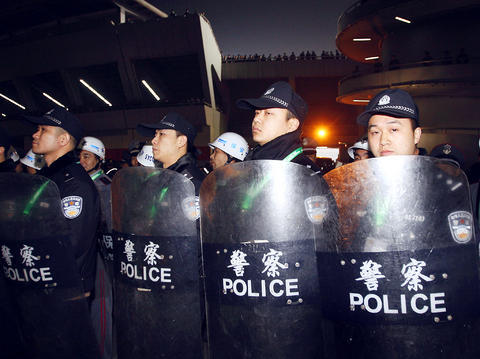
PHOTO: AP
Ahead of Wednesday's match, which Japan won 1-0, local media carried articles saying true soccer fans respect their opponents, according to a Chinese journalist.
At the stadium, officials used the public address system called on the crowd to "refrain from using abusive language."
Chinese supporters largely adhered to the warnings and did not boo the Japanese national anthem, although some were seen lighting smoke flares and burning small Japanese flags.
Instead they turned their wrath on their own underachieving team, with tempers flaring towards the end of the game as the crowd booed and chanted "fire him," directed at China Football Association (CFA) chief Xie Yalong.
They also threw plastic bottles on the pitch as Koji Yamase's early strike proved decisive for China's second-straight defeat.
Chinese newspapers expressed dismay at the latest failure of the national side, also blaming the CFA.
"China loses to Japan: Why?" asked the mass-circulation Beijing Morning Post in its main headline
"Chinese football has deteriorated over the past 10 years. Why? The China Football Association can't shrug off the blame. Only it can answer this `why?' Give us an explanation," the paper said.
The Star Daily, a Beijing tabloid, said: "To be honest, there is nothing surprising about losing to Japan. It would have been a real surprise if we had beaten them instead."
While the supporters' behavior was better-than-expected, the Chinese let rip on the pitch, picking up four yellow cards for some wild tackles in a bad-tempered game.
Japan also picked up two yellow cards as tensions boiled over.
"Hit back when you get hit. That's the spirit. I felt it was what I should do, at least," Japan midfielder Keita Suzuki said.

After letting another big lead slip with an error-strewn performance at the French Open on Wednesday, top-ranked Aryna Sabalenka felt like getting as far away from the courts as possible. “Just want to quit tennis right now,” Sabalenka said after wasting a lead of a set and two breaks in a 3-6, 7-5, 6-0 loss to Diana Shnaider in the women’s singles quarter-finals. “We’ll see in few days. Hopefully I’ll get back on track mentally.” Sabalenka’s wait for a first French Open title continues despite the four-time major winner leading 4-1 in the second set and being two points from victory while

BIG NAMES GONE: Zverev is the clear favorite for a maiden Grand Slam title, reaching semi-finals for the fifth time in six years and finishing second on three occasions Alexander Zverev on Tuesday breezed past Rafael Jodar to stay on course for an elusive Grand Slam title at the French Open, while Jakub Mensik halted Joao Fonseca’s scintillating run in the quarter-finals. Zverev, the highest-ranked player left in the men’s draw, put an end to Spanish teenager Jodar’s impressive Roland Garros debut, easing into the semi-finals with a 7-6, (7/3), 6-1, 6-3 win. The 29-year-old Zverev is the clear favorite for a maiden Grand Slam title. He has finished runner-up on three occasions, including at the 2024 French Open. “I want to win the matches that are ahead of

Liverpool are in advanced talks with former AFC Bournemouth manager Andoni Iraola as they seek a replacement for Arne Slot, reports said on Tuesday. Iraola has emerged as Liverpool’s top target to replace Slot, who was sacked on Saturday last week after a turbulent second season in charge. Liverpool have reportedly agreed a deal in principle to bring the Spaniard, who left Bournemouth at the end of this season, to Anfield. Sporting director Richard Hughes was heavily involved in hiring Iraola during his time at Bournemouth and is again spearheading the recruitment of the highly rated coach. The Reds are

KNICKS TAKE LEAD: San Antonio put on a 9-0 run to be up 95-94 with just over 2 minutes to play, but the rest of the game belonged to the New York Knicks It was past five minutes through the third quarter of Game 1 of the NBA Finals on Wednesday and the New York Knicks’ 11-game winning streak was in major jeopardy. The Knicks missed nine of their first 10 shots in the early part of the period and trailed the San Antonio Spurs by 14 points. They were floundering. Then something crazy happened. The Knicks found new life from an unlikely source: The Spurs. New York rallied to tie the game by the end of the period, gave up the lead briefly late in the fourth quarter, and pulled away late for a 105-95


 RSS
RSS