


Sebastian Deisler was burnt out and "old" from the business of soccer when he made a decision that shocked a German public sure he was destined to be great.
Deisler, only 26 at the time, quit the game in January after an eight-year career in which he played well enough for Germany and Bayern Munich to keep alive German faith that he would be one of the country's best players ever.
He decided enough was enough after five knee operations and two bouts of depression brought on by the never-ending expectations.
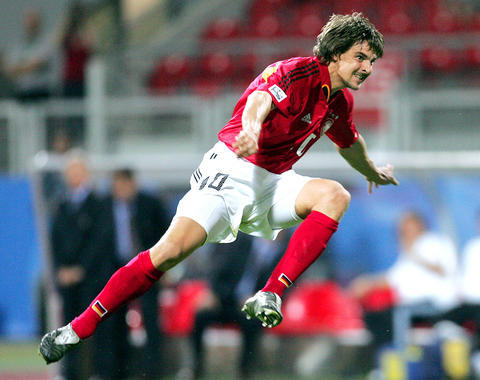
PHOTO: AP
"I recognized that I wasn't made for this business considering the way things went. At the end I was empty. I was old. I was tired," Deisler told the Tagesspiegel am Sonntag in an interview published on Sunday.
Bayern manager Uli Hoeness called the central midfielder "one of the best players we ever had in Germany."
Deisler's silky touch on the ball, not often seen in German players, helped him captivate both the fans and soccer establishment in 1998 when he was 18 and playing at Bundesliga club Borussia Moenchengladbach.
He soon found himself the center of hopes that he could reverse the steady decline of German soccer following the 1990 World Cup title -- a turnaround that didn't materialize until three years ago.
Germany put him in charge of its attack when he was 19 and the consensus soon grew in his homeland that he was their future. All he needed was experience to lead the national team back to the top again.
That ended when he went down with his first knee injury, but the pattern was set for Deisler. The country tried to rush him back from another operation for the 2002 World Cup, only to see his fragile knee collapse again in a warmup match against Austria.
But the more he was thrust into the role of savior, the more the likable boy who loved the game grew into a recluse who shunned interviews.
"The business of soccer took over too soon," Deisler said. "I never had the time to grow. I never had the time to grow up. I didn't even have the time to make mistakes."
Deisler began to place unrealistic demands on himself when he stepped onto the field he couldn't meet. That led to treatment for depression in 2003 and 2004.
Deisler began to hate his public image, all the exaggerated hopes he generated in Germany.
"I wore a mask, inside I was rebelling against it," said Deisler, who admitted he should have spoken out earlier. "But I was afraid of that."
Deisler decided instead to drop out and all his potential left a meager balance statistically: 62 games and eight goals for Bayern in four-and-a-half years and 28 appearances and three goals for Germany, plus a handful of European matches.
No matter how much the Germans wanted it, Deisler could never be their soccer superstar because his mentality didn't fit his physical gifts.
"I fought against myself for a long time. I waged war against myself until I couldn't stand it anymore," Deisler said. "That's why I've made a clean break."

When Paddy Dwyer arrived in China in 1976, crowds jostled to catch a glimpse of him and his companions — the first Western soccer team to play in the country. China was emerging from the chaos of the Cultural Revolution, and on the brink of market reforms that would take the country from economic stagnation to explosive growth. “All we could see was lines of people running beside our bus, trying to look in the windows, to see their first visual of a white person,” he said. “It was all bicycles,” he said. “There were very few cars to be seen.” Dwyer,
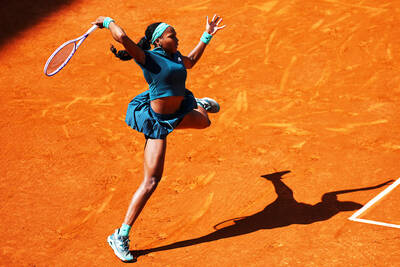
Jannik Sinner continued his quest to become the first man in history to win five Masters 1000 tournaments in a row with a 6-2, 6-3 victory over Danish qualifier Elmer Moller at the Madrid Open on Sunday. The world leader extended his winning streak to 19 matches, a run that began early March in Indian Wells, and he has captured 24 consecutive victories at the Masters 1000 level, dating back to the Paris Masters last October. Searching for a maiden title at this level on clay, Sinner advanced to the round of 16 at the Caja Magica with a 77-minute performance against

Some of Clearlake Capital Group’s largest investors are growing increasingly concerned about how much time the company’s co-founders are spending on sports investments as they have struggled to complete the fundraising for the private equity firm’s latest flagship fund. One of Clearlake’s co-founders, Behdad Eghbali, has been spending what some investors described as a disproportionate amount of time on the firm’s investment in Chelsea Football Club in recent months. Now, co-founder Jose E. Feliciano and his wife, Kwanza Jones, are nearing a record US$3.9 billion deal to acquire the San Diego Padres. That personal investment by Feliciano has set off the latest
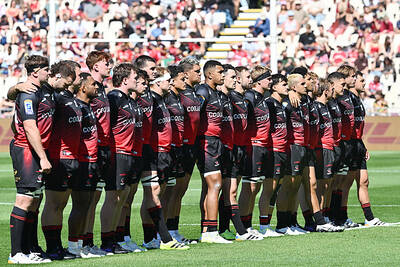
A new NZ$683 million (US$404 million) stadium that was a symbol of Christchurch’s struggle to rebuild after a deadly earthquake struck the New Zealand city is to host its first match tomorrow in front of a sellout crowd. A magnitude 6.2 earthquake killed 185 people in February 2011 and toppled or damaged buildings, including the city’s old Lancaster Park. The stadium, which hosted international rugby and cricket, and was home to the Canterbury Crusaders, was badly damaged and never reopened. It was bulldozed in 2019 and turned into sports fields, leaving the Crusaders without a permanent home. Government funding for a new stadium was


 RSS
RSS