


The athlete tipped to be Britain's golden girl at the London 2012 Games had gone to ground on Monday night, fearing her Olympic dream was in tatters after it was revealed she has missed three drug tests.
Last night, in a gloomy assessment, David Moorcroft, chief executive of UK Athletics said: "The IAAF [International Association of Athletics Federations] and the rest of the world will be watching this case. An athlete is responsible for what they take, and their availability for out-of-competition testing is part of being a professional athlete. It goes with the territory and it's a responsibility that needs to be taken very seriously."
The news is a devastating blow for Christine Ohuruogu, whose destiny seemed mapped out from the moment last year that London was awarded the Olympics. The hugely talented athlete was tipped to be the face of the Games, a positive symbol of multicultural Britain.
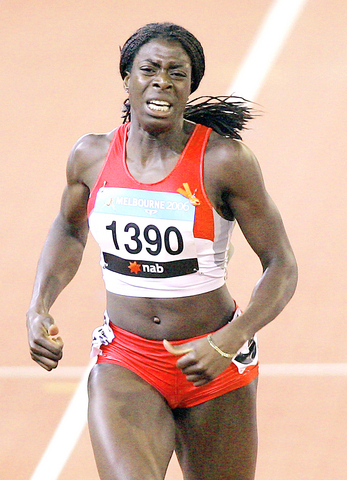
PHOTO: AP
But the 22-year-old east Londoner may now be banned from appearing in the Games. Instead of lining up in this week's European Championships, she is at home in Stratford, preparing her defense against a charge of missing three drug tests, an offence that carries a two-year ban from the sport and, under a British Olympic Association bylaw, a lifetime Olympic ban.
The athlete, who has recently joined former Olympic gold medallist Linford Christie's Nuff Respect training stable, has apologized in a public statement. But for a sport reeling from high-profile drugs controversies, sympathy may be at a premium.
Born into a large British-African family and raised in Stratford, a short jog from the site of the Olympic stadium, Ohuruogu was being billed as the potential darling of London's Games. She underlined her credentials in March when she finished ahead of reigning Olympic champion Tonique Williams-Darling to win the 400m at the Commonwealth Games in Melbourne, following a path taken by Australia's Cathy Freeman six years before, at the Sydney Olympics.
Ohuruogu is also bright and articulate. It seemed by incredibly good fortune that Sebastian Coe and his officials discovered someone on their doorstep who could fill the kind of role Freeman did when she became a symbol of Australian-Aboriginal reconciliation and lit the flame at Sydney before winning a 400m gold.
Last night those hopes were at grave risk, and Ohuruogu was facing a fight just to be allowed to compete in 2012. She has been provisionally suspended by UK Athletics and told not to go to the European Championships, which opened in Gothenburg yesterday, where she was due to run in the 400m and 4x400m relay.
The British Olympic Association is one of only three national bodies that have the capacity to impose such selection bans. Ohuruogu is facing a similar charge to that which led to Manchester United and England defender Rio Ferdinand being banned for eight months in 2004 and Greek sprinters Kostas Kederis and Ekaterina Thanou being kicked out of the Athens Olympics. Sally Gunnell was also nearly banned for a missed test in 1992 but was let off, and went on to win the 400m hurdles at Barcelona.
Since then, things have been tightened up. Under new rules, athletes have to make themselves available for random drug testing for one hour on five out of seven days by being at a specified location. On three occasions between October last year and the last week of July, officers from UK Sport, which conducts testing, turned up to test Ohuruogu at the address she had provided. Each time she failed to turn up.
The chances of Ohuruogu escaping punishment when she appears before a UK Athletics disciplinary hearing on a date to be decided appear slim, because she has apologized in a statement that failed to offer any explanation beyond a change in her "training circumstances."
Lord Coe was having dinner with journalists in Gothenburg on Sunday evening when the news broke. He was as stunned as the rest of the sport, having grown to know and like Ohuruogu.
"It would wrong to comment on the situation until the full facts are known," he said.
"I hope I'd be a role model for everyone," Ohuruogu said after her triumph in Melbourne. "You do see lots of kids with talent that's going to waste."
She will be praying she can come up with an explanation that prevents her story becoming one of missed opportunity.

Taiwan’s men’s table tennis team won bronze on Saturday at this year’s International Table Tennis Federation World Team Table Tennis Championships in London, matching the country’s best-ever finish at the regular tournament. Consisting of Lin Yun-ju, Taiwan’s top-ranked player at world No. 7, Feng Yi-hsin, Kuo Guan-hong, Hong Jing-kai and Hsu Hsien-chia, the team won bronze after losing 0-3 to Japan in the semifinals. In the opening match, 24-year-old Lin played the first game against world No. 3 Tomokazu Harimoto 11-5, but ultimately lost the next three closely contested games 9-11, 10-12 and 10-12. Feng then faced world No. 8 Sora Matsushima in

Lin Yun-ju on Thursday handed Taiwan two key victories as they advanced to the semi-finals of the ITTF World Team Table Tennis Championships Finals in London. The Taiwan men’s table tennis team beat Sweden 3-2 in five singles matches. The 24-year-old Lin, Taiwan’s top-ranked player at world No. 7 and nicknamed the “Silent Assassin,” opened the tie by defeating world No. 2 Truls Moregard 3-0 (11-8, 11-9, 13-11) before clinching the deciding fifth match with a 3-0 (11-8, 11-9, 11-5) win over Anton Kallberg to hand his team the overall victory. Kuo Guan-hong put Taiwan up 2-0 with a 3-2 (4-11, 11-8, 8-11,

Taiwanese fire dancer Yang Li-wei advanced to the final of Britain’s Got Talent this weekend after receiving a Golden Buzzer during her live semi-final performance. Yang, a member of Taiwan’s Coming True Fire Group, awed judges and audiences with a high-intensity fire performance featuring flaming umbrellas, fire swallowing and spinning metal structures balanced with her legs. Judge Simon Cowell praised Yang as a star, while guest judge KSI reacted with amazement before pressing the Golden Buzzer, sending her to the finals. The dance group wrote on social media that the Golden Buzzer was “the highest honor” on the talent show, adding: “Twenty-three years

As Super Rugby fast approaches its playoff season it finds itself racing toward a reckoning with many issues that threaten the southern hemisphere tournament. A group of stakeholders met in the New Zealand city of Christchurch late last month to address problems that are making the future of the 31-year-old competition increasingly tenuous. The discussion was made more urgent by the decision by the owners of Moana Pasifika to fold the Auckland-based club for financial reasons. That followed the closure of the Melbourne Rebels at the end of the 2024 season, likewise because of financial difficulties. Problems addressed included player retention as more


 RSS
RSS