


The riders in the Tour de France enjoyed the first of two Mondays off, most of them using the time to rest in preparation for the terrain ahead in the Pyrenees.
The ninth stage of the this year's Tour de France got underway in the city of Bordeaux yesterday.
The route for Stage 9 covers 169.5km of mainly flat territory from Bordeaux to Dax, giving the sprinters another chance to shine before the true contenders establish themselves in the Pyrenees in southwest France.
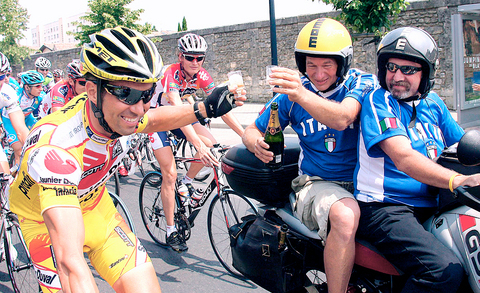
PHOTO: EPA
The race should be decided, as it almost always is, in that mountain range.
The race enters the Pyrenees today for two daily stages, then moves into the Alps next week.
The strongest or most consistent climber does not always win the tour, but having a combination of power and consistency is vital. A rider who gains four minutes one day in the mountains, then loses four minutes the next, can be shattered psychologically because of the lack of progress.
Some riders have positioned themselves nicely to make a move in the Pyrenees. After winning the individual time trial on Saturday, Serhiy Honchar of Ukraine, a rider on the T-Mobile team, is the overall leader.
Floyd Landis of the US, who rides for Phonak, is a minute behind and certainly within striking distance.
The other riders from the US are in less-promising positions. George Hincapie, on the Discovery Channel team, struggled in the time trial and is 17th overall, 2:30 behind Honchar.
Cyrille Guimard, a cycling legend who guided three riders to victory in the tour in the 1970s and 1980s as a team coach, told Reuters that Discovery Channel did not have a chance, saying: "The Discovery Channel are not in the pace. They will not win the tour."
The first day in the Pyrenees, today's Stage 10, includes climbs up the Soudet and Marie Blanque cols, or passes.
Tomorrow will be a bigger challenge, with five major climbs over the course.
After three days eastward on the plains and a day off, the tour will return to the mountains on July 18, this time for three days in the Alps. Among the daunting obstacles are the 21 hairpin turns up L'Alpe d'Huez.
Of the five climbing days, the first and last end in descents, allowing riders who have been left behind on the ascents to make up time. The other three stages offer no second chance; they end at altitude, atop a mountain.
If the winner of this tour is not decided by the Pyrenees and the Alps, he should emerge on July 22, during a long individual time trial the day before the race ends in Paris.
As recently as 1989, the mountains did not have the last word. That year, Greg LeMond made up a 50-second deficit on the final day in a time trial into the Champs-Elysees and won the tour by eight seconds. Since then, and for most of the many decades before, the mountains have determined who looks best in yellow.
Almost from the beginning of the tour, the purpose of the mountains was to decide a champion. The first climb, up the Ballon d'Alsace, was added in 1905 in the third edition of the race. The Pyrenees were added in 1910.

When Paddy Dwyer arrived in China in 1976, crowds jostled to catch a glimpse of him and his companions — the first Western soccer team to play in the country. China was emerging from the chaos of the Cultural Revolution, and on the brink of market reforms that would take the country from economic stagnation to explosive growth. “All we could see was lines of people running beside our bus, trying to look in the windows, to see their first visual of a white person,” he said. “It was all bicycles,” he said. “There were very few cars to be seen.” Dwyer,
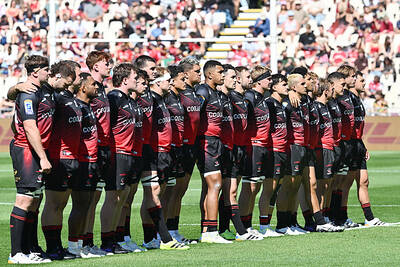
A new NZ$683 million (US$404 million) stadium that was a symbol of Christchurch’s struggle to rebuild after a deadly earthquake struck the New Zealand city is to host its first match tomorrow in front of a sellout crowd. A magnitude 6.2 earthquake killed 185 people in February 2011 and toppled or damaged buildings, including the city’s old Lancaster Park. The stadium, which hosted international rugby and cricket, and was home to the Canterbury Crusaders, was badly damaged and never reopened. It was bulldozed in 2019 and turned into sports fields, leaving the Crusaders without a permanent home. Government funding for a new stadium was

Some of Clearlake Capital Group’s largest investors are growing increasingly concerned about how much time the company’s co-founders are spending on sports investments as they have struggled to complete the fundraising for the private equity firm’s latest flagship fund. One of Clearlake’s co-founders, Behdad Eghbali, has been spending what some investors described as a disproportionate amount of time on the firm’s investment in Chelsea Football Club in recent months. Now, co-founder Jose E. Feliciano and his wife, Kwanza Jones, are nearing a record US$3.9 billion deal to acquire the San Diego Padres. That personal investment by Feliciano has set off the latest

The Philadelphia Flyers and the Pittsburg Penguins on Wednesday put a squeeze on the penalty box in Game 3 of their NHL playoff series — with 11 players cramped inside their designated punishment areas. Each could have snapped a team photo after a melee broke out in the second period of the Flyers’ 5-2 win over the Penguins in their Eastern Conference first-round series. “It was a party in there,” penalized Flyers defenseman Nick Seeler said. The celebration extended into the joyous locker room after the Flyers took a 3-0 series lead. Penguins forward Bryan Rust slammed Travis Konecny to the ice behind the


 RSS
RSS