


Inspired defending, some brilliant attacking, a dubious refereeing decision: Sunday's epic World Cup final could be seen as the 2006 tournament in microcosm.
At the conclusion of 64 matches spread over four memorable weeks, Italy were left celebrating their fourth World Cup crown to set alongside victories in 1934, 1938 and 1982.
In the end, Italy's masterful back four proved too much for France's spirited attacking effort, which was ultimately the overall story of the tournament. Defense ruled this year and goals were hard to come by.
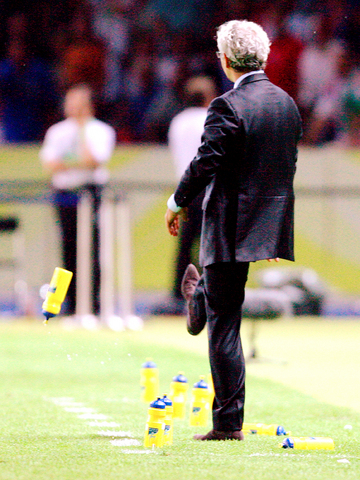
PHOTO: AFP
A controversial penalty awarded to France in the seventh minute also highlighted the difficulties referees have faced in officiating throughout the competition, Florent Malouda tumbling in the area after minimal contact.
But just like his colleagues elsewhere in the tournament, Sunday's referee Horacio Elizondo got much more right than wrong.
And when history judges the 18th World Cup, arguably the most entertaining for 20 years, the image evoked will be largely positive.
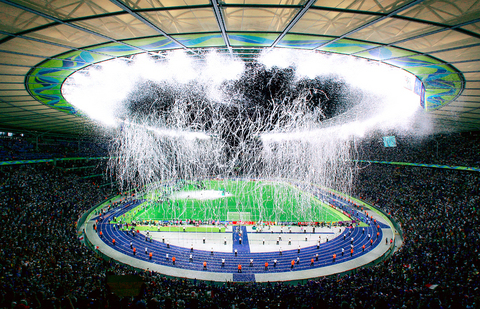
PHOTO: AFP
From the mesmerizing beauty of Argentina's 6-0 destruction of Serbia-Montenegro to the utterly absorbing drama of Italy's classic semi-final win over Germany, technical excellence was not hard to come by.
And though frequent examples of gamesmanship left a sour taste -- with players diving and urging referees to issue cards -- the vast majority of teams approached the tournament with a positive mindset.
Predictably the goals dried up when the knockout rounds began and caution prevailed, but ultimately fortune favored the brave, most notably when Italy coach Marcello Lippi hurled on two strikers in extra-time during the epic last-four collision with Germany.
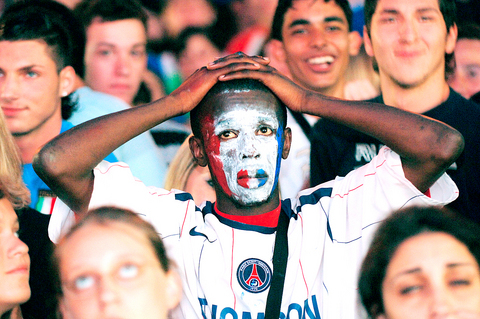
PHOTO: AFP
Unquestionably, FIFA's insistence on a month-long break between the end of the European season and the start of the World Cup paid dividends.
In 2002, France and Zinedine Zidane arrived in the Far East exhausted and were bundled out early; four years later and the benefits of a proper rest for "Les Bleus" were plain to see as they swept into the final.
So a World Cup that was expected to be dominated by a new breed of young tyros ended up with a final contested by two of the oldest teams in the tournament. That the final's protagonists were France and Italy reflected the dominance of Europe, as the football world was put back on its axis after the "Cup of Shocks" in 2002.
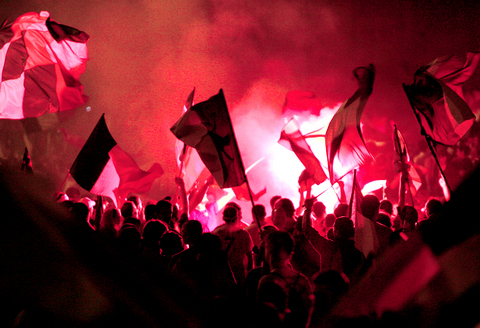
PHOTO: AFP
The South American challenge ended when both holders Brazil and Argentina were dumped out at the quarter-final.
Brazil's campaign proved to be a disappointment. With world player of the year Ronaldinho a strangely peripheral figure, the Brazilians failed to live up to the sum of their parts.
"We made some silly mistakes and that cost us," Brazil's glum coach Carlos Alberto Parreira said after his side's exit to France.
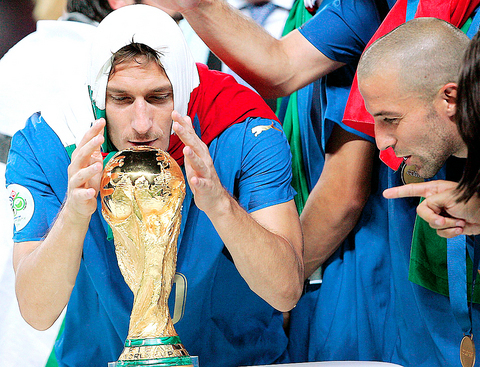
PHOTO: EPA
Argentina looked better equipped to carry the torch and produced some scintillating football in the first phase. The 24-pass masterpiece that culminated in Esteban Cambiasso's goal against the Serbs will go down as among the finest ever scored at a World Cup.
Yet when it mattered most, Argentina's adventure deserted them and they were dumped out on penalties to Jurgen Klinsmann's energetic Germany.
The penalty curse was also to account for England's attempt to win the World Cup for the first time since 1966.
PHOTO: EPA
That was how the Boston Globe newspaper assessed England's chances before the tournament and as predictions go it proved to be impossibly accurate.
Sven-Goran Eriksson's inept squad selection and tactics came back to haunt England and the Swede ended his five-year reign with a disastrous quarter-final exit to Portugal, beaten on penalties once more.
Yet while Eriksson departed under a hail of tabloid abuse, it could not disguise the fact that when it came down to it England's so-called "Golden Generation" turned out to be tin men.
PHOTO: AFP
Naturally, the resurgence of football's super-powers spelt trouble for the minnows. While upsets were the story of the 2002 finals, the emerging nations found the going far tougher in Germany.
Ghana and Australia were probably the best of the sides from Africa and Asia, advancing to the last 16 from tricky first round groups.
Ghana's Black Stars exited in the second round after stretching Brazil before losing 3-1.
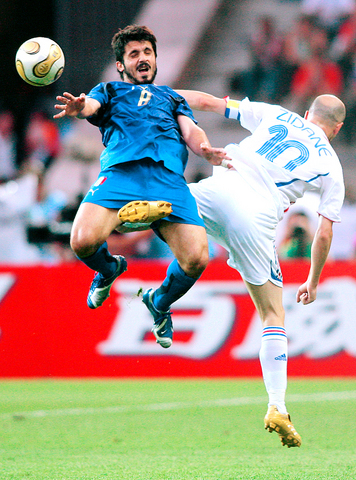
PHOTO: AFP
Australia, playing in the World Cup for the first time in 32 years, were desperately unlucky to lose 1-0 to Italy in the last 16, the decisive goal coming from the penalty spot in the fifth minute of stoppage time.
While the tournament may have ended for Germany at the last four stage, the World Cup was a dazzling triumph for the host nation.
Pre-tournament fears of hooliganism scarring the quadrennial fiesta proved unfounded, with crowd trouble restricted to a handful of isolated incidents involving relatively small numbers of fans.
"A time to make friends," was the slogan for the World Cup. Germany's population, and the estimated one million foreign fans who descended on the 12 venue cities, took up the challenge with gusto.
Hundreds of thousands crammed into "fan zones" set up in venue city centers, bringing a carnival atmosphere as Germany cast off its staid image.
The slogans on banners seen among one million fans gathered at Berlin's Brandenburg Gate on Sunday celebrated Germany's soccer players but could just as easily have been directed at the organizers of a memorable tournament: "Danke schoen!"
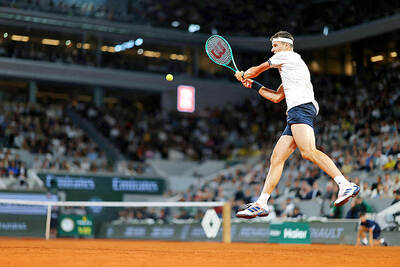
BIG NAMES GONE: Zverev is the clear favorite for a maiden Grand Slam title, reaching semi-finals for the fifth time in six years and finishing second on three occasions Alexander Zverev on Tuesday breezed past Rafael Jodar to stay on course for an elusive Grand Slam title at the French Open, while Jakub Mensik halted Joao Fonseca’s scintillating run in the quarter-finals. Zverev, the highest-ranked player left in the men’s draw, put an end to Spanish teenager Jodar’s impressive Roland Garros debut, easing into the semi-finals with a 7-6, (7/3), 6-1, 6-3 win. The 29-year-old Zverev is the clear favorite for a maiden Grand Slam title. He has finished runner-up on three occasions, including at the 2024 French Open. “I want to win the matches that are ahead of
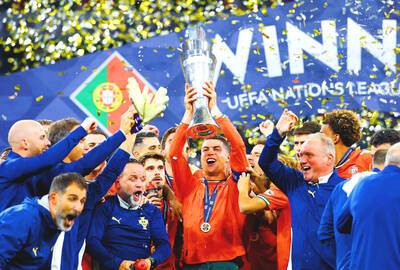
For some, Cristiano Ronaldo remains the essential spearhead for Portugal’s FIFA World Cup bid, while others believe his presence would prevent Roberto Martinez’s strong side from flourishing. The debate around the five-time Ballon d’Or winner rages on, as it did at UEFA Euro 2024 and four years ago in Qatar — yet Ronaldo endures, ready to play in a record sixth World Cup. The 41-year-old remains a global superstar despite swapping the European elite for Saudi Arabia’s Al-Nassr, and is the leading men’s international goalscorer with 143 strikes. With 25 of those coming in 30 games under Martinez, the coach
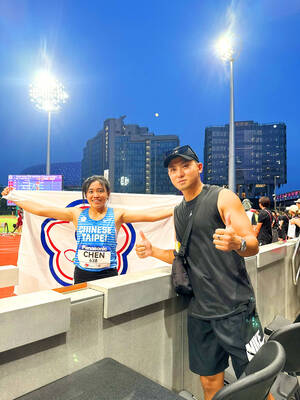
Taiwanese sprinter Chen Yi-cen on Friday won the silver medal in the women’s 400m final at the Asian U20 Athletics Championships in Hong Kong, with a time of 53.16 seconds. Chen, 15, was the youngest among the eight finalists, and her performance also met the qualifying standard of 53.50 seconds for the Nagoya Asian Games in Japan in September and October. Chen first made her mark at the National Games in Tainan in 2023, at the age of 13, winning the women’s 400m final in 55.55 seconds to become the youngest gold medalist in the history of the event. Meanwhile,
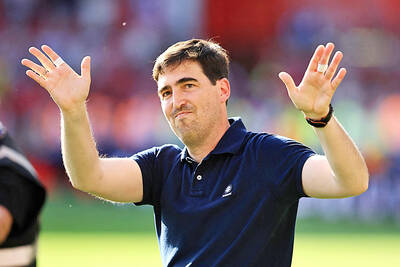
Liverpool are in advanced talks with former AFC Bournemouth manager Andoni Iraola as they seek a replacement for Arne Slot, reports said on Tuesday. Iraola has emerged as Liverpool’s top target to replace Slot, who was sacked on Saturday last week after a turbulent second season in charge. Liverpool have reportedly agreed a deal in principle to bring the Spaniard, who left Bournemouth at the end of this season, to Anfield. Sporting director Richard Hughes was heavily involved in hiring Iraola during his time at Bournemouth and is again spearheading the recruitment of the highly rated coach. The Reds are


 RSS
RSS