


Chinese Olympic table tennis champion Chen Qi's temper tantrum at a recent tournament did not amuse the country's famously strict sports discipline chiefs.
With echoes of the Cultural Revolution, and just two years out from the Beijing Olympics, Chen was ordered to be "re-educated" as part of an extraordinary set of punishments that have cast light on how China moulds its world-beating table tennis squad.
Chen, a 21-year-old who won gold in the men's doubles at the Athens Games, infuriated his mentors when he threw the ball and kicked a chair after losing the final of the Asia Cup in Japan on March 5 to compatriot Wang Hao.
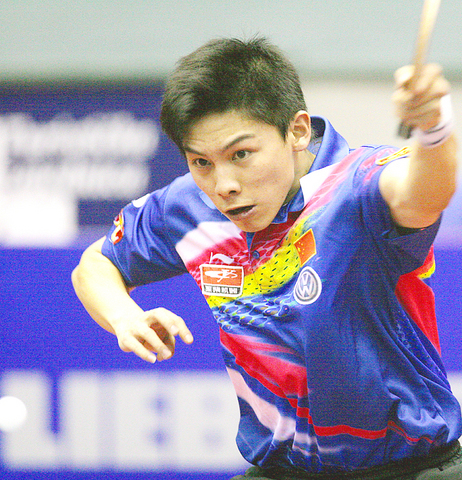
PHOTO: AP
"The case is very serious and the influence is extremely bad. A case this serious has hardly been seen over the past 50 years of Chinese table tennis history," China's table tennis association said in a statement.
"The principle is to treat the disease and save the person, and give a lesson to the whole team," it said.
Just as Mao Zedong (毛澤東) banished intellectuals to the countryside to "learn from the impoverished peasants" during the Cultural Revolution, Chen will be sent to work in a remote area of China for one week sometime over the next six months.
"Only by experiencing the hardship of impoverished country life can he learn his mistakes," the statement said.
He will also be sent to a People's Liberation Army boot camp for a week where drill sergeants will give him a dose of military-style discipline.
As further punishment Chen will be fined 10 percent of his entire earnings this year, while he has already been forced into a humiliating apology on national television.
"I lost both the match and my sportsmanship. I made a severe mistake and I created a terrible international impression. I apologize to everybody," Chen said with his head bowed.
"I will resolutely reflect, accept lessons, work hard to change, train hard and try my best to get good scores and achievements to repay the motherland and society. I just ask everyone to give me another chance," he said.
But in true Cultural Revolution style, Chen was not the only one to suffer.
Chen's main coach, Xiao Zhan, was fined 10,000 yuan (US$1,246) and banned from leading the national team in international competitions for six months.
Liu Guoliang, the head of the men's team, also fined himself 20,000 yuan and penalized several other coaches who had worked with Chen.
The money raised from the fines will be spent putting on extra classes for the team members in "political and mental education," the table tennis association's statement said.
Chen is just one of a long line of Chinese table tennis stars to have been strictly disciplined for their indiscretions.
In 1995 three players were fined 50,000 yuan each and forced to make self-criticisms for playing mahjong in their hotel room after a tournament.
Two years later Kong Linghui was fined 20,000 yuan and forced to make a public apology after he kicked the table in anger at an umpires decision during the National Games. Kong went on to win men's singles gold at the Sydney 2000 Olympics,
Yang Ying, an Olympic silver medalist, was suspended from the national team for three months in 1998 because she was three hours late reporting to the training camp after the Lunar New Year holiday.
In one of the more bizarre incidents, Li Nan had to apologize to the team in 2002 and endure a public criticism after a sports official saw her wearing a mud-pack face mask to cleanse her skin one evening during the Asian Games in South Korea.
The table tennis authorities said putting on the face-mask indicated her attitude to the tournament was too relaxed.
Li Nan and three other players were actually kicked off the team in 2004 when officials found they were involved in relationships with other team members.

Greek swimmer Kristian Gkolomeev was the only athlete to “beat” a world record on Sunday at the Enhanced Games, winning the men’s 50m freestyle at the divisive competition where athletes were free to take performance-enhancing substances. His time of 20.81 seconds — which is not considered official — came in the final event of the night in Las Vegas, sparing the blushes of organizers who made claims that multiple world records would be surpassed due to a sophisticated doping regime. Gkolomeev, who was wearing a synthetic “supersuit” long banned at events such as the Olympics, outpaced Australia’s Cameron McEvoy’s 20.88 set in
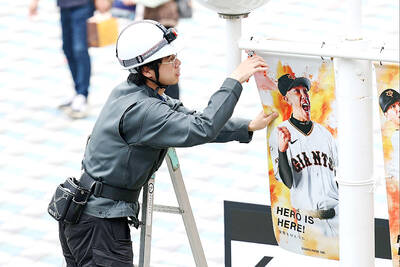
The manager of the Yomiuri Giants, one of Japan’s most popular baseball teams, resigned yesterday after he was arrested for allegedly physically attacking his teenage daughter. Shinnosuke Abe allegedly grabbed the 18-year-old and forced her to the floor at their home in central Tokyo on Monday evening, reported national broadcaster NHK and Kyodo News, citing unnamed police sources. “Leaving like this really means I’m causing you a lot of trouble, and I feel truly sorry about that,” Abe told a hastily arranged news conference, his eyes red with tears. The former star catcher, who is among baseball-obsessed Japan’s most recognized sports figures,

For some, Cristiano Ronaldo remains the essential spearhead for Portugal’s FIFA World Cup bid, while others believe his presence would prevent Roberto Martinez’s strong side from flourishing. The debate around the five-time Ballon d’Or winner rages on, as it did at UEFA Euro 2024 and four years ago in Qatar — yet Ronaldo endures, ready to play in a record sixth World Cup. The 41-year-old remains a global superstar despite swapping the European elite for Saudi Arabia’s Al-Nassr, and is the leading men’s international goalscorer with 143 strikes. With 25 of those coming in 30 games under Martinez, the coach

Taiwanese tennis star Hsieh Su-wei on Wednesday advanced to the second round of the mixed doubles at the French Open, after she and German partner Mark Wallner defeated Slovenian Andreja Klepac and Briton Lloyd Glasspool in straight sets, despite temperatures exceeding 32°C in Paris, while Taiwan’s top men’s doubles player Ray Ho also reached the second round. Hsieh, who made it to the semi-finals in the mixed doubles at Roland Garros in 2024, and Wallner defeated Klepac and Glasspool 6-3, 7-5 in just more than an hour, converting three of five break points, while holding their opponents to just one conversion


 RSS
RSS