


Weakened by the heat and a 1km sprint to the finish, Catherine Ndereba had to receive her winner's medal and olive wreath in a wheelchair.
As for the traditional bowl of beef stew, she took a pass.
It was much too hot for that.
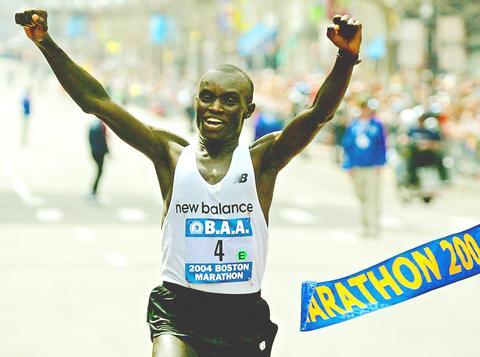
PHOTO: REUTERS
Ndereba won the Boston Marathon for the third time Monday, running together with Elfenesh Alemu for 16km before sprinting away in Kenmore Square to finish in 2 hours, 24 minutes, 27 seconds. The 16-second margin of victory matched the closest in the history of the women's event.
"Toward the finish, I felt like I was dead," said Ndereba, who collapsed to the pavement at the finish line. "All of the sudden, I had all those cramps and I could not stand ... The heat was too tough. So I was going out there knowing I had to run very smart."
Timothy Cherigat won the men's race in 2:10:37 to complete a Kenyan sweep. He broke away from Robert Cheboror right before Heartbreak Hill to win by 1:12 as Kenyan men took the first four spots and six of the first seven.
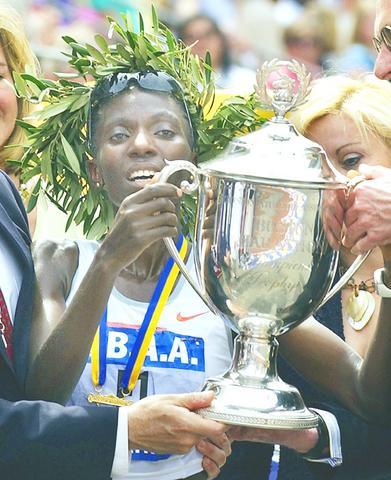
PHOTO: AP
A Kenyan man has won 13 of the last 14 Boston Marathons, and the country is so deep at the distance that Cherigat is not on the Olympic team despite winning the world's oldest and most prestigious annual marathon.
"It is sad because the team has already been chosen," he said. "I will wait for my time, and it will come."
For the women's field, the time came on Monday.
Four decades after a race official tried to run Kathrine Switzer off the course, the women were put in front of the race and given their own start. Leaving Hopkinton 29 minutes before the men and 20,000 recreational runners, Ndereba and Alemu didn't have to confront the clutter of men who glom onto the women's winners for pacing or TV exposure.
"It is so great and we have all the room," said Ndereba, the reigning world champion who won here in 2000-2001. "We have all the road to run wherever you feel like."
The two ran side-by-side and alone together for about 6km before reaching Kenmore Square -- 1.6km to go -- where Ndereba sprinted into the lead. Alemu, suffering from back pains and cramping, did not have the energy to respond.
"Catherine sped up, but I slowed down because of the pain in my back," Alemu said. "I wanted to improve my time, but the heat and the wind wouldn't allow me to do that."
Ndereba's time -- the 11th-best for a woman at Boston -- was fast for a tough course and one of the hottest races in the event's 108-year history. But it was temperate compared to the 96 degrees reached in the 1976 "Run for the Hoses."
Once again, spectators who live along the course tried to cool the runners by spraying their garden hoses onto the street. Others offered water that was eagerly accepted by the competitors.
"It slowed us down a lot," Cherigat said. "I kept pouring water over my head to keep cool."
It was 28? Celsius in Hopkinton when the female contenders began at 11:31am, leaving the traditional noon start for the men and the recreational field. By the midpoint in Wellesley, the temperature was 29 Celsius -- far above the average high of 14? C for April 19 in Boston.
Race officials prepared for the heat with extra water at every mile marker, and additional medical personnel throughout the course.
The Red Cross had double the usual amount of ice -- 36kg at each of 26 spots along the route, said Bruce Kahn, station supervisor at the starting line.
"We've got lots of ambulances standing by," he said. "If they don't cool off, it can be life threatening."
At least 800 runners sought medical attention along the course, and 136 were transported by ambulance to hospitals, race organizers said. Most of the medical problems stemmed from the heat.
By the time officials stopped counting, 16,793 runners had finished the course.
Ernst Van Dyk of South Africa won the men's wheelchair division with the fastest marathon in history, finishing in 1:18:27 to win for the fourth straight year. Van Dyk is tied with Franz Nietlispach (1997-2000) for the most consecutive victories in the men's wheelchair.
Cheri Blauwet of Menlo Park, California, won the women's wheelchair race in 1:39:53.

Taiwan’s men’s table tennis team won bronze on Saturday at this year’s International Table Tennis Federation World Team Table Tennis Championships in London, matching the country’s best-ever finish at the regular tournament. Consisting of Lin Yun-ju, Taiwan’s top-ranked player at world No. 7, Feng Yi-hsin, Kuo Guan-hong, Hong Jing-kai and Hsu Hsien-chia, the team won bronze after losing 0-3 to Japan in the semifinals. In the opening match, 24-year-old Lin played the first game against world No. 3 Tomokazu Harimoto 11-5, but ultimately lost the next three closely contested games 9-11, 10-12 and 10-12. Feng then faced world No. 8 Sora Matsushima in

Lin Yun-ju on Thursday handed Taiwan two key victories as they advanced to the semi-finals of the ITTF World Team Table Tennis Championships Finals in London. The Taiwan men’s table tennis team beat Sweden 3-2 in five singles matches. The 24-year-old Lin, Taiwan’s top-ranked player at world No. 7 and nicknamed the “Silent Assassin,” opened the tie by defeating world No. 2 Truls Moregard 3-0 (11-8, 11-9, 13-11) before clinching the deciding fifth match with a 3-0 (11-8, 11-9, 11-5) win over Anton Kallberg to hand his team the overall victory. Kuo Guan-hong put Taiwan up 2-0 with a 3-2 (4-11, 11-8, 8-11,

Taiwanese fire dancer Yang Li-wei advanced to the final of Britain’s Got Talent this weekend after receiving a Golden Buzzer during her live semi-final performance. Yang, a member of Taiwan’s Coming True Fire Group, awed judges and audiences with a high-intensity fire performance featuring flaming umbrellas, fire swallowing and spinning metal structures balanced with her legs. Judge Simon Cowell praised Yang as a star, while guest judge KSI reacted with amazement before pressing the Golden Buzzer, sending her to the finals. The dance group wrote on social media that the Golden Buzzer was “the highest honor” on the talent show, adding: “Twenty-three years

As Super Rugby fast approaches its playoff season it finds itself racing toward a reckoning with many issues that threaten the southern hemisphere tournament. A group of stakeholders met in the New Zealand city of Christchurch late last month to address problems that are making the future of the 31-year-old competition increasingly tenuous. The discussion was made more urgent by the decision by the owners of Moana Pasifika to fold the Auckland-based club for financial reasons. That followed the closure of the Melbourne Rebels at the end of the 2024 season, likewise because of financial difficulties. Problems addressed included player retention as more


 RSS
RSS