


A Taiwanese-German woman, long believed to be a key witness in the murder of navy Captain Yin Ching-feng (
Speaking at a press conference in Taipei yesterday to publicize her book, Surfacing: Mysteries about the Yin Ching-feng case, Tu Cheng Chun-chu (涂鄭春菊) said she hoped that her memoirs would help remove the label "key witness," which has been imposed upon her since the murder of Captain Yin.
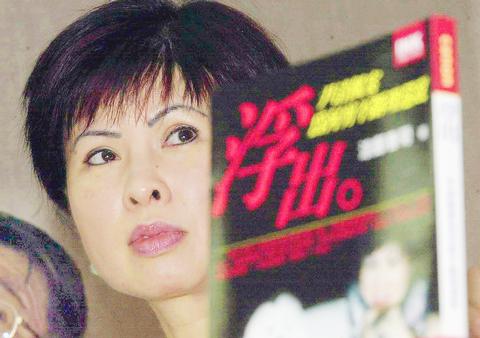
PHOTO: CHIANG YING-YING, TAIPEI TIMES
"My book is entitled `Surfacing' mainly as a declaration of my determination to speak openly about what I know -- and don't know -- of the Yin case," Tu said at the press conference.
For the past seven years, Tu has been one of the key witnesses in the Yin case. Part of the reason is that Tu was the person Yin planned to visit before he went missing.
"On that day, Dec. 9, around 7:00am, Yin Chin-feng called and said that he would be over in 10 minutes ... however, he never showed up," Tu wrote in her book.
Others also wondered why Tu left Taiwan immediately after one of Yin's colleagues informed her of the death. Yin's body was found drifting off the coast of Suao in Ilan County later that day, apparently killed by a blow to the back of the head.
"Yin talked with me on the phone before he died. But until I was informed of his death, I had no idea what had happened and I wasn't involved. I was also curious about what had happened to Yin," Tu said.
Tu said the reason she left the country following Yin's murder was because the navy had instructed her to do so.
"The navy told me that if any accident befell Yin, I would never be able to return to Taiwan again. And I asked the naval procurement officer `what does that have to do with me?'" Tu wrote in her book. "But he refused to give me an explanation."
At the time, Tu was in Taiwan negotiating with the navy over spare parts for four German-made minesweepers. She worked as a broker on behalf of a German arms manufacturer. Yin was sent by the navy to talk with her, since he was then the director of the navy's procurement office.
Tu, however, denied that she was an arms dealer.
"I was just handling the legal affairs of the deal," Tu said.
When asked by one reporter if she knew more about how Yin died and more details related to the case, Tu said, "If I knew I would tell you."
"All I know are some details related to the navy's procurement scandals during that period," Tu said.
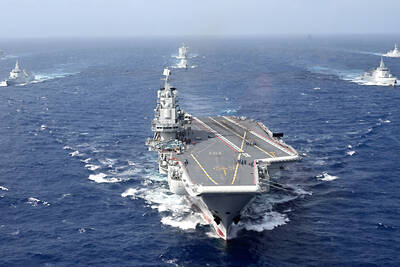
PROVOCATIVE: Chinese Deputy Ambassador to the UN Sun Lei accused Japan of sending military vessels to deliberately provoke tensions in the Taiwan Strait China denounced remarks by Japan and the EU about the South China Sea at a UN Security Council meeting on Monday, and accused Tokyo of provocative behavior in the Taiwan Strait and planning military expansion. Ayano Kunimitsu, a Japanese vice foreign minister, told the Council meeting on maritime security that Tokyo was seriously concerned about the situation in the East China and South China seas, and reiterated Japan’s opposition to any attempt to change the “status quo” by force, and obstruction of freedom of navigation and overflight. Stavros Lambrinidis, head of the EU delegation to the UN, also highlighted South China Sea

SILENCING CRITICS: In addition to blocking Taiwan, China aimed to prevent rights activists from speaking out against authoritarian states, a Cabinet department said The Ministry of Foreign Affairs (MOFA) yesterday condemned transnational repression by Beijing after RightsCon, a major digital human rights conference scheduled to be held in Zambia this week, was abruptly canceled due to Chinese pressure over Taiwanese participation. This year’s RightsCon, the world’s largest conference discussing issues “at the intersection of human rights and technology,” was scheduled to take place from tomorrow to Friday in Lusaka, and expected to draw 2,600 in-person attendees from 150 countries, along with 1,100 online participants. However, organizers were forced to cancel the event due to behind-the-scenes pressure from China, the ministry said, expressing its “strongest condemnation”
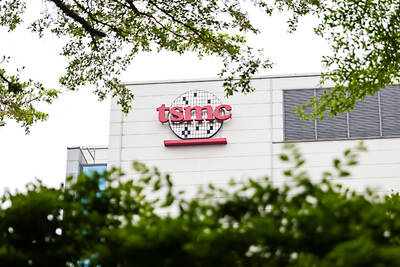
Taiwan Semiconductor Manufacturing Co (TSMC, 台積電), the world’s largest contract chipmaker, said it expects its 2-nanometer (2nm) chip capacity to grow at a compound annual rate of 70 percent from this year to 2028. The projection comes as five fabs begin volume production of 2-nanometer chips this year — two in Hsinchu and three in Kaohsiung — TSMC senior vice president and deputy cochief operating officer Cliff Hou (侯永清) said at the company’s annual technology symposium in Silicon Valley, California, last week. Output in the first year of 2-nanometer production, which began in the fourth quarter of last year, is expected to
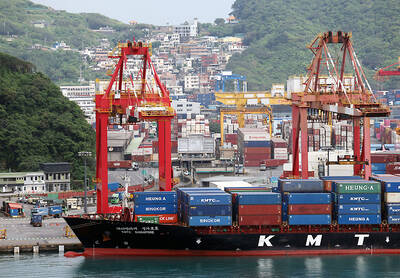
Taiwan’s economy grew far faster than expected in the first quarter, as booming demand for artificial intelligence (AI) applications drove a surge in exports, spilling over into investment and consumption, the Directorate-General of Budget, Accounting and Statistics (DGBAS) said yesterday. GDP growth was 13.69 percent year-on-year during the January-to-March period, beating the DGBAS’ February forecast by 2.23 percentage points and marking the most robust growth in nearly four decades, DGBAS senior official Chiang Hsin-yi (江心怡) told a news conference in Taipei. The result was powered by exports, which remain the backbone of Taiwan’s economy, Chiang said. Outbound shipments jumped 51.12 percent year-on-year to


 RSS
RSS