


Vice Minister of Education Fan Sun-lun (
She said that students should not be victimized due to partisan feuds in the Legislative Yuan.
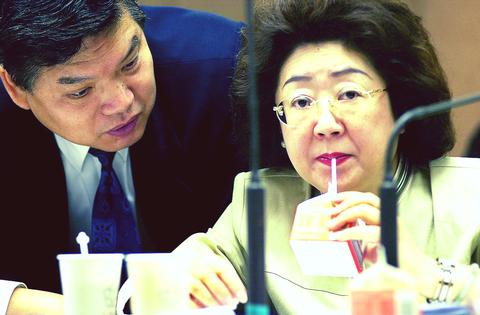
PHOTO: LIAO RAY-SHANG, TAIPEI TIMES
Students stricken by hunger have been a much-talked-about subject since last month when Chinese-language media reported that more than 70,000 primary school students could not afford to pay for the lunch meals provided by schools, and schools could not offer any help either, because the subsidy was frozen by the legislature.
As there has been no development on the issue because of differing views between the ruling and opposition parties on the issue, Fan yesterday voiced her concern and called on the lawmakers to seek for a timely solution for the sake of students.
For this fiscal year, NT$433 million has been apportioned to local governments for the lunch meals of elementary students.
However, in accordance with a newly passed legislative resol-ution, the Executive branch must first gain approval from the legislature at a monthly meeting regarding how the funding will be used, so that the legislature can better monitor the executive departments.
Fan said because of this regulation, the budget earmarked for the lunch meal was rejected twice this year -- on March 27 and April 26 respectively, when the Directorate General of Budget, Accounting and Statistics (主計處), under the Executive Yuan, reported to the legislature because the opposition alliance disapproved part of the subsidies for local governments.
The vice minister stressed that her appeal was not meant to prompt partisan feuding, but was to prevent students from suffering because of political conflicts.
But Fan also dismissed media reports that students were stricken with hunger.
She said no students should be suffering from hunger nowadays because -- although being strapped for cash -- the local governments have managed to cover part of the fees for students who are from low-income families. And, along with the assistance from charity groups and faculty members at the schools, she said, no students should be afflicted by starvation.
Opposition lawmakers, however, did not consider it fair for them to shoulder the blame.
They accused the ruling administration of fault, and said that the DPP was spreading wrong information intended to mislead the general public.
"The budget bill was not sent to the legislature until March. How can we finish the reviewing process now?" said PFP lawmaker Diane Lee
DPP lawmakers said the opposition alliance was "opposed for the sake of opposing," and its request solely indicated how the legislative power had overridden the executive power.
"It is absolutely unreasonable for the Executive branches to report to the legislature every month in detail how its budget is used. By doing so, [opposition parties] just attempt to gain control of the authority to distribute financial resources," said DPP lawmaker Wang Li-ping (

The National Chungshan Institute of Science and Technology yesterday showcased its locally developed variants of the Vision 60 robotic patrol dog, which it plans to deploy on the nation’s outlying territories in the South China Sea. The variants were produced under the Joint Lab project — created by the institute and domestic companies — and assembled with domestically produced motors, lenses and artificial intelligence (AI) systems alongside licensed tech from the US, Missile and Rocket Systems Research Division deputy director Jen Kuo-kang (任國光) told the media event at a military base in Taipei’s Dazhi (大直) area. Taiwan has built up its strengths

RIGHT DIRECTION: Taiwan’s efforts to prevent forced labor include a proposal to ‘fully prohibit’ employers from withholding workers’ documents, an official said Taiwan is to establish a mechanism to restrict imports of goods linked to forced labor, the Executive Yuan said yesterday, after the US proposed imposing additional tariffs on Taiwanese goods over labor concerns. “The Ministry of Labor and the Ministry of Economic Affairs are to establish an interministerial review procedure,” Executive Yuan spokesperson Michelle Lee (李慧芝) said at a news briefing in Taipei. “The government is to use the Foreign Trade Act [貿易法] as the legal basis to restrict imports of goods produced with forced labor” and bring its supply chain governance more in line with international standards on human rights, resilience

NOT IMMEDIATE: Taiwan has a chance to appeal the proposed 10 percent tariff before it starts, while other countries face a 12.5 percent tariff from the trade office Taiwan is among 60 economies determined by the US to have failed to impose or enforce a ban on the importation of goods produced with forced labor, according to a notice released on Tuesday by the Office of the US Trade Representative (USTR), which proposed imposing an additional 10 percent or more tariff on them. The USTR in a statement said that following an investigation, it had determined under Section 301 of the Trade Act of 1974 that the failure of the 60 economies to impose and effectively enforce a prohibition on the importation of goods produced with forced labor is

TIT-FOR-TAT: The US allegedly revoked the visa of a Chinese national working at Xinhua News Agency in the US in response to Beijing’s expulsion of Vivian Wang The Presidential Office yesterday condemned China for expelling a New York Times correspondent from Beijing following the newspaper’s interview with President William Lai (賴清德), saying the move highlighted Beijing’s suppression of press freedom and its threat to international news media. Taiwan has noted a series of recent incidents in which Beijing used similar tactics to “threaten and pressure international media outlets and journalists,” Presidential Office spokeswoman Karen Kuo (郭雅慧) said in a statement. “This concerns not only press freedom and freedom of expression, but also the safety of journalists, and Taiwan and relevant partners are paying close attention to the situation,” she


 RSS
RSS