


Film director Ang Lee (李安) yesterday received a welcome befitting a hero in his hometown of Tainan from students of Tainan First High School (台南一中), where he spent so much of his youth.
After winning four Oscars for his martial arts epic Crouching Tiger, Hidden Dragon (
Lee's gifts for his mother included a hug, a birthday cake, and a glowing Oscar statuette.
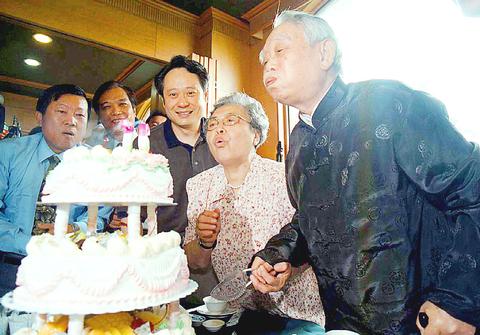
PHOTO: WU HSING-HUA, TAIPEI TIMES
"I wish her to stay young forever. She is, like my father said, still naive, like a child," said Lee, with a joyous smile. He was accompanied by Yang, his father Lee Sheng (
It was not the first time the 47-year-old filmmaker had returned home with a statuette. In 1996, Lee brought a Golden Globe Award for his father's 80th birthday, won for the film Sense and Sensibility.
As the first Taiwanese filmmaker to win an Oscar, Lee's return this time is glorious indeed. Lee chose to share some of the honor bestowed upon him with his alma mater, Tainan First High School. The school, where Lee spent his boyhood days, gave him a hero's welcome.
Lee's father, Lee Sheng, was principal of the school for more than two decades.
Dozens of students jammed up against the school's fence next to the teacher's dormitory where Lee's family still resides, leaning against the bars shouting, "We love you, director! We want the statuette!"
Responding to his "fellow schoolmates," Lee said "I am bringing back my happiness to share with everyone here, in the place I grew up."
"So I brought the statuette here specially to let everyone touch it," Lee said, lifting up the Oscar in triumph. He later gave a speech at the school.
Returning home for Lee is a journey full of complexity and joy.
Lee recalled, "my circle of life during my youth was around the school and my house, the teacher's dormitory. I was a shy boy and a good student in class and at home. But I was not happy. I went to a bushiban every day, and that took up all my free time during those days. The only happy time I remember ... was the movies I went to every Saturday afternoon, my escape from reality," he said.
"The further I went away from home, the more freedom I had. But ... Chinese culture is a tricky thing. The more you want to escape the more you are seized by it. The more you are forced to face how you were brought up and your character," he said.
Lee went on to explain that, had he not gone overseas, he would not have had the chance to study Chinese culture from a "Western angle," referring to his cross-cultural film The Wedding Banquet (喜宴), a bittersweet comedy about traditional Taiwanese parents dealing with their son's homosexuality.
"I am the son in the film the Wedding Banquet. You think you're having a happy life in New York, but your family and those family rules come and grab you!" he said, jokingly.
The schedule for Lee's six-day visit also includes a meeting with President Chen Shui-bian (
Chen was Lee's schoolmate at Tainan First High School, although he was two years ahead of him. Chen will travel to Tainan to meet Lee.
On Thursday, the director will meet with Government Information Office (
Lee is also scheduled to meet with KMT Chairman Lien Chan. Lee's Pushing Hands, the Wedding Banquet and Eat Drink, Man Woman were all sponsored by the Central Motion Picture Corporation (

‘NO SECURITY RISK’: The Railway Bureau reassured the public that the technicians’ activities were limited to technical guidance and did not involve sensitive systems The Railway Bureau yesterday said it had invited eight Chinese technicians to assist with an airport MRT construction project. The bureau issued the confirmation after an Internet user said Chinese nationals had entered the construction zone of Taiwan Taoyuan International Airport’s Terminal 3 project. They asked why “individuals from an enemy state” were allowed access to such a major national infrastructure project, which raised serious concerns over Taiwan’s industrial safety, sensitive systems and information security. The bureau’s Northern Region Engineering Branch Office said subcontractor Taiwan Handle Industrial Co (台灣手把工業) of the Taoyuan airport MRT’s “Contract No. CU05 Project A14 Station Civil, MEP &

A US uncrewed surface vessel (USV) encountered multiple Chinese warships during an autonomous transit of the Taiwan Strait, US defense company Seasats said in a statement on Wednesday. Seasats announced that a Lightfish USV had completed the first autonomous transit of the Taiwan Strait. Over five days, the USV traversed the entire length of the Strait while constantly monitoring surface vessel traffic, the company said. The Lightfish encountered multiple Chinese warships, one of which was a Chinese People’s Liberation Army Navy (PLAN) Type 056 corvette, it said. The Chinese vessels were operating “well within Taiwan’s exclusive economic zone without transmitting their identity via the
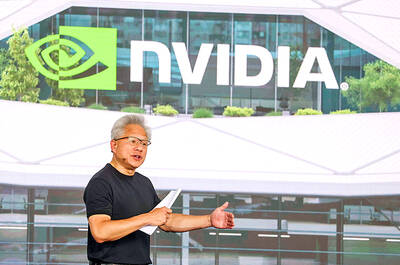
‘BOOMING’: ’ The number of partners we have here is incredible. You can see from their stock prices. They’re doing so well, they’re so happy,’ Jensen Huang said Nvidia Corp’s spending in Taiwan has ballooned to about US$150 billion a year, 10 times the US$10 billion to US$15 billion the company spent five years ago, Nvidia chief executive officer Jensen Huang (黃仁勳) said yesterday, suggesting Taiwan’s strategic importance in the global artificial intelligence (AI) supply chain. “Taiwan is the epicenter of the AI revolution. This is where the chips come, packaging comes. This is where the systems are made. This is where AI supercomputers were created,” Huang said at a meeting for the company’s employees in Beitou-Shilin Technology Park (北投士林科技園區) in Taipei, the planned site of Nvidia’s Taipei headquarters. “Taiwan
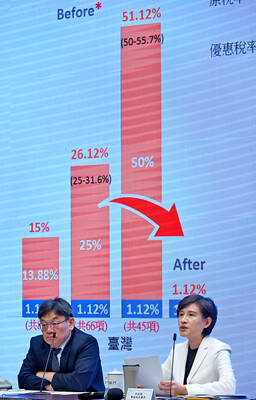
GREATER REACH? Auto parts and wood products would face tariffs of up to 15%, matching those targeting the EU, Japan and South Korea, Vice Premier said The US has announced that preferential tariff treatment for Taiwan’s non-semiconductor Section 232 goods would take effect retroactively from May 1, the Executive Yuan said yesterday. The US government yesterday posted a notice on the Federal Register’s public inspection Web site previewing tariff concessions for Taiwan under a memorandum of understanding (MOU) on Taiwan-US investment after two months of negotiations. The MOU signed on Jan. 15 stipulated three major preferential tariff arrangements: a 15 percent “reciprocal” tariff rate for Taiwan without stacking most-favored nation (MFN) rates; preferential Section 232 treatment for semiconductors and related products; and preferential Section 232 treatment for non-semiconductor


 RSS
RSS