


The battle over the Fourth Nuclear Power Plant has shifted from the legislative and executive branches of government to the Control Yuan, as members of the country's watchdog for public officials vowed to speed up their investigation into the Cabinet's Oct. 27 decision to halt construction of the plant.
While the Cabinet announced on Wednesday that the project, which was interrupted for almost four months, would proceed, the future of the plant is far from secure.
"The political responsibility that should be shouldered by the officials involved is not our concern. We [the five-member special task force of the Control Yuan] will focus on the legal aspects of the decision-making process. That is, whether the decision was reached in accordance with the law," said Lin Shih-chi (
Lin went on to dismiss rumors that the resumption of construction of the power plant would affect the Control Yuan's decision.
"Our determination to make an impartial ruling ... has never been shaken. It is also unfair to make any speculation at the moment as the first meeting will not be held until next week."
Lin said that although no definite timetable had been set, they would proceed as quickly as possible.
In related news, disenchanted by the Cabinet's giving ground to renew the power plant's construction, anti-nuclear groups yesterday appealed to the Control Yuan, claiming that the government had failed to conduct a new environmental impact assessment (EIA) for the power plant, given that the specifications for the reactors had changed since the initial EIA was approved.
The petitioners said that the Cabinet was irresponsible to allow further construction of the plant as a significant increase to the planned power output of the reactor had been made, but not officially approved by the relevant government agency.
According to Kao Cheng-yen (
Kao pointed out that the government departments in charge had been censured in the past by the Control Yuan for failure to follow proper procedures, but so far no compensatory measures had been taken.
Government agencies also came under attack for failing to reassess the plant's earthquake resistance, as well as failing to find a proper site for the nuclear waste it would generate.
In response to the attacks, Control Yuan member Kang Ning-hsiang (
"Citing the change to the power output of the reactor, for example, how could such a vast change be made without a safety assessment being made beforehand" Kang said. "The assessment has to be done, and it needs to be done in accordance with an even stricter standard."
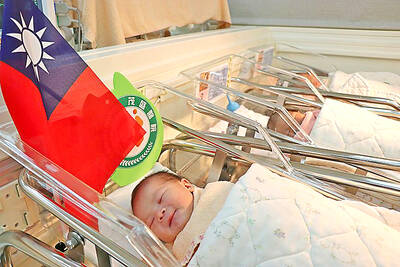
AGING: As of last month, people aged 65 or older accounted for 20.06 percent of the total population and the number of couples who got married fell by 18,685 from 2024 Taiwan has surpassed South Korea as the country least willing to have children, with an annual crude birthrate of 4.62 per 1,000 people, Ministry of the Interior data showed yesterday. The nation was previously ranked the second-lowest country in terms of total fertility rate, or the average number of children a woman has in her lifetime. However, South Korea’s fertility rate began to recover from 2023, with total fertility rate rising from 0.72 and estimated to reach 0.82 to 0.85 by last year, and the crude birthrate projected at 6.7 per 1,000 people. Japan’s crude birthrate was projected to fall below six,
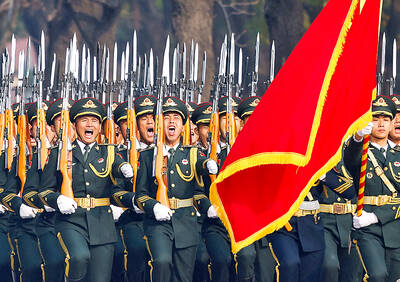
Conflict with Taiwan could leave China with “massive economic disruption, catastrophic military losses, significant social unrest, and devastating sanctions,” a US think tank said in a report released on Monday. The German Marshall Fund released a report titled If China Attacks Taiwan: The Consequences for China of “Minor Conflict” and “Major War” Scenarios. The report details the “massive” economic, military, social and international costs to China in the event of a minor conflict or major war with Taiwan, estimating that the Chinese People’s Liberation Army (PLA) could sustain losses of more than half of its active-duty ground forces, including 100,000 troops. Understanding Chinese
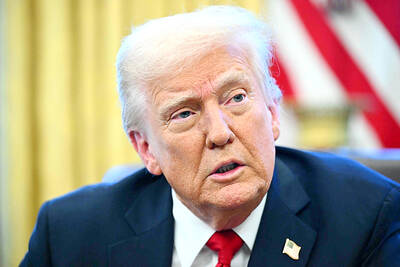
US President Donald Trump in an interview with the New York Times published on Thursday said that “it’s up to” Chinese President Xi Jinping (習近平) what China does on Taiwan, but that he would be “very unhappy” with a change in the “status quo.” “He [Xi] considers it to be a part of China, and that’s up to him what he’s going to be doing, but I’ve expressed to him that I would be very unhappy if he did that, and I don’t think he’ll do that. I hope he doesn’t do that,” Trump said. Trump made the comments in the context
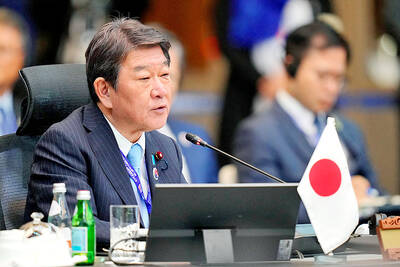
SELF-DEFENSE: Tokyo has accelerated its spending goal and its defense minister said the nation needs to discuss whether it should develop nuclear-powered submarines China is ramping up objections to what it sees as Japan’s desire to acquire nuclear weapons, despite Tokyo’s longstanding renunciation of such arms, deepening another fissure in the two neighbors’ increasingly tense ties. In what appears to be a concerted effort, China’s foreign and defense ministries issued statements on Thursday condemning alleged remilitarism efforts by Tokyo. The remarks came as two of the country’s top think tanks jointly issued a 29-page report framing actions by “right-wing forces” in Japan as posing a “serious threat” to world peace. While that report did not define “right-wing forces,” the Chinese Ministry of Foreign Affairs was


 RSS
RSS