


The Control Yuan yesterday reached an agreement to impeach Minister of Education Ovid Tzeng (
The decision makes Tzeng the first educational minister in history -- and also the first Cabinet member in the newly formulated government -- to be impeached by the country's supreme watchdog body.
"The conclusion was made after careful consideration ? Nine out of 10 members of the special task force supported the impeachment decision. Tzeng breached two regulations -- Article 10 of the Nationality Law's Enforcement Statute (
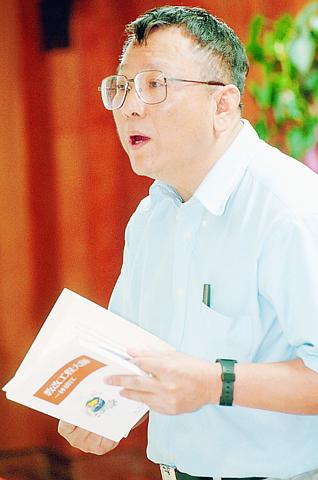
TAIPEI TIMES FILE PHOTO
According to Article 10 of the Nationality Law's Enforcement Statute, employees of state-run education facilities are public officials and have to give up citizenship of other countries.
The Nationality Law was subsequently revised in February of this year, stating that only those who gain approval from their supervisors can hold dual citizenship and serve as the president of a national university.
When Tzeng held the previously stated three posts, he was in violation Article 10 of the Nationality Law's Enforcement Statute.
Even after the Nationality Law was amended, the minister still transgressed Article 20 of the newly revised Nationality Law on the ground that he never applied for approval from the Ministry of Education -- his direct supervisory unit at the time, Lin said.
"In August 1998, the Examination Yuan's Ministry of Personnel released an order to all public officials, requesting them to renounce dual citizenship within a year.
Tzeng ignored the directive. In March of 1999, when Tzeng bid to become the president of YMU, he promised that he would forsake his US citizenship if elected. He was elected and started his stint in June 1999. He then notified the school authorities that he would give up his US citizenship within a year.
The deadline to carry out this promise was June 29 of this year," Lin continued. "Though Tzeng stressed that he had gone to the American Institute in Taiwan to officially give up his US citizenship on June 5, the procedures were not completed until July 14, which was too late."
The related documents will be sent to the Committee on the Discipline of Public Functionaries (CDPF,
Member Li Shen-yi (
"The decision will not affect Tzeng's current post as the minister of education, but he is still liable for his misconduct in the past," he said.
Upon hearing the news, Tzeng said that he respected the decision made by the Control Yuan, adding that he would abide by the laws of the country. "If the impeachment is confirmed and the relating legal procedures are completed, I will do what is right according to the law."
Chung Chin (鍾琴), director of the Government Information Office (新聞局), told the media after being told the news that what Tzeng had done in the past did indeed leave plenty of room for criticism.
"We all feel regret about the consequences of his actions and will accept the decision made by the CDPF," she added.

AGING: As of last month, people aged 65 or older accounted for 20.06 percent of the total population and the number of couples who got married fell by 18,685 from 2024 Taiwan has surpassed South Korea as the country least willing to have children, with an annual crude birthrate of 4.62 per 1,000 people, Ministry of the Interior data showed yesterday. The nation was previously ranked the second-lowest country in terms of total fertility rate, or the average number of children a woman has in her lifetime. However, South Korea’s fertility rate began to recover from 2023, with total fertility rate rising from 0.72 and estimated to reach 0.82 to 0.85 by last year, and the crude birthrate projected at 6.7 per 1,000 people. Japan’s crude birthrate was projected to fall below six,
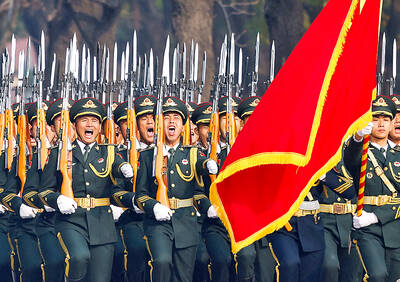
Conflict with Taiwan could leave China with “massive economic disruption, catastrophic military losses, significant social unrest, and devastating sanctions,” a US think tank said in a report released on Monday. The German Marshall Fund released a report titled If China Attacks Taiwan: The Consequences for China of “Minor Conflict” and “Major War” Scenarios. The report details the “massive” economic, military, social and international costs to China in the event of a minor conflict or major war with Taiwan, estimating that the Chinese People’s Liberation Army (PLA) could sustain losses of more than half of its active-duty ground forces, including 100,000 troops. Understanding Chinese
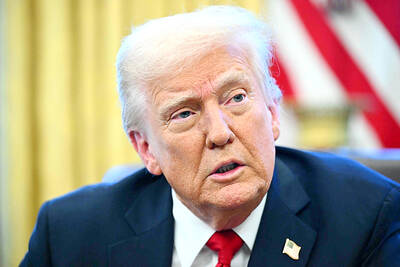
US President Donald Trump in an interview with the New York Times published on Thursday said that “it’s up to” Chinese President Xi Jinping (習近平) what China does on Taiwan, but that he would be “very unhappy” with a change in the “status quo.” “He [Xi] considers it to be a part of China, and that’s up to him what he’s going to be doing, but I’ve expressed to him that I would be very unhappy if he did that, and I don’t think he’ll do that. I hope he doesn’t do that,” Trump said. Trump made the comments in the context
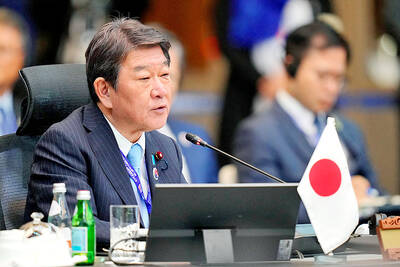
SELF-DEFENSE: Tokyo has accelerated its spending goal and its defense minister said the nation needs to discuss whether it should develop nuclear-powered submarines China is ramping up objections to what it sees as Japan’s desire to acquire nuclear weapons, despite Tokyo’s longstanding renunciation of such arms, deepening another fissure in the two neighbors’ increasingly tense ties. In what appears to be a concerted effort, China’s foreign and defense ministries issued statements on Thursday condemning alleged remilitarism efforts by Tokyo. The remarks came as two of the country’s top think tanks jointly issued a 29-page report framing actions by “right-wing forces” in Japan as posing a “serious threat” to world peace. While that report did not define “right-wing forces,” the Chinese Ministry of Foreign Affairs was


 RSS
RSS