


The Taipei District Court on Thursday granted a divorce to a 35-year-old man, who felt unable to maintain his marriage to his wife after she suffered a brain tumor three years ago that left her comatose.
The court reasoned it was natural, in the husband's situation, to lose the intention to maintain the marriage. It also awarded custody of their seven-year-old daughter to the father.
An initial glance at the ruling may suggest Taiwan has very liberal divorce laws, under which terminating a marriage is a simple matter. Some, however, suspect the result may have been radically different had the tables been turned, and the wife had requested a divorce from her disabled husband.
"Chances are that the court would deny the divorce and remind the wife of her moral obligations to look after her sick husband. In extreme cases, the court would even scold the wife for her attempts to get a divorce when her husband needs her more than at any other time," said Yu Mei-nu (
Since the Civil Code was created in 1930, the family chapter of the code has become the most cited law governing marriage and other relationships deriving from it.
The chapter, however, is viewed by the nation's women groups as a "nightmare" for married women because of its male bent.
Step by step, women groups have struggled to reverse the gender inequality set within the law over the past decade. Some victories were scored, from major changes in the Custody Law to minor changes in the Property Law, but these were just small battles in a major war.
The first victory
Four years ago, it was stated in the Custody Law that the court should award child custody to the father where a divorced couple could not reach an agreement themselves over the issue.
Until 1996, amendments were made to the custody law so that the court has final say on which party will receive child custody, depending on the best interests of the child. Notably, the change was only made possible after an interpretation by the Council of Grand Justices, handed down in 1994, which determined the custody law was biased toward men and violated the rights to equality protected under the Constitution.
"If not for the council ruling, we wouldn't have got there so early," Yu said, in recalling that first victory for women's groups in their struggle for equal standing before the law.
Indeed, it was under pressure of a so-called "sunset clause," which would render the law invalid after two years and was attached to the interpretation, that the legislature passed the amendment to the custody law in 1996. The initial victory was heartening for women's groups, but the battle has continued to be an uphill one.
Property law binds women
Women's groups have argued that the entire family chapter of the Civil Code is so blatantly biased against women that a complete overhaul is required to rectify the situation. To their dismay, the Ministry of Justice has opted for a gradual three-step introduction process for new equality measures, fearing dramatic moves may be too upsetting.
Reluctantly, women's groups have agreed to the three-phase plan.
Following the first phase, in which the amendment to the custody law was made, the legislature passed other amendments in 1998 to allow a woman to decide whether to use her husband's last name after marrying and to have a say on where should be the couple's registered residence.
Progress has been made, but at a glacial pace.
Amending the Property Law, which the women's groups blame for the worst injustices against married women, was first proposed almost a decade ago.
However, to this day, draft amendments to the law are collecting dust in the legislature without the possibility of their being passed in this session.
"With the new legislature to be elected next winter, the whole process will have to start all over again," Yu lamented, noting new rules in the legislature which state that stock bills must be cleared out with the replacing of the legislature.
The Property Law states that a husband has total control over his and his wife's property if no settlement has been made.
"Imagine if a wife wants to keep her own car, and her husband wants the car, too. She actually can do nothing but let him take it because the law says he has the rights to her property," Yu said. "And what if the husband wants to sell his wife's house? She can't prevent it because the law gives him the rights. When marriages break down, lots of women would rather maintain appearances than go through with a divorce. But don't think they're doing this out of family values or whatnot. Most of them are just afraid they'd end up with nothing after the divorce," she said.
Divorce on the rise
Ten years ago, a total of 27,479 couples divorced by agreement or by trial in a one-year period, amounting to 1.4 out of 1,000 people.
The number jumped to 49,157 in 1999, which translates to 2.2 out of 1,000 persons.
Pointing to the rapidly rising divorce rate, conservative groups have warned against what they see as the gradual erosion of traditional family values. However, there are also occasional complaints about the difficulty of obtaining a divorce in Taiwan's courts.
Currently, Taiwan's divorce law allows a divorce on 10 grounds, such as bigamy, adultery, cruelty, desertion, insanity, incurable and so-called "infamous" diseases, and imprisonment. But an exception is allowed as long as a third party can provide sufficient proof the marriage is irreparable.
Among the more distressing results of the difficulty of actually getting a divorce is the lack of guarantee for women's safety in cases where divorces are not granted.
An example is raised of a wife who requested a divorce because she could no longer tolerate her husband's violent acts. Her husband suffered from mania -- a mental illness marked by excitement and violence. The couple's children testified in court against their father, saying they frequently saw their father beating the mother. This testimony and other evidence led the court to determine that the husband was indeed beating his wife.
Despite the incriminating evidence against the husband, the court denied the divorce on the ground that mania did not fit into the definition of incurable and infamous disease. Not surprisingly, the wife was so dismayed with the court decision that ultimately she fled with her children.
"This type of incident has happened, indeed, but not as much now as it did before," said Sheng Feng-wei (
"The law has limits, especially in regard to family matters," Sheng said. "I always feel society expects too much of the court to resolve problems of a family. How can you expect judges to take sides when they're also supposed to be neutral toward all disputes?"
Marriage ends, obligations don't
Time passes and society changes, but many women still feel it is a moral flaw to walk away from a marriage, even if they are not happy with it.
"We don't want to encourage moralistic thoughts, because it's unfair to have one party stuck in an unhappy marriage just to make others feel comfortable," said Yang Feng-wan (
Women's groups have made great efforts to fight for better protection for women under the existing legal framework and have also taken pains to help people understand the nature of marriage.
"When love is gone, it's painful to remain in a relationship. This is true both for men and women," Yang said. "I think what has made divorce such a terrible word in Taiwan is a misunderstanding about the nature of marriage. Love is the foundation of marriage. But with marriage also come obligations. A marriage might end, but the obligations won't," Yang said. "As long as it is safe, no one should be afraid of walking out of a unhappy marriage."

LEVERAGE: China did not ‘need to fire a shot’ to deny Taiwan airspace over Africa when it owns ‘half the continent’s debt,’ a US official said, calling it economic warfare The EU has raised concerns about overflight rights following the delay of President William Lai’s (賴清德) planned state visit to the Kingdom of Eswatini after three African nations denied overflight clearance for his charter at the last minute. Taiwanese allies Paraguay and Saint Kitts and Nevis, as well as several US lawmakers and the Inter-Parliamentary Alliance on China (IPAC) condemned China for allegedly pressuring the countries. Lai was scheduled to fly directly to Taiwan’s only African ally from yesterday to Sunday to celebrate the 40th anniversary of King Mswati III’s accession and his 58th birthday, but Seychelles, Mauritius and Madagascar suddenly revoked

The number of pet cats in Taiwan surpassed that of pet dogs for the first time last year, reaching 1,742,033, a 32.8 percent increase from 2023, the Ministry of Agriculture said yesterday, citing a survey. By contrast, the number of pet dogs declined slightly by 1.2 percent over the same period to 1,462,528, the ministry said. Despite the shift, households with dogs still slightly outnumber those with cats by 1.2 percent. However, while the number of households with multiple dogs has remained relatively stable, households keeping more than two cats have increased, contributing to the overall rise in the feline population. The trend

China on Wednesday teased in a video an aircraft carrier that could be its fourth, and the first using nuclear power, while making an allusion to Taiwan and vowing to further build up its islands, as it looks to boost maritime power, secure resources and bolster territorial claims. The video, issued on the eve of the 77th founding anniversary of the Chinese People’s Liberation Army Navy, featured fictional officers with names that are homophones of three commissioned aircraft carriers, the Liaoning (遼寧), Shandong (山東) and Fujian (福建). Titled Into the Deep, it showed a 19-year-old named “Hejian” (何劍) joining the group, sparking
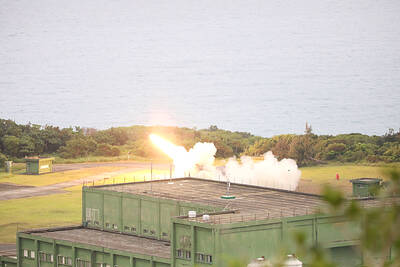
Taiwan has signed six arms procurement offers from the US totaling more than NT$208 billion (US$6.59 billion) covering long-range precision strike systems, missile stockpile replenishment and joint production of large-caliber ammunition, the Ministry of National Defense said yesterday. The government’s proposed NT$1.25 trillion special defense budget has been stalled in the Legislative Yuan as opposition lawmakers question the amount and procurement items, while the Presidential Office and defense ministry say that the full amount is necessary to safeguard Taiwan. Minister of National Defense Wellington Koo (顧立雄) on Monday briefed the legislature’s Foreign Affairs and National Defense Committee on the defense budget for


 RSS
RSS