


With Chief of the General Staff, General Tang Yao-ming (湯曜明) having refused to fill the defense minister position, it appears increasingly likely that Taiwan's representative in Holland, ex-Navy Commander-in-Chief Ku Chung-lien (顧崇廉) will take the position, defense officials said yesterday.
The likelihood that Ku would become defense minister increased after President-elect Chen Shui-bian (陳水扁) said yesterday that his main selection criteria is to keep a balance of power between the services.
Chen reportedly made the statement during a meeting with Ni Chang-yi (黎昌意), son of the ex-chief of the general staff (CGS), and with current strategic advisor to the President, Ni Yue-si (黎玉璽). Chen said he visited Ni to pay his respects and to seek advice from the retired admiral.
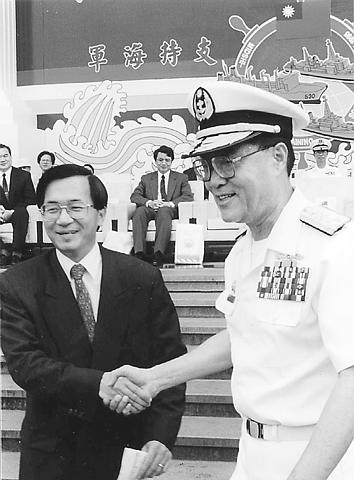
FILE PHOTO FROM THE LIBERTY TIMES.
Ni, 86, is the second naval general and former-CGS that Chen has visited since winning the presidential election on March 18.
Previously, Chen visited former naval leader and ex-CGS Liu Ho-chien (劉和謙), to whom Chen promised a place in the presidential office as a consultant.
Chen's visits to the two retired naval leaders were the only visits he made openly to former military leaders. Analysts say that this shows Chen's preference for the navy in his plans for armed forces development in the next four years.
Chen's desire to maintain a "balance of power" between the services would be met if he appoints Ku as the next defense minister. Chen has already settled arrangements for the air force and the army leadership by selecting Tang Fei (唐飛), from the air force, as premier, and by keeping incumbent CGS army General Tang Yao-ming in his current position.
A high-ranking official with the Ministry of National Defense (MND), who declined to be identified, said Chen also has personal reasons for choosing Ku for the defense minister post.
The two developed good relations seven years ago when Ku was vice defense minister and Chen was a lawmaker for the opposition DPP, the official said.
"The relations between the two got even better after Ku took over the command of the navy from Chuang Ming-yao (莊銘耀), who stepped down because of the murder of subordinate captain Ying Ching-feng (尹清楓)," the official said. "Ku often invited Chen, who then was Taipei mayor, to attend naval ceremonies as an honored guest, a move which aroused complaints from the conservative military leadership."
Although Chuang is also a possible candidate for defense minister, his chances are slim because the Yin murder case remains unsolved, the official said.
Su Chin-chiang (蘇進強), a military analyst at Nanhua University, said that if Chen appoints Ku as the new defense minister, there will be two main implications.
"First, Chen appreciates and trusts Ku's ability and willingness to negotiate with and listen to opinions of people outside the military. It is this same quality that he values in Tang Fei and both Tang and Ku will be able to help Chen implement the new Defense Law and Organization Law for the MND," Su said.
Second, "the move indicates a new direction for arms build-up in the future. Taiwan will need a stronger air force and navy. No other island country puts so much emphasis on the army as Taiwan does now," he said.

CREDIT-GRABBER: China said its coast guard rescued the crew of a fishing vessel that caught fire, who were actually rescued by a nearby Taiwanese boat and the CGA Maritime search and rescue operations do not have borders, and China should not use a shipwreck to infringe upon Taiwanese sovereignty, the Coast Guard Administration (CGA) said yesterday. The coast guard made the statement in response to the China Coast Guard (CCG) saying it saved a Taiwanese fishing boat. The Chuan Yu No. 6 (全漁6號), a fishing vessel registered in Keelung, on Thursday caught fire and sank in waters northeast of Diaoyutai Islands (釣魚台). The vessel left Keelung’s Badouzih Fishing Harbor (八斗子漁港) at 3:35pm on Sunday last week, with seven people on board — a 62-year-old Taiwanese captain surnamed Chang (張) and six

RISKY BUSINESS: The ‘incentives’ include initiatives that get suspended for no reason, creating uncertainty and resulting in considerable losses for Taiwanese, the MAC said China’s “incentives” failed to sway sentiment in Taiwan, as willingness to work in China hit a record low of 1.6 percent, a Ministry of Labor survey showed. The Directorate-General of Budget, Accounting and Statistics (DGBAS) also reported that the number of Taiwanese workers in China has nearly halved from a peak of 430,000 in 2012 to an estimated 231,000 in 2024. That marked a new low in the proportion of Taiwanese going abroad to work. The ministry’s annual survey on “Labor Life and Employment Status” includes questions respondents’ willingness to seek employment overseas. Willingness to work in China has steadily declined from

The Legislative Yuan’s Finance Committee yesterday approved proposed amendments to the Amusement Tax Act (娛樂稅法) that would abolish taxes on films, cultural activities and competitive sporting events, retaining the fee only for dance halls and golf courses. The proposed changes would set the maximum tax rate for dance halls and golf courses at 50 and 20 percent respectively, with local governments authorized to suspend the levies. Article 2 of the act says that “amusement tax shall be levied on tickets sold or fees charged by amusement places, facilities or activities” in six categories: “Cinema; professional singing, story-telling, dancing, circus, magic show, acrobatics
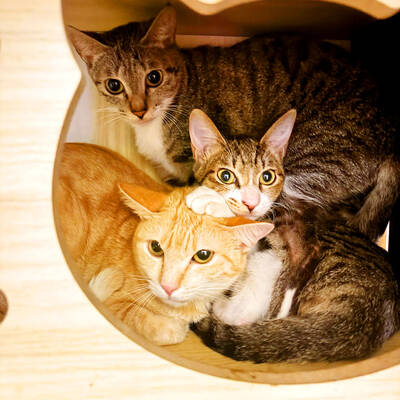
The number of pet cats in Taiwan surpassed that of pet dogs for the first time last year, reaching 1,742,033, a 32.8 percent increase from 2023, the Ministry of Agriculture said yesterday, citing a survey. By contrast, the number of pet dogs declined slightly by 1.2 percent over the same period to 1,462,528, the ministry said. Despite the shift, households with dogs still slightly outnumber those with cats by 1.2 percent. However, while the number of households with multiple dogs has remained relatively stable, households keeping more than two cats have increased, contributing to the overall rise in the feline population. The trend


 RSS
RSS