


The Ministry of Education yesterday announced that National Taipei University and National Kaohsiung University -- which have been in the preparatory stage for several years -- will be officially established on Feb. 1, and will begin recruiting students this year.
National Chiayi University, meanwhile, a merger of the National Chiayi Institute of Technology and National Chiayi Teachers' College, will also be established on the same day, effectively creating three national-level educational institutions at the same time.
"This is going to have a deep impact on the development of higher education in Taiwan," Vice-Minister for Education Lin Chao-hsien (
The government began planning National Taipei University in 1989, but its construction was delayed until March last year after encountering problems acquiring land.
The university's headquarters are located in Sanhsia, Taipei County, on a 54.54-hectare site. When established, the Taipei campus of the Taichung-based National Chunghsing University -- consisting of the law and business schools, and the 8,000 students studying there -- will be merged with National Taipei University.
Lee Chien-hsing (
Two new master's programs will be launched soon after its establishment in February, and an additional six new undergraduate programs, 13 master's programs and six doctoral programs are scheduled for launch this fall, Lee said.
"By that time, the university is expected to have over 9,000 students in total," Lee said.
National Kaohsiung University will launch six undergraduate programs with a total of 290 student enrolled in the fall.
Wang Jen-hung (
The university, planned since 1997, is located in the southern port city of Kaohsiung.
Lin said the education ministry strategically planned the university's construction -- its purpose being to balance the development of higher education in the northern and southern regions and to upgrade Kaohsiung's cultural standards.
"Kaohsiung plays a crucial role in Taiwan's economic miracle, but its cultural standard has lagged behind that of Taipei," Lin said.
National Taipei University and National Kaohsiung University are the last two public universities that the government plans to construct.
Considering limitations imposed by government funding, the education ministry is now trying to channel corporate funding into public universities and is encouraging the private sector to invest in the building of institutes of higher education.
The ministry is seeking to integrate existing educational resources to boost their efficiency while working to redistribute effectively limited financial resources.
It is against this background that the merger of National Chiayi Institute of Technology and National Chiayi Teachers' College took place. "The merger of public colleges will be an inevitable trend in the future, and the establishment of National Chiayi University has a symbolic meaning," Lin said.
One interesting proposal raised so far is the possible merger of the research-intensive National Tsing Hua, National Chiao Tung and National Yang-Ming universities.
The proposal has been raised based on the belief that the merger would facilitate the integration of resources and help upgrade the scale and academic standard of the integrated institution to world-class level, making it comparable to internationally prestigious universities around the globe.

‘NO SECURITY RISK’: The Railway Bureau reassured the public that the technicians’ activities were limited to technical guidance and did not involve sensitive systems The Railway Bureau yesterday said it had invited eight Chinese technicians to assist with an airport MRT construction project. The bureau issued the confirmation after an Internet user said Chinese nationals had entered the construction zone of Taiwan Taoyuan International Airport’s Terminal 3 project. They asked why “individuals from an enemy state” were allowed access to such a major national infrastructure project, which raised serious concerns over Taiwan’s industrial safety, sensitive systems and information security. The bureau’s Northern Region Engineering Branch Office said subcontractor Taiwan Handle Industrial Co (台灣手把工業) of the Taoyuan airport MRT’s “Contract No. CU05 Project A14 Station Civil, MEP &

A US uncrewed surface vessel (USV) encountered multiple Chinese warships during an autonomous transit of the Taiwan Strait, US defense company Seasats said in a statement on Wednesday. Seasats announced that a Lightfish USV had completed the first autonomous transit of the Taiwan Strait. Over five days, the USV traversed the entire length of the Strait while constantly monitoring surface vessel traffic, the company said. The Lightfish encountered multiple Chinese warships, one of which was a Chinese People’s Liberation Army Navy (PLAN) Type 056 corvette, it said. The Chinese vessels were operating “well within Taiwan’s exclusive economic zone without transmitting their identity via the
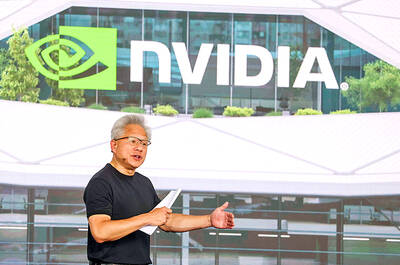
‘BOOMING’: ’ The number of partners we have here is incredible. You can see from their stock prices. They’re doing so well, they’re so happy,’ Jensen Huang said Nvidia Corp’s spending in Taiwan has ballooned to about US$150 billion a year, 10 times the US$10 billion to US$15 billion the company spent five years ago, Nvidia chief executive officer Jensen Huang (黃仁勳) said yesterday, suggesting Taiwan’s strategic importance in the global artificial intelligence (AI) supply chain. “Taiwan is the epicenter of the AI revolution. This is where the chips come, packaging comes. This is where the systems are made. This is where AI supercomputers were created,” Huang said at a meeting for the company’s employees in Beitou-Shilin Technology Park (北投士林科技園區) in Taipei, the planned site of Nvidia’s Taipei headquarters. “Taiwan
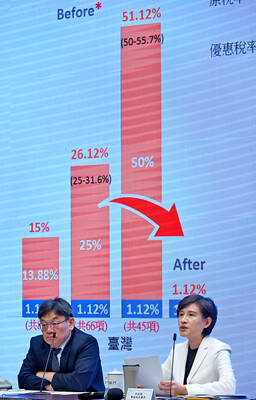
GREATER REACH? Auto parts and wood products would face tariffs of up to 15%, matching those targeting the EU, Japan and South Korea, Vice Premier said The US has announced that preferential tariff treatment for Taiwan’s non-semiconductor Section 232 goods would take effect retroactively from May 1, the Executive Yuan said yesterday. The US government yesterday posted a notice on the Federal Register’s public inspection Web site previewing tariff concessions for Taiwan under a memorandum of understanding (MOU) on Taiwan-US investment after two months of negotiations. The MOU signed on Jan. 15 stipulated three major preferential tariff arrangements: a 15 percent “reciprocal” tariff rate for Taiwan without stacking most-favored nation (MFN) rates; preferential Section 232 treatment for semiconductors and related products; and preferential Section 232 treatment for non-semiconductor


 RSS
RSS