


"Your cheatin' heart" might tell on you, as the song says, but in Taiwan it can also land you in jail. Taiwan might be the only country left in the world where adultery is not only grounds for divorce but a criminal offense punishable by a jail sentence of up to 12 months.
In practice, few are jailed; a sentence is usually commutable to a fine of around NT$900 for each day of jail time handed out.
The question that legal scholars are now dealing with, however, is whether, as Taiwan enters a new century, the criminalization of adultery is an outdated concept which should be scrapped.
But a range of interests is stacked against altering the law, from women's groups that believe criminalization is a weapon against erring husbands that Taiwan's women -- often legally disadvantaged in family-related matters -- would be loath to lose, to private detectives who make a good living from adultery cases.
Much of the business for private detectives comes from wives of suspected adulterers who either want to obtain a divorce or to force their husband's mistress out and win their "stray" husbands back.
In fact, the law itself encourages such happy endings -- getting couples "back together" -- by allowing accusers to drop adultery charges against their spouses, while at the same time allowing the charge to be sustained against the "intruders."
Ironically, despite the fact that use of the law is generally initiated by wives against their husbands, at one time the law allowed criminal liability for adultery only against women. Such legal discrimination is, to this day, still cited by women's rights activists, as reflecting the values of a society where it is common for a man to have sexual relationships outside of marriage.
The law was eventually changed to treat men and women adulterers equally and now it is viewed as an "effective weapon" by women today.
Opponents say it is "savage" to put someone in jail for adultery and have long called for the law's abolition.
But many women support the idea that the law protects "good" people who are loyal to their marriage and punishes those who betray their marriage vows.
While the debate on decriminalization has gone on for years, both proponents and opponents of the law are far from reaching common ground.
The court's perspective
Although adultery is punishable by a jail sentence, few adulterers have actually been sent to prison. More often than not, the court allows one found guilty of adultery to escape with a fines of "equal" value to the jail sentence.
In general, adultery can result in both criminal and civil liabilities. It also constitutes legal grounds for requesting a divorce via the court.
The majority of cases involve an alleged adulterer being subjected to a criminal trial. And along with a divorce request based on the fault of adultery often comes a request of compensation for mental distress caused by the adultery.
Huang Ja-lei (
He said, however, that chances are that the marriage is hurt even more once the charge is filed and the charge is itself detrimental to a couple's reconciliation .
"Many women thought they could get their husbands back by taking [a case] to court. They tried to make a deal, promising to drop the charge as long as the husband came back," Huang said. "But in reality, most of them would only regret it when they realize the court can't help love to continue."
Huang said that while some use the criminal charge as a means of protecting their own marriages, others use it as a "weapon" which often forces the cheating spouse to offer more in a divorce agreement in terms of the distribution of property.
"It works," Huang said. "Lots of people feel it's very disgraceful to have a criminal record tagged on them. And they would rather give more to avoid the tagging."
What women say
A few years ago, the Ministry of Justice recommended the decriminalization of adultery, but it was not able to push the change through in the face of strong opposition from the public, particularly married women.
While public support for decriminalization is gradually increasing, even so, the change might be some time in coming.
"We've found more and more women do accept that adultery is not a crime. They might admit [criminalization] is a mean wea-pon; nevertheless it's still their belief that their rights can be secured better with that weapon to hand," according to Yang Fang-wan (
Yang said it is indisputable that everyone is free to love and to be loved. She said, however, one cannot make judgements about the issue without considering the reality that many women will not be able to survive, emotionally or financially, after a divorce.
"Those loyal to their marriage are supposed to be the good people the law should protect. It's not easy for them to come to terms with the idea that the betrayer of the marriage can get away with it so easily," Yang said.
"Love is free and it's neither right or wrong. But it's really difficult for these women, who have dedicated themselves to their marriage, to accept they have to take the pain caused by the fault of their spouse," she said.
From a practical point of view, Yang said, the existing divorce law does not give enough protection to women on property rights after the divorce. The government has started working on amending the law on distribution of property between divorcing spouses under pressure from women groups. "Until legal protection is better established for women, we don't think the time is right to decriminalize adultery. At the very least, it serves as an effective weapon to force cheating husbands to offer more financial support to their divorcing wives," Yang said.
Scholarly perspectives
Adultery remained a crime in West Germany until 1969. The German decision to decriminalize adultery was generally based on the fact that there were only a small number of adultery prosecutions, sentences delivered for the crime seemed often too lenient and most importantly, there was a danger that the adultery charge was used simply to get revenge.
Legal scholars in Taiwan have long argued that the reasoning behind the German decision could be applied equally to Taiwan. Adult-ery, they believe, is a civil issue, not a criminal one in which the power of the government should intervene.
Scholars have especially criticized the use of the charge as a weapon to obtain more from a divorce agreement.
"We feel a lot of sympathy for those women who might have difficulties surviving after the divorce. But the law should not punish anyone, only to help others get better deals in a divorce," said Huang Jung-chien (
"We can understand how difficult it is for them to come to terms with the fact that love is not there anymore. But there is no reason at all to use criminal liabilities against the adulterers just to keep their spouses from feeling emotional pain," he said.
Despite persistent opposition to the decriminalization of adultery, Huang appeared optimistic about future developments.
"Taiwanese society is changing quickly. Sooner or later, I think this idea will be accepted by the majority," he said.

LEVERAGE: China did not ‘need to fire a shot’ to deny Taiwan airspace over Africa when it owns ‘half the continent’s debt,’ a US official said, calling it economic warfare The EU has raised concerns about overflight rights following the delay of President William Lai’s (賴清德) planned state visit to the Kingdom of Eswatini after three African nations denied overflight clearance for his charter at the last minute. Taiwanese allies Paraguay and Saint Kitts and Nevis, as well as several US lawmakers and the Inter-Parliamentary Alliance on China (IPAC) condemned China for allegedly pressuring the countries. Lai was scheduled to fly directly to Taiwan’s only African ally from yesterday to Sunday to celebrate the 40th anniversary of King Mswati III’s accession and his 58th birthday, but Seychelles, Mauritius and Madagascar suddenly revoked
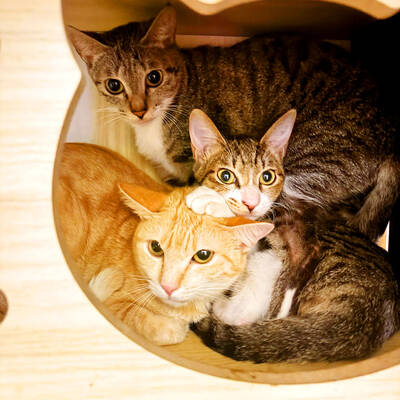
The number of pet cats in Taiwan surpassed that of pet dogs for the first time last year, reaching 1,742,033, a 32.8 percent increase from 2023, the Ministry of Agriculture said yesterday, citing a survey. By contrast, the number of pet dogs declined slightly by 1.2 percent over the same period to 1,462,528, the ministry said. Despite the shift, households with dogs still slightly outnumber those with cats by 1.2 percent. However, while the number of households with multiple dogs has remained relatively stable, households keeping more than two cats have increased, contributing to the overall rise in the feline population. The trend

China on Wednesday teased in a video an aircraft carrier that could be its fourth, and the first using nuclear power, while making an allusion to Taiwan and vowing to further build up its islands, as it looks to boost maritime power, secure resources and bolster territorial claims. The video, issued on the eve of the 77th founding anniversary of the Chinese People’s Liberation Army Navy, featured fictional officers with names that are homophones of three commissioned aircraft carriers, the Liaoning (遼寧), Shandong (山東) and Fujian (福建). Titled Into the Deep, it showed a 19-year-old named “Hejian” (何劍) joining the group, sparking

Taiwan has signed six arms procurement offers from the US totaling more than NT$208 billion (US$6.59 billion) covering long-range precision strike systems, missile stockpile replenishment and joint production of large-caliber ammunition, the Ministry of National Defense said yesterday. The government’s proposed NT$1.25 trillion special defense budget has been stalled in the Legislative Yuan as opposition lawmakers question the amount and procurement items, while the Presidential Office and defense ministry say that the full amount is necessary to safeguard Taiwan. Minister of National Defense Wellington Koo (顧立雄) on Monday briefed the legislature’s Foreign Affairs and National Defense Committee on the defense budget for


 RSS
RSS