


Challenging Taiwan's political status quo in the 1970s, when the island was in the grip of martial law, required both courage and considerable commitment. But the reason why these opposition leaders dared to risk their lives -- after being labeled "violent political dissidents" and "traitors" by the KMT government -- remains inconclusive.
Analysts and activists involved in the opposition movement do, however, agree on one thing: that the 1979 Kaohsiung Incident (
Increasing Diplomatic Isolation in the 1970s
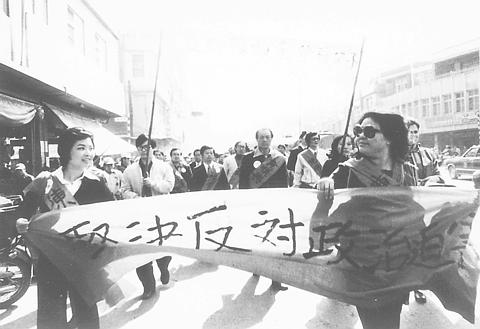
PHOTO COURTESY OF NEW TAIWAN FOUNDATION
Analysts say serious setbacks in the international arena for Taiwan in the early 1970s triggered anxiety among Taiwan's intellectuals over the island's future. This drove them to seek out possible ways to change the status quo.
"The ROC's withdrawal from the United Nations [in 1971] was a major blow for Taiwan, and so was the US' announcement that it would shift diplomatic recognition from Taipei to Beijing [in 1978]," said Chang Yen-hsien (
DPP legislator Shih Ming-teh (
"In the past, the US -- which led the fight against communism -- supported Taiwan wholeheartedly. But this was no longer the case after its decision to consider detente with Beijing," Shih said. "We realized it was time to reconsider Taiwan's future from our own viewpoint, instead of allowing the KMT to be the only decisionmaker for the island's destiny."
Domestic factors
Like many opposition movements around the globe that helped transform authoritarian regimes into democracies, Taiwan's experience in the 1970s had its own unique domestic roots. They centered on three major factors: the rise of the middle class, the emergence of a well-educated new generation that dared to challenge the island's political system, and the anti-government sentiment that developed during the period of White Terror that began soon after the 228 Incident of 1947.
But it was the rise of the middle class in the 1970s that ultimately served as the fundamental basis of the social fabric needed for such a movement, analysts said.
Yeh Chen-huei (
"In the early 1970s, Taiwan's per capita income exceeded US$1,000. Although it's not a very impressive figure, it does indicate changes in Taiwan's social structure. That is, after adequate clothing and food, the public started to demand political and social reforms from the government," Yeh said.
Chang also supports this interpretation.
"The rise of the middle class is often the driving force behind democratic movements in authoritarian countries. Taiwan was no exception," Chang said, citing Hsu Hsing-liang (
Legacy of oppression
The second factor was the new generation that had grown up after the events of the White Terror and were no longer haunted by those events which had turned almost the entire previous generation of people away from politics.
The results of the 228 Incident and its tragic aftermath, as historian Huang Fu-san (
"Since the incident, anti-establishment sentiments took root in society," Huang said, although the KMT's heavy-handed rule prevented their expression. But in the 1970s, a new generation emerged, who were less influenced by the White Terror.
Furthermore, advanced studies in Western countries or in Taiwan had allowed the younger generations to learn more about democracy and freedom -- the normative values praised or practiced in many developed countries but lacking in Taiwan, analysts said.
Wei Pen (
The undemocratic practices in Taiwan at the time were comprehensive, such as that the KMT could cheat with impunity during elections and grant aging mainland-elected parliamentarians lifetime tenure. In fact, it was not until 1969 that periodic supplementary elections were held to infuse new blood into the parliamentary bodies.
Venues to challenge the status quo
Pinpointing the shortcomings in Taiwan's political system that where in need of repair, many opposition activists called for a fundamental reform of the system through three kinds of forums for propagating their ideas: publications, elections and demonstrations.
While demonstrations were used only sparingly by opposition activists, publications and elections were the preferred options. Opposition magazines relentlessly challenged the regime's efforts to control debate. But publishers of these magazines and the KMT were engaged in a cat-and-mouse game: when publications went too far, the KMT closed them down, only to see them reopen under new names, insiders said.
Elections, on the other hand, were seen by many others as a chance to work within the system to publicize their reformist messages.
"Many voiced their criticisms of the KMT during the election campaign period because the intelligence system normally turned a blind eye during these times, which opposition figures dubbed as a `democratic vacation' period," Wei said.
To gain further ground, the opposition decided to coordinate their campaign efforts. In the 1977 local election, the term "tangwai" (黨外, literally, "outside the party") was used by the media to refer to the handful of non-KMT candidates who then made attempts to campaign.
In 1978, the "tangwai" Campaign Corps (
After 1977 and 1978, the "tangwai" movement gathered momentum, and some opposition pundits such as Shih decided to launch a new party in defiance of the KMT's ban on the formation of political parities. The end product was the launch of the Formosa magazine (美麗島雜誌) in 1979, both as an instrument to propagate their political ideas and as an organizational core for, in Shih's terms, "a new party without a formal title." Although the weekly magazine was forced to stop publishing after four issues, the shock wave delivered by the Formosa group culminated in the Kaohsiung Incident on Dec. 10, 1979 -- a demonstration that later lapsed into a violent clash between "tangwai" activists and KMT-hired agents and local police.
Far from finalized
Looking back at the past through the filter of time is a challenging task, and the lack of sufficient original materials has often held back such an undertaking. The attempt to analyze forces that led to the 1970s "tangwai" movement is one such example. But Wei remains optimistic, saying raw materials collected in the project -- a six million word manuscript -- can serve as "reservoirs" for future studies into the series of opposition movements of twenty years ago.
"Our project does not offer a final conclusion on the late 1970s `tangwai' movement. Rather, it will change the public perception of the Kaohsiung Incident. It will cease to be a taboo subject," Shih said. "[The project] only serves as a starting point for the public to understand that period."
As original materials on the 1970s opposition movement are surfacing, questions on forces behind the movement may find more comprehensive answers -- say in another twenty years time.

The National Chungshan Institute of Science and Technology yesterday showcased its locally developed variants of the Vision 60 robotic patrol dog, which it plans to deploy on the nation’s outlying territories in the South China Sea. The variants were produced under the Joint Lab project — created by the institute and domestic companies — and assembled with domestically produced motors, lenses and artificial intelligence (AI) systems alongside licensed tech from the US, Missile and Rocket Systems Research Division deputy director Jen Kuo-kang (任國光) told the media event at a military base in Taipei’s Dazhi (大直) area. Taiwan has built up its strengths

RIGHT DIRECTION: Taiwan’s efforts to prevent forced labor include a proposal to ‘fully prohibit’ employers from withholding workers’ documents, an official said Taiwan is to establish a mechanism to restrict imports of goods linked to forced labor, the Executive Yuan said yesterday, after the US proposed imposing additional tariffs on Taiwanese goods over labor concerns. “The Ministry of Labor and the Ministry of Economic Affairs are to establish an interministerial review procedure,” Executive Yuan spokesperson Michelle Lee (李慧芝) said at a news briefing in Taipei. “The government is to use the Foreign Trade Act [貿易法] as the legal basis to restrict imports of goods produced with forced labor” and bring its supply chain governance more in line with international standards on human rights, resilience

NOT IMMEDIATE: Taiwan has a chance to appeal the proposed 10 percent tariff before it starts, while other countries face a 12.5 percent tariff from the trade office Taiwan is among 60 economies determined by the US to have failed to impose or enforce a ban on the importation of goods produced with forced labor, according to a notice released on Tuesday by the Office of the US Trade Representative (USTR), which proposed imposing an additional 10 percent or more tariff on them. The USTR in a statement said that following an investigation, it had determined under Section 301 of the Trade Act of 1974 that the failure of the 60 economies to impose and effectively enforce a prohibition on the importation of goods produced with forced labor is

TIT-FOR-TAT: The US allegedly revoked the visa of a Chinese national working at Xinhua News Agency in the US in response to Beijing’s expulsion of Vivian Wang The Presidential Office yesterday condemned China for expelling a New York Times correspondent from Beijing following the newspaper’s interview with President William Lai (賴清德), saying the move highlighted Beijing’s suppression of press freedom and its threat to international news media. Taiwan has noted a series of recent incidents in which Beijing used similar tactics to “threaten and pressure international media outlets and journalists,” Presidential Office spokeswoman Karen Kuo (郭雅慧) said in a statement. “This concerns not only press freedom and freedom of expression, but also the safety of journalists, and Taiwan and relevant partners are paying close attention to the situation,” she


 RSS
RSS