


Vice President Lien Chan (
But the statement was rebuffed by military officials, who said they could not comment on the matter.
"We must build up a reliable deterrent and strengthen our second-strike capabilities in the future. The goal will be achieved through the deployment of high-mobility air and naval forces and long-range surface-to-surface missiles," Lien said.
Lien made the remarks at the opening ceremony of an academic conference on national security and military strategy, which was attended by military personnel and scholars in the field.
The comments appeared to be a reference to the Tien Ma or "Sky Horse" missile program developed secretly in the 1980s.
Lien also declared that the country's defensive strategy must be modified from a passive defense to an "aggressive defense."
"I suggest a modification of defense strategy to allow more space for the military. We need an aggressive defense to effectively deter China's potential military threats and to maintain the peace and security of Taiwan," Lien said.
Lien's remarks on the program have been widely reported by local media as a confirmation of the military's secret development of a medium- or long-range surface-to-surface missile.
In response, however, the Ministry of National Defense issued statements emphasizing that Lien's comments represented his own viewpoint and not the military's.
"The vice president was just expressing his own opinions concerning development of the missile. The defense ministry has no grounds to voice agreement or disagreement about it," said Minister of National Defense Tang Fei (
"That the ministry did not deny knowledge of the long-range surface-to-surface missile does not mean that it is a fact," said an official at the defense ministry, who declined to be identified.
Commenting on Lien's suggestion of a change of defense strategy from a passive defense to an "aggressive defense," the official emphasized again that Lien was expressing his own views on the issue.
"It is too early to talk about a change in defense strategy. Lien's proposition represents his own thinking. If there must be a change to it, a prior formal discussion among government leadership is required," the official said.
"It is understandable that Lien proposed an aggressive defense policy. He wanted it to provide a framework for the deployment of strategic deterrent forces like a long-range surface-to-surface missile," he said.
Chang Li-teh (張立德), an editor of the Defense Technology Monthly magazine, said a long-range surface-to-surface missile usually has a range of more than 4,000km and is not a "decisive weapon" unless equipped with a nuclear warhead.
"A long-range missile of that kind will be wasted if it is used to attack land targets with conventional warheads," Chang said.
"To equip the missile with a nuclear warhead is another story. It looks impossible from the current technological capability of the military," he said.
"The long-range missile which Lien talked about is probably to be an upgraded version of the Sky Horse surface-to-surface missile, which the military developed in the 1970s on its own," he said.
"A considerable number of Sky Horse missiles were produced before the project was called off after the intervention of the US. The missile had a range of 1,000km, capable of reaching Wuhan (
The military would most likely use the Sky Horse missile or potentially an upgraded variant to attack commercial hubs along the coastline of China, including Shanghai, Hong Kong and Guangzhou, Chang said.
"These cities are high-value targets. Destroying them will paralyze the economy of China," he said. "If Taiwan really wants to launch a missile attack against China, these cities will be the best targets," he said.
"When we recall what KMT-run businesses chairman Liu Tai-ying (

‘NO SECURITY RISK’: The Railway Bureau reassured the public that the technicians’ activities were limited to technical guidance and did not involve sensitive systems The Railway Bureau yesterday said it had invited eight Chinese technicians to assist with an airport MRT construction project. The bureau issued the confirmation after an Internet user said Chinese nationals had entered the construction zone of Taiwan Taoyuan International Airport’s Terminal 3 project. They asked why “individuals from an enemy state” were allowed access to such a major national infrastructure project, which raised serious concerns over Taiwan’s industrial safety, sensitive systems and information security. The bureau’s Northern Region Engineering Branch Office said subcontractor Taiwan Handle Industrial Co (台灣手把工業) of the Taoyuan airport MRT’s “Contract No. CU05 Project A14 Station Civil, MEP &

A US uncrewed surface vessel (USV) encountered multiple Chinese warships during an autonomous transit of the Taiwan Strait, US defense company Seasats said in a statement on Wednesday. Seasats announced that a Lightfish USV had completed the first autonomous transit of the Taiwan Strait. Over five days, the USV traversed the entire length of the Strait while constantly monitoring surface vessel traffic, the company said. The Lightfish encountered multiple Chinese warships, one of which was a Chinese People’s Liberation Army Navy (PLAN) Type 056 corvette, it said. The Chinese vessels were operating “well within Taiwan’s exclusive economic zone without transmitting their identity via the
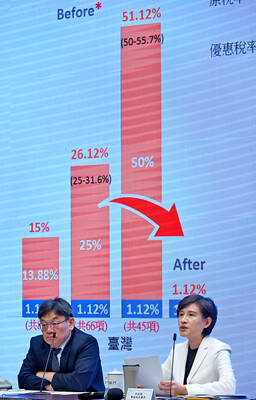
GREATER REACH? Auto parts and wood products would face tariffs of up to 15%, matching those targeting the EU, Japan and South Korea, Vice Premier said The US has announced that preferential tariff treatment for Taiwan’s non-semiconductor Section 232 goods would take effect retroactively from May 1, the Executive Yuan said yesterday. The US government yesterday posted a notice on the Federal Register’s public inspection Web site previewing tariff concessions for Taiwan under a memorandum of understanding (MOU) on Taiwan-US investment after two months of negotiations. The MOU signed on Jan. 15 stipulated three major preferential tariff arrangements: a 15 percent “reciprocal” tariff rate for Taiwan without stacking most-favored nation (MFN) rates; preferential Section 232 treatment for semiconductors and related products; and preferential Section 232 treatment for non-semiconductor

TIT-FOR-TAT: The US allegedly revoked the visa of a Chinese national working at Xinhua News Agency in the US in response to Beijing’s expulsion of Vivian Wang The Presidential Office yesterday condemned China for expelling a New York Times correspondent from Beijing following the newspaper’s interview with President William Lai (賴清德), saying the move highlighted Beijing’s suppression of press freedom and its threat to international news media. Taiwan has noted a series of recent incidents in which Beijing used similar tactics to “threaten and pressure international media outlets and journalists,” Presidential Office spokeswoman Karen Kuo (郭雅慧) said in a statement. “This concerns not only press freedom and freedom of expression, but also the safety of journalists, and Taiwan and relevant partners are paying close attention to the situation,” she


 RSS
RSS