


The Ministry of Education yesterday promised to safeguard the education opportunities of students whose schools were destroyed or damaged during the earthquake last week.
According to the ministry's statistics, a total of 619 schools were either partially damaged or had collapsed in Tuesday's powerful earthquake. These include 33 colleges, 20 high schools and 566 elementary and junior high schools.
Administrative Vice Minister of Education Yang Kuo-shih (楊國賜) said civil engineering experts are helping the ministry examine all the schools located in affected areas.
"Before classes are restored, we need to ensure the buildings are safe," Yang said.
For the schools that are unlikely to be repaired in a short period of time, Yang said the ministry sought assistance from the military to help demolish damaged structures and set up tents or prefabricated houses to serve as temporary classrooms.
"The ministry will provide the funds needed for the reconstruction," Yang said.
Another option is to let the affected students attend neighboring schools, Yang said.
As for elementary and junior high students who wish to go to schools in other localities, the ministry is urging members of the public to volunteer to provide a homestay for them, Yang said.
He added that local education authorities will find out this week how many students want to take such action, and make proper arrangements for them.
Most of the schools affected are located in hard-hit Nantou County and Taichung County. Only 60 percent of the schools in Nantou County can reopen on Oct. 4 -- the rest have been completely destroyed. Nantou County Government has estimated that it will cost at least NT$10 billion to repair and reconstruct these schools.
Of the 200 schools in Taichung County, severe damage means 40 will remain closed this week. Property losses alone are estimated at NT$5 billion.
One of the destroyed schools is Kuangfu Junior High School in Wufeng, Taichung County. The school is located on one of Taiwan's 52 active faults, and has seen two-thirds of its classrooms collapse. The school's location on seismologically active ground is not unique among Taiwan's educational institutions.
Research commissioned by the education ministry, conducted at National Central University has shown that 358 schools around the island are located in the vicinity of active faults.
Of these, 111 are in northern Taiwan, 94 in central Taiwan, 100 in the south and 53 in the east. Those located within 100 meters from a fault line total 66.
Yang said the ministry notified local governments several years ago -- after the report was released -- to strengthen the affected school buildings and introduce other earthquake safety measures.
"Most local governments were unwilling to relocate the schools and we could not force them to do so since [no earthquake] had occurred," Yang said.
Yang said now that many schools were destroyed by the earthquake, local governments were taking a more active role -- checking how many of them are on the "danger list" in order to implement the ministry's advice.
The National Science Council is currently drafting a reconstruction proposal which may include prohibiting the construction of any buildings in potentially dangerous areas.
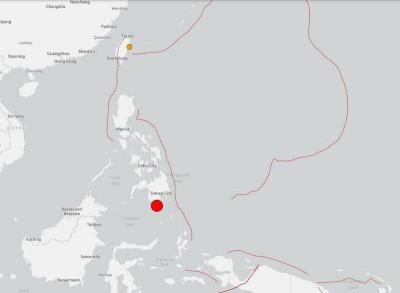
A magnitude 7.8 earthquake struck off the southern coast of Mindanao in the Philippines at 7:38am today, prompting the US Tsunami Warning System to issue an alert for neighboring countries, including Taiwan. The system issued a purple alert indicating a "tsunami threat." The potential threat zone includes Taiwan, the Philippines, Papua New Guinea, Yap and Palau. Philippine authorities were assessing the damage from the quake, with the office of civil defense seeking to verifying initial reports that 15 people had been killed and 129 injured in the region, mostly from falling debris. Arlene Hollero, disaster chief of Maasim town in the Philippines' Sarangani Province,
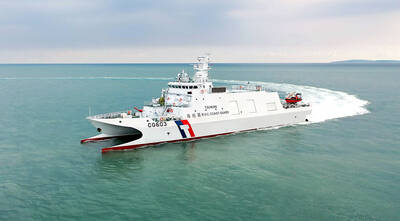
‘GRAY ZONE’ PRESSURE: Beijing’s activities are intended to create the deceitful impression that China has jurisdiction over the area around Taiwan, the CGA said Taiwan’s rights over its territorial waters and exclusive economic zone must not be violated by any country, the Mainland Affairs Council said yesterday, adding that it will not accept any unprovoked actions. The council issued the remarks in response to the China Coast Guard conducting maritime enforcement drills near eastern Taiwan and claiming to fully exercise China’s maritime administrative law enforcement authority. The Coast Guard Administration (CGA) has been closely monitoring the situation and is taking concrete steps to defend the nation’s sovereignty and secure its waters, the council said. China has no sovereign rights over the waters off eastern

RESILIENCE: Taiwan plays a key role in semiconductors, energy, information infrastructure and advanced manufacturing, AIT Director Raymond Greene said Taiwan’s continued investment in deterrence and resilience remains vital, especially in uncrewed systems and other emerging technologies, American Institute in Taiwan (AIT) Director Raymond Greene said yesterday. Greene made the remarks at the annual National Strategic Summit on Supply Chain Resilience held by the Research Institute for Democracy, Society and Emerging Technology (DSET), a government-backed think tank. As Taiwan last year became the US’ fourth-largest trading partner and supply chain security is becoming more important, cooperation in emerging technologies continues to deepen between the two countries, he said. The US is committed to accelerating innovation, building key infrastructure, strengthening cooperation

The National Chungshan Institute of Science and Technology yesterday showcased its locally developed variants of the Vision 60 robotic patrol dog, which it plans to deploy on the nation’s outlying territories in the South China Sea. The variants were produced under the Joint Lab project — created by the institute and domestic companies — and assembled with domestically produced motors, lenses and artificial intelligence (AI) systems alongside licensed tech from the US, Missile and Rocket Systems Research Division deputy director Jen Kuo-kang (任國光) told the media event at a military base in Taipei’s Dazhi (大直) area. Taiwan has built up its strengths


 RSS
RSS