


A Cameroon-flagged cargo vessel “Shunxin-39” was believed to have caused damage to an undersea cable of Taiwan telecoms operator Chunghwa Telecom on the morning of Jan. 3. It was suspected that the Chinese merchant ship, which was registered with the nationality of another country, deliberately cut off the cable by dragging the anchor over it.
While the incident is still under investigation, China has a long history of using maritime tactics to sabotage Taiwan’s infrastructure.
In February last year, two cables linking Taiwan to its outlying Matsu Islands were damaged within days of each other by a Chinese fishing boat and a Chinese cargo vessel, causing slower Internet connections and dropped phone calls, in what one analyst described as a dry run for an “invisible blockade” of Taiwan.
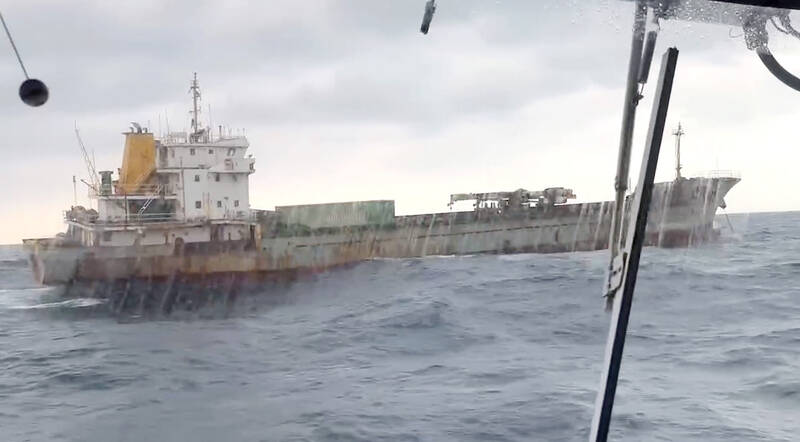
Photo courtesy of Coast Guard Administration 照片:海巡署提供
A report by Taiwan’s National Audit Office this year said foreign ships had damaged cables linking the country with its outer islands 36 times since 2019, with 12 incidents registered last year. The damage was caused by a variety of vessels including fishing boats, cargo boats and sand dredgers.
The incident was believed to be a Chinese ploy to gauge the point at which the international community would draw a red line in an attempt to escalate its “gray zone” tactics.
The geopolitical backdrop to the current threat against undersea cables is the Russian invasion of Ukraine, China’s behavior towards Taiwan, and the Israel-Gaza war, but they have long been an obvious target.
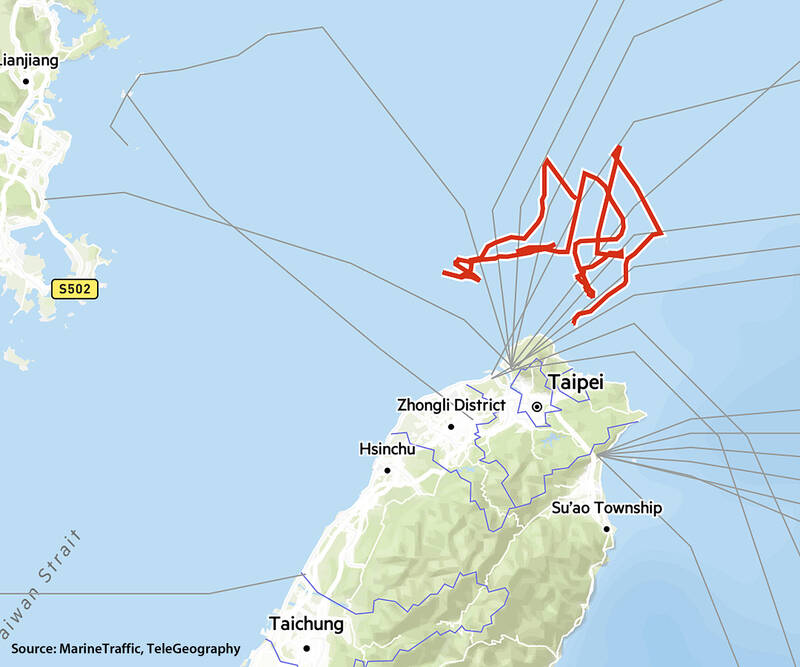
Photo: Screen grab from Financial Times 照片:擷圖自金融時報
In November, a perpetrator cut two undersea cables in Sweden’s exclusive economic zone. The incident followed a similar one just over a year previously, affecting an undersea cable and one pipeline in the exclusion zones of Sweden, Finland and Estonia. And on Christmas Day last year, several cables in the Gulf of Finland were cut by a shadow vessel, Finnish authorities say.
Germany and Finland launched a probe on Nov. 18 last year after an undersea cable linking the countries was severed, warning of the threat of “hybrid warfare” amid heightened tensions with Russia.
During last year, “there were 500 suspicious incidents in Europe. Up to 100 them can be attributed to Russia, hybrid attacks, espionage, influence operations,” said Czech Foreign Minister Jan Lipavsky.
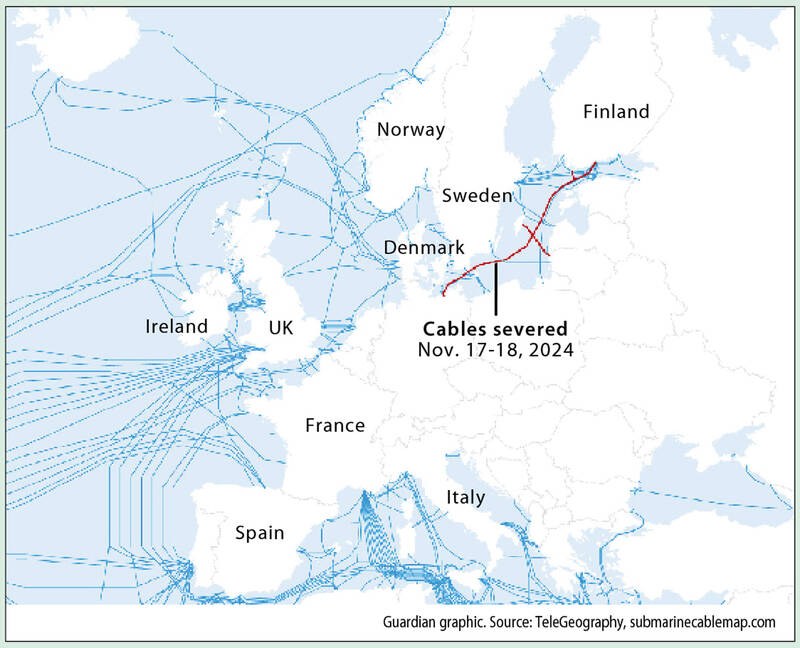
Photo: Screen grab from the Guardian 照片:擷圖自衛報
The West has accused Moscow of being behind a string of sabotage attacks on European soil aimed at deterring Ukraine’s backers from sending support to Kyiv.
NATO Secretary General Mark Rutte said on Dec. 4 last year after talks with NATO foreign ministers the alliance had agreed on “proactive measures” to counter Russia’s campaign of hybrid attacks against its members. “Allies are working very hard to make sure when it comes to sabotage, cyber-attacks, energy blackmail, that we take all the measures necessary to counter that.”
Sabotaging or manipulating undersea cables is not a new tactic. As early as 1898, during the Spanish-American war, US navy cut the telegraphic cable off the coast of Cuba to disrupt the enemy’s communications.
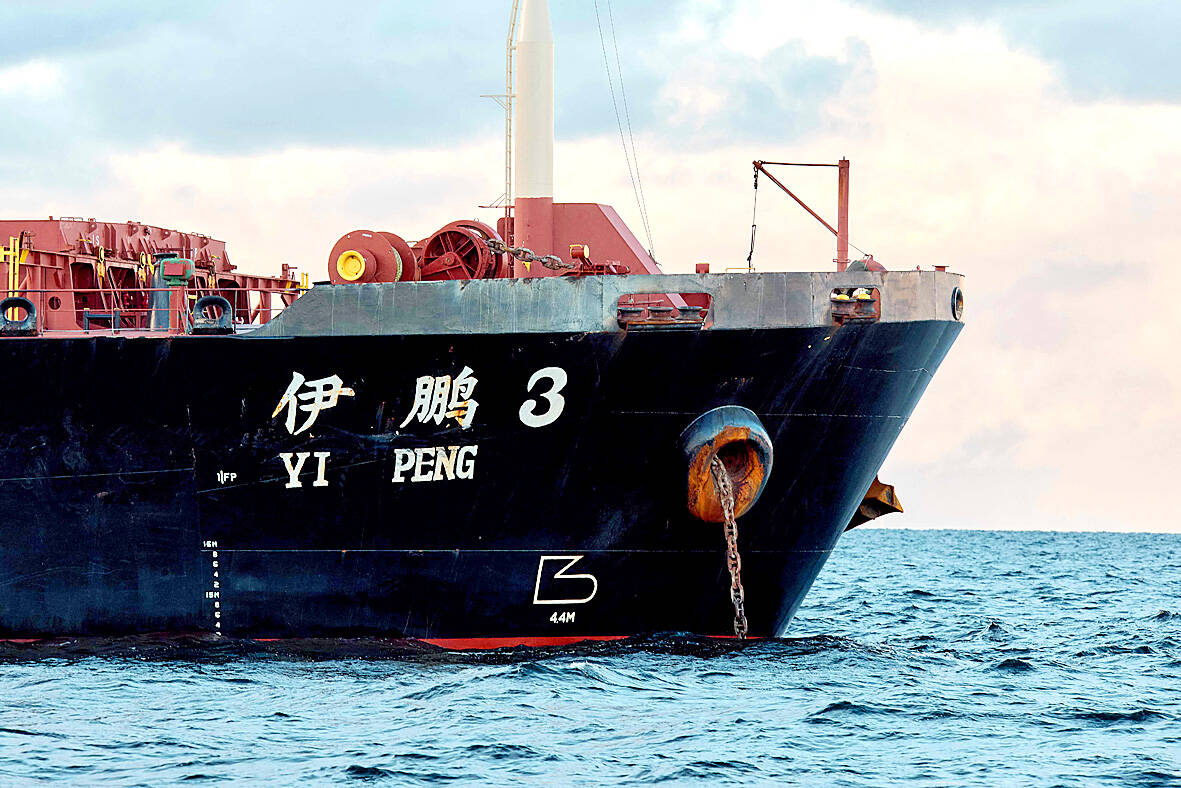
Photo: AFP 照片:法新社
According to Danish press reports, the US listened in via Denmark’s subsea network on communications from four countries — Germany, Sweden, Norway and France — between 2012 and 2014, including then-chancellor Angela Merkel.
Currently, undersea fiber optic cables transport 98 percent of global digital data. Undersea cables ferry data of all kinds between the continents, “transmitting everything from streaming videos and financial transactions to diplomatic communications and essential intelligence” according to a recent report from the US-based Center for Strategic and International Studies (CSIS).
Around 450 undersea cables are currently in operation worldwide, stretching for around 1.2 million km. Dozens more are in the planning stage.
Most countries with a coastline have at least one, according to a map from TeleGeography, a US-based firm specialising in telecoms data analysis. Only a few rare corners of the Earth such as Eritrea, North Korea and Antarctica are without subsea links.
(Lin Lee-kai, Taipei Times)
1月3日上午在台灣東北方基隆港外海,一艘懸掛喀麥隆國旗的貨輪「順興39號」,疑似下錨拖斷中華電信的海底電纜。外界懷疑中國商船註冊他國國籍,故意拖斷我國海底電信纜線。
雖然事件仍在調查中,但中國利用海上戰術破壞台灣基礎設施的歷史由來已久。
去年2月,連接台灣和馬祖列島的兩條電纜,在數天內被一艘中國漁船和一艘中國貨船破壞,導致網路連線速度變慢、電話中斷。一位分析師形容,這是中國對台灣實施「隱形封鎖」的演習。
台灣審計部今年公布的一份報告指出,自2019年以來,外國船隻損壞台灣與外島之間電纜的事件已有36次,去年就發生了12起。肇事的船隻種類多樣,包括漁船、貨船及挖泥船。
一般認為,這些事件是中國為試探國際社會的紅線而採取的策略,旨在升級其「灰色地帶」戰略。
目前威脅海底電纜的地緣政治背景是俄羅斯入侵烏克蘭、中國對台灣的動作,以及以色列—加薩戰爭,但海底電纜長期以來一直是明顯的目標。
去年11月,一名犯罪分子切斷了瑞典專屬經濟海域的兩條海底電纜。在這之前一年多已發生過類似情況,影響了瑞典、芬蘭及愛沙尼亞專屬經濟海域中的一條海底電纜和一條管線。芬蘭政府表示,去年聖誕節當天,芬蘭灣有數條電纜被一艘影子艦隊船隻切斷。
德國和芬蘭去年11月18日在連接兩國的海底電纜被切斷後啟動了調查,警告在與俄羅斯的緊張局勢加劇之際,可能發生「混合戰爭」。
去年,「歐洲發生了500起可疑事件。其中多達100起可歸因於俄羅斯、混合攻擊、間諜活動、認知作戰」,捷克外交部長揚.利帕夫斯基表示。
西方指責莫斯科是幕後黑手,在歐洲領土上進行一連串破壞性攻擊,目的是阻止烏克蘭的支持者向基輔提供援助。
北大西洋公約組織秘書長馬克.呂特去年12月4日與北約各國外交部長會談後表示,北約已同意採取「前瞻性措施」,來對抗俄羅斯對北約成員國的混合攻擊活動。「盟國正努力確保在遇到破壞、網路攻擊和能源勒索時,能採取一切必要措施加以應對」。
破壞或操縱海底電纜並非新手段。早在1898年美西戰爭期間,美國海軍就在古巴外海切斷電報電纜,來破壞敵方的通訊。
據丹麥媒體報導,2012年至2014年間,美國透過丹麥海底網路監聽了來自德國、瑞典、挪威和法國這四個國家的通信,其中包括當時的德國總理安格拉.梅克爾。
目前全球98%的數位資料是透過海底光纖電纜傳輸。根據美國戰略與國際研究中心(CSIS)最近的一份報告,海底電纜在各大洲之間傳輸各種資料,「傳輸從串流媒體視訊、金融交易,到外交通訊和重要情報的所有內容」。
全球運作中的海底電纜目前約有450條,總長度約為120萬公里。還有數十條在規劃中。
專門從事電信數據分析的美國公司TeleGeography的地圖顯示,大多數有海岸線的國家都至少有一條海底電纜。地球上只有厄利垂亞、北韓和南極洲等少數幾個角落沒有海底連線。
(台北時報林俐凱)
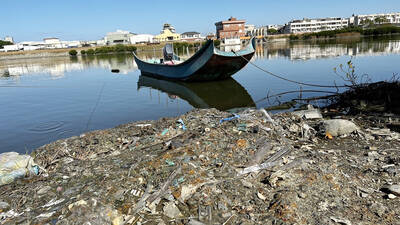
Many consumers are guilty of filling drawers or closets with old laptops, cellphones, fitness trackers and other electronic devices once they are no longer needed. It’s hard to know where to recycle such items, or it seems costly and inconvenient to do so. The world generates millions of tons of electronic waste — also called e-waste — each year. According to the UN’s most recent estimate, people worldwide produced 62 million metric tons of e-waste in 2022, and only about 22 percent of it was properly recycled. The US’ Environmental Protection Agency estimates that less than a quarter of e-waste is
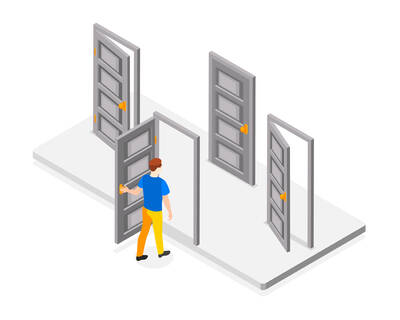
You’re sitting in class when a classmate asks to borrow a pencil. It seems like a small favor, so you agree without hesitation. The following week, the same classmate asks to share your notes. Later, they request help with a group project. You agree each time — after all, you helped out the first time — but before you know it, it has become automatic. This scenario demonstrates the “foot-in-the-door technique,” a psychological concept that shows how agreeing to small, acceptable demands makes it easier to accept larger ones later on. The name for this strategy comes from door-to-door

A: The four-day Tomb Sweeping Day long weekend begins Friday and will run until Monday. Are you going to sweep your ancestors’ tombs? B: I did in advance last weekend, so I can go to Kaohsiung to see the musical “The Phantom of the Opera.” A: Wow, is “Phantom” touring Taiwan again? It debuted in 1986, so this year marks the 40th anniversary of the show. B: And it’s not just touring Kaohsiung starting March 31, but also Taipei starting April 21 and Taichung starting May 26. A: “Phantom” is one of the world’s Four Major Musicals. I’ve seen all of them, except “Les

Dos & Don’ts — 想想看,這句話英語該怎麼說? 1. 我們很早到達電影院。 ˇ We arrived at the theater very early. χ We arrived the theater very early. 註︰arrive 為不及物動詞,後面如果有受詞要用 at 或 in。例如:They arrived in Taipei yesterday.。一般大地方,如國家、省、大城市等前面用 in,凡小地方城鎮、學校等則用 at。 2. 開車半小時以後,我們到達了海灘。 ˇ After half an hour’s drive, we got to the beach. χ After half an hour’s drive, we got the beach. 註︰come, go, get(來、去、到達)某地時,在表示地點的名詞前面應該用 to,如 go to school, go to Taipei, come to Shanghai 等。如果這些動詞後面所跟的是 here, there, home 等副詞,則不用 to。 3. 明天我會回辦公室。 ˇ I will be back in the office tomorrow. χ I will be back to office tomorrow. 註︰to be back 一語裡的 back 是副詞,不是介詞,所以後面要用 at (the market) 或 in (the office)。 假如假期結束,要回學校上課了則可說: ? Kids will be back


 RSS
RSS