


中文的「縮寫」,英文有可能是 abbreviation, acronym, 或 initialism。英文的 abbreviation 則是個上位詞 (superordinate/hypernym),它包括 acronym 和 initialism。
acronym 和 initialism 有什麼區別呢?

Photo: Wikimedia Commons l 照片:維基共享資源
譬如 LASER 是雷射 (Light Amplification by Stimulated Emission of Radiation) 的縮寫;NASA是美國航太總署 (National Aeronautics and Space Administration) 的縮寫;OPEC 是石油輸出國家組織 (Organization of Petroleum Exporting Countries) 的縮寫;我們若把這些縮寫當一個字來唸,LASER 唸 /ˈleɪ•zər/,NASA 唸 /ˈnæs.ə/,OPEC 唸 /ˈoʊ.pek/,這樣的縮寫就是 acronym。
至於 initialism 則只是照縮寫後的個別字母唸:
FBI 是 Federal Bureau of Investigation(聯邦調查局)的縮寫,唸 F, B, I; CIA 是 Central Intelligence Agency(中央情報局)的縮寫,唸 C, I, A, 這樣的縮寫就是 initialism。
The abbreviation formed with initialism is not pronounced as a word, rather you say the individual letters, such as FBI & CIA.
世衛組織 2020 年 2 月 11 日宣布,為避免污名化特定地區 (to avoid references to a specific geographical location . . . aimed at preventing stigmatization),正式將新型冠狀病毒病 (2019-nCoV acute respiratory disease)命名為 COVID-19,並說明 CO 代表冠狀 (Corona),VI代表病毒 (virus),D 代表疾病 (disease)。
COVID-19 唸成 /koʊ.vɪd.naɪnˈtiːn/ ,而不是唸 C, O, V, I, D, 19,像這樣的縮寫,英文叫 acronym,不是 initialism。
台灣人熟悉的葉克膜 (extracorporeal membrane oxygenation, ECMO),最早引入台灣時,主要用於支持換心患者在接受心臟移植前,或心臟移植後的過渡期,暫時取代心臟功能。然而目前葉克膜已經廣泛用於需要短期心肺功能支持的病患身上。
Extracorporeal Membrane Oxygenation (ECMO) uses a mechanical heart and lung to support the body and give a patient’s organs time to rest. ECMO does the work your heart and lungs would normally do to support your body when your own organs are too sick to do the job alone. ECMO, pronounced EK-moe, will not heal you. It simply allows your body time to heal on its own.
ECMO 唸 /ˈek-ˌmō/ ,不唸成 E, C, M, O,也是 acronym。
至於「應用程式」(Application) 的縮寫 App,應唸 /æp/,也是 acronym。台灣許多人喜歡以 initialism 的方式,唸成 A, P, P.,不符英文習慣。
另外,全球資訊網 (World Wide Web) 的縮寫 WWW,應以 initialism 的方式,讀作 W, W, W /’dʌblju dʌblju dʌblju/,不讀“triple W”。(Jerome Su, Nov. 20, 2024)
防疫必備詞彙:病名相關詞彙
冠狀病毒 Coronavirus
新型冠狀病毒 2019 Novel Coronavirus (2019-nCoV)
嚴重特殊傳染性肺炎 Coronavirus Disease 2019
嚴重急性呼吸綜合症冠狀病毒2型 Severe Acute Respiratory Syndrome Coronavirus 2 (SARS-CoV-2)
新型冠狀病毒病 COVID-19
致死率 case fatality rate (CFR)
世衛組織 World Health Organization (WHO)
文章由書林出版公司提供:
www.bookman.com.tw
蘇正隆 — 台灣翻譯學學會前理事長、師大翻譯研究所兼任副教授; 編著《英語的對與錯》,《世紀病毒:必讀防疫英文知識與詞彙》...等

A: Taiwan legalized same-sex marriage on May 24, 2019, so this week marks the seventh anniversary of that milestone. By the end of 2024, a total of 32,126 LGBT couples had tied the knot. B: How many of them got married to foreign partners? A: In 2024, there were 504 cross-border same-sex marriages. By the end of that year, there were 130 cross-strait same-sex marriages between Taiwanese and Chinese — accounting for only about 0.4 percent of the total. B: I’ve heard that a seven-year marriage brings the “seven-year itch.” I bet some couples regret their decisions now. A:

A: While Taiwan is celebrating the 7th anniversary of legalizing same-sex marriage, a poll shows that the support rate for same-sex marriage rose sharply from 37.4 percent seven years ago to 69.9 percent last year. B: Actually, I’m a bit curious about the size of Taiwan’s LGBT population. A: I’m not sure. But if we take a Gallup poll in the US as an example, 9.3 percent of American adults identified as LGBT in 2024. B: Wow, is it because the Americans are relatively open? In many other countries, the figures hover around 5 percent. A: Based on this,

Taiwan Travelogue, the novel by Taiwanese author Yang Shuang-zi and translated into English by Lin King, won the prestigious International Booker Prize in London on May 19. It marks the first time a Taiwanese literary work has received the International Booker Prize, setting a historic milestone both for Taiwanese literature and for the award itself. Prior to this achievement, Taiwan had only once appeared on the Booker radar, when Taiwanese author Wu Ming-yi was longlisted for the Booker Prize in 2018 with The Stolen Bicycle. The International Booker Prize honors works of fiction translated into English and published in the UK or Ireland.
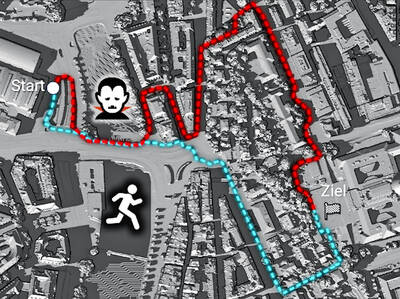
As climate change and urbanization push city temperatures higher, walking outdoors is becoming increasingly uncomfortable in many parts of the world, especially when prolonged time spent in sunlight is involved. As a result, outdoor lovers are now seeking cooler, shaded walking routes. However, most mainstream map apps still do not __1__ shaded footpaths. Enter routing.osm.ch — a Swiss web-based route planner that introduces a novel solution to this problem. Its “Vampire mode,” named after the legendary creatures’ fear of being __2__ natural light, was developed by a Swiss research team led by Professor Stefan Keller. The platform combines open data from


 RSS
RSS