


Have you ever hiked up a mountain and thought about how much easier it would be if there were a stairway? Well, there is a mountain in Switzerland which features that very thing. Visitors to Niesen Mountain in the Bernese Oberland region of Switzerland will find a stairway consisting of 11,674 steps running up its side. At 3.4km in length, it has been officially __1__ by the Guinness World Records as the world’s longest stairway.
Unfortunately, this stairway is usually not accessible to the general public. It actually runs parallel to a railway that travels up the mountain and serves as a rescue and maintenance stairway. Therefore, due to __2__, people are not allowed to use it unless there is an emergency involving the train. However, once a year in June, an event gives 500 lucky people the __3__ to use the stairway. The legendary Niesen Stairway Run has become a popular attraction for athletes looking for a special challenge. Despite being less than 4km long, the run features an elevation gain of almost 1,700 meters, __4__ it a truly grueling event. In fact, the record time for covering that distance is just over one hour, which gives an idea of how difficult it is.
Those lucky enough to walk or run up the stairway will be __5__ stunning views of the surrounding mountains and valleys. Keep in mind, though, that only those who join the Niesen Stairway Run will get to see them.

Photo: AdobeStock I 照片:AdobeStock
你是否曾在爬山時想著,如果有一條階梯,是不是會讓爬山更容易得多?嗯,瑞士有一座山就以那樣子的設施為特色。造訪在瑞士伯恩高地地區的尼森山的遊客會看到一條包含一萬一千六百七十四階的階梯沿著山腰而上。這條樓梯全長3.4公里,已經被金氏世界紀錄官方認可為世上最長的階梯。
可惜的是,這條階梯通常不對一般大眾開放。實際上,它與一條通往山頂的鐵路平行,是一條用於救援和維護的階梯。因此,出於安全考量,一般人不被允許使用,除非發生跟火車有關的緊急情況。然而,每年六月都會舉辦一場活動,讓五百位幸運者有機會使用這條階梯。傳奇的尼森階梯大賽已經成為找尋特殊挑戰的運動員的熱門景點。儘管這場賽事不到四公里,但爬升高度增加了近一千七百公尺,使其成為一場真正艱辛的賽事。事實上,完成全程的最快紀錄僅略超過一個小時,表明了這項挑戰有多困難。
那些足夠幸運能夠步行或跑上階梯的人將欣賞到周圍山脈和山谷的迷人景色作為獎賞。不過請記住,只有參加尼森階梯大賽的人才能欣賞到。

Photo: AdobeStock I 照片:AdobeStock
What Did You Learn?
1.
(A) predicted
(B) recognized
(C) sacrificed
(D) dismissed
2.
(A) political issues
(B) mountain trails
(C) keen competitions
(D) safety concerns
3.
(A) opportunity
(B) necessity
(C) introduction
(D) reservation
4.
(A) made
(B) makes
(C) making
(D) to make
5.
(A) divided into
(B) rewarded with
(C) reduced to
(D) trapped in
參考答案
1. (B) 2. (D) 3. (A) 4. (C) 5. (B)
Word in Use
1. feature vt. 以……為特色
The museum exhibition features woolly mammoths.
這場博物館展覽以長毛象為主要特色。
2. officially adv. 官方地;正式地
The mayor officially announced his retirement yesterday.
這位市長昨天正式宣布他退休的事。
3. unfortunately adv. 令人遺憾地,不幸地
Unfortunately, Owen got a speeding ticket the first time he
got behind the wheel.
很不幸,歐文第一次開車就被開超速罰單。
4. parallel adv. 平行地 & a. 平行的
run parallel to... 和……平行
The highway runs parallel to the river.
這條高速公路與這條河平行。
Mary drew two parallel lines in the top left corner of the
sheet of paper.
瑪麗在這張紙的左上角畫了兩條平行線。
5. rescue n. 救援,援救
The rescue operation successfully saved the hikers
stranded on the mountain.
救援行動成功拯救了被困在山上的健行者。
Practical Phrases
1. consist of... 包含……;由……組成
= be composed of...
= be made up of...
This shower gel consists of sea salt and other minerals.
這種沐浴乳包括海鹽以及其他礦物質。
2. 數字 + in length 長度方面(有)……
The road measures 200km in length.
這條路量起來有兩百公里長。
3. be accessible to... 是……可進入∕使用的
accessible a. 可進入的,可使用的
The library is accessible to the public.
一般大眾都可以使用那座圖書館。
4. serve as... 作為……之用
= act as...
A suitcase can serve as a seat when you get tired while traveling.
當你旅行累了的時候,行李箱可以充當椅子坐。
5. keep in mind + that子句 牢記……
= bear in mind + that子句
Keep in mind that Billy is only a child and can’t handle a lot of responsibilities.
要記得比利只是個小孩,無法承擔太多責任。
聽文章朗讀及講解: https://ivy.pse.is/455bfu
本文出自常春藤解析英語雜誌: www.ivy.com.tw
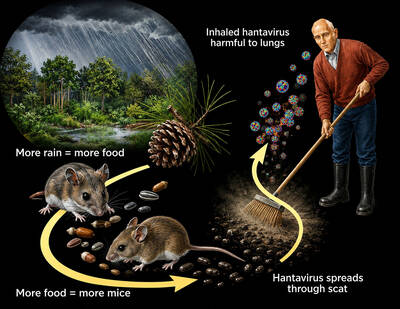
An outbreak aboard a cruise ship of a rare rodent-borne illness called hantavirus has left three passengers dead and sickened others, but global health officials say the risk to the general public remains low because the germ does not easily spread between people. “This is not the next COVID, but it is a serious infectious disease,” said Maria Van Kerkhove, director of epidemic and pandemic preparedness at the World Health Organization (WHO). “Most people will never be exposed to this.” The virus usually spreads when people inhale contaminated residue of rodent droppings. Hantaviruses have been around for centuries and are thought to

Have you ever wondered how people navigate the world when they can’t see a map? For individuals with visual impairments, conventional maps are nearly impossible to use. This is where tactile maps come in — essential tools that allow people to “see” the world through touch. A tactile map is specially designed with raised lines, textures, and symbols to represent geographical features such as roads, rivers, and buildings. Users explore it with their fingertips. However, these maps are not exclusively for people with visual disabilities. They serve as valuable multisensory learning tools that enhance spatial understanding for everyone, making

1. 他病了三天。 ˇ He has been sick for three days. χ He has been sick since three days. 註︰這裡現在完成時態 have / has been 表示從過去某一時日到現在的一段時間存在的行為或狀態,與它連用的時間副詞應為 「for +若干時」,如 for a year, for three hours 等,意思是歷時多少。 2. 他自從星期三以來都很忙。 ˇ He has been busy since Wednesday. χ He has been busy from Wednesday. 註︰「自從……以來」,該用 since。說從某一天(某一時刻)到某一天(某一時刻)才用 from,如 from Monday till Friday。 3. 房間角落裡散放著一些零星物件。 ˇ There were some odds and ends lying in the corner of the room. χ There were some odds and ends lying at the corner of the room. 註︰「在房間角落裡」該用介詞 in。例如: He stood in the corner. There is a lamp in the corner of the room. at the corner 指房子外部的拐角。例如: A little boy

A: In early May, there were concerts by Icyball, Chyi Yu, Korea’s EXO and Japan’s Anisama, but I missed them all. What a shame. B: That’s OK. There are shows coming up by various artists, including Power Station, Accusefive, Japanese singer Mika Nakashima, Chinese-Icelandic jazzer Laufey, and even Singaporean diva Stefanie Sun. A: After a 12-year hiatus, Stefanie is finally returning to Taipei again. B: In late May, there will be more shows by Crowd Lu, WeiBird, Korea’s Donghae, 2AM, EXID, and Thailand’s BUS. A: The Thai boyband is so popular. It looks like “T-pop” is catching up with J-pop


 RSS
RSS